| Sandro Botticelli [ w ] |
 Fortitude – Primavera – Pallas and the Centaur – Venus and Mars – The Birth of Venus – Calumny of Apelles – Illustrations to the Divine Comedy – Venus and the Three Graces Presenting Gifts to a Young Woman – The Story of Virginia – The Story of Lucretia Fortitude – Primavera – Pallas and the Centaur – Venus and Mars – The Birth of Venus – Calumny of Apelles – Illustrations to the Divine Comedy – Venus and the Three Graces Presenting Gifts to a Young Woman – The Story of Virginia – The Story of Lucretia
|
 Note – this is a mirrored content from Wikipedia, click [ w ] to visit the source, all the images are ‘hotlinked’ (hosted there), Wikipedia restricts almost nothing, Note – this is a mirrored content from Wikipedia, click [ w ] to visit the source, all the images are ‘hotlinked’ (hosted there), Wikipedia restricts almost nothing, but I don’t know if ‘hotlinking’ is allowed by their policies, I was just testing… I learned now that this is allowed, as long as people write the credit for authors, photographers, artists, painters etc. (in this case it’s clear Sandro Botticelli was the artist : ) don’t forget the credit and it’s simply allowed to link or hotlink whatever you want, no restrictions whatsoever, in fact this is the very purpose of Wikipedia, all content to be public and accessible globally – I was told : ) |
| The Calumny of Apelles (1494-95) |

|
[ w ] – The figures are either personifications of vices or virtues, or in the case of the king and victim, of the roles of the powerful and the powerless. Truth, nude and pointing upwards to Heaven; Repentance in black; Perfidy (Conspiracy) in red and yellow, over the innocent half-naked victim on the floor, who is being pulled forward by the hair by Calumny (Slander), in white and blue and holding a flaming torch…
|
| Divine Comedy Illustrated (mid-1480s-mid-1490s) |

|
[ w ] – a manuscript of the Divine Comedy by Dante, illustrated by 92 full-page pictures, mostly not taken beyond silverpoint drawings, many worked over in ink, but four pages are fully coloured – Canto XVIII, part of the 8th circle of Hell. Dante and Virgil are each shown 6 times, descending through the 10 chasms of the circle via a ridge. One of only 4 fully coloured pages.
|
| Venus and the Three Graces Presenting Gifts to a Young Woman (1483-86) |

|
[ w ] – the fresco shows a young woman, probably Giovanna Tornabuoni, being received by Venus and the three Graces. Giovanna holds open a white cloth, into which Venus is laying roses symbolizing beauty and love.
|
| The Story of Virginia (1500–04) |

|
[ w ] – The painting has a fundamental theme of violated honor and matrimonial fidelity. Virginia, in the company of other women, is violated or assaulted by Marcus Claudius, who wants to force her to yield to Appius Claudius Crassus. He carries her to the tribunal presided by Appius Claudius who declares her a slave…
|
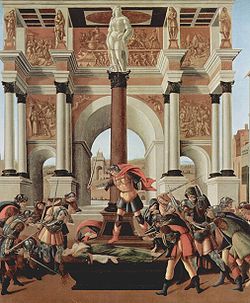
| The Tragedy (Death, Suicide) of Lucretia (1496–1504) |
|
[ w ] – The main scene is given center foreground. It is the beginning of the revolution that created the Roman Republic. The legend is that Lucretia, a noblewoman, was raped by Sextus Tarquinius, the son of the last king of Rome.
|
| The Birth of Venus (c. 1484–1486) |

|
[ w ] – The Birth of Venus (Nascita di Venere) depicts the goddess Venus arriving at the shore after her birth, when she had emerged from the sea fully-grown (called Venus Anadyomene and often depicted in art). In the centre, the goddess Venus (newly born in fully grown state, in accordance with tradition) stands nude in a giant scallop shell.
|
| Venus and Mars (or Mars and Venus) (c. 1485) |

|
[ w ] – a panel painting shows the Roman gods Venus, goddess of love, and Mars, god of war, in an allegory of beauty and valour. The youthful and voluptuous couple recline in a forest setting, surrounded by playful baby satyrs.
|
| Pallas and the Centaur (c. 1482) |

|
[ w ] – There is a centaur on the left, and a female figure holding a very elaborate halberd on the right. She is clutching the hair of the centaur, who was evidently about to shoot from his bow. The female figure was called Camilla in the earliest record of the painting, an inventory of 1499, but in an inventory of 1516 she is called Minerva, the Roman equivalent of Pallas Athene; Pallas remains her usual modern identification, but Camilla has supporters.
|
| Primavera (late 1470s or early 1480s) |

|
[ w ] – Primavera, meaning “Spring”) is a large panel painting in tempera paint by the Italian Renaissance painter Sandro Botticelli made in the late 1470s or early 1480s (datings vary). The painting depicts a group of figures from classical mythology in a garden, but no story has been found that brings this particular group together…
|
| Fortitude, 1470 |

|
[ w ] – Fortitude is a painting by the Italian Renaissance master Sandro Botticelli, finished in 1470. Housed in the Galleria degli Uffizi, in Florence, Italy, Fortitude was the first recorded masterpiece by Botticelli.
|
Shënim – përmbajtje e pasqyruar direkt nga Wikipedia, kliko [ w ] për të vizituar burimin ose origjinalin, të gjitha imazhet janë ndërlidhje (hotlinks – të hostuara atje), Wikipedia nuk kufizon pothuaj asgjë, mirëpo nuk e di nëse “hotlinking” lejohet, thjesht isha duke testuar… Tani mësova se lejohet, për sa kohë njerëzit e cekin autorësinë (meritat) për autorët, fotografët, artistët, piktorët etj. (në këtë rast e qartë se Sandro Botticelli ishte artisti : ) mos harroni autorërsinë dhe thjesht lejohet të lidhni ose “ndërlidhni” çfarë të dëshironi, pa asnjë kufizim, në fakt ky dhe është qëllimi i Wikipedias, në përmbajtjen dhe ose materien të kihet qasje publike globalisht – më është thënë : )
|