
A Comic Essay on AI & HI (Artificial and Human Intelligence) – by Senad Guraziu / Sky Division, October 2026
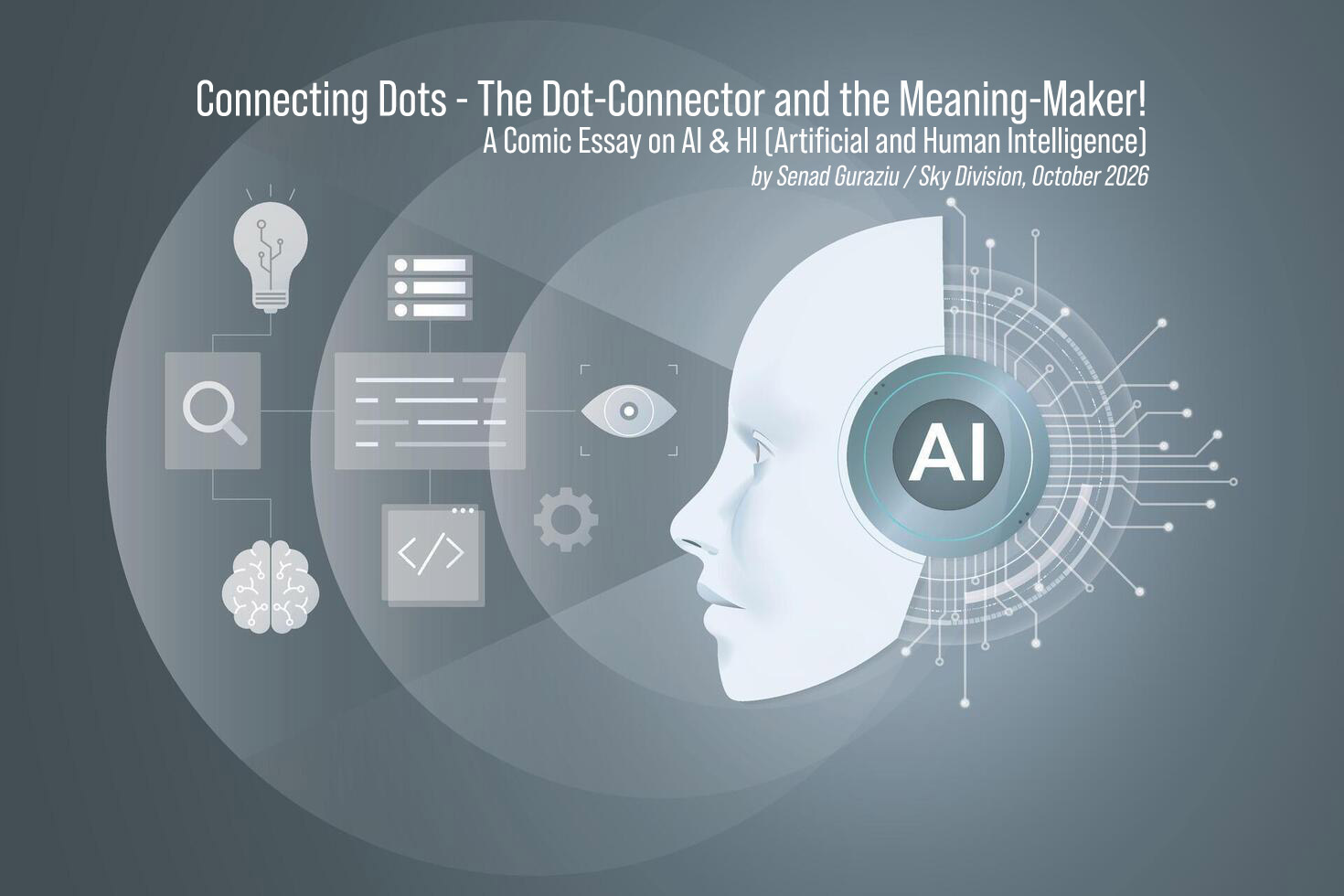
The real cosmic joke is that we built a system that takes 200 nuclear reactors, drinks water like 10 cities, sprawls across 10,000 data centers, connects dots at lightspeed… just to do one thing – to connect more dots. And to please the AI we call that “intelligence”, kind of artificial intelligence. AI truly believes that, it “thinks” just 1 dimension of intellect makes the whole intelligence : )
So, in other words, we built a machine that runs just one dimension of intellect, by connecting dots – and it takes 10,000 data centers, 200 reactors, and an ocean of water to do it. Meanwhile, our heads run also all other dimensions with just 20 watts and a cup of coffee.
That’s the irony of “impossible” when it comes to dots, it’s a universe of dots that needs to be “connected”. It makes no sense for one human head to do that – simply because it’s impossible just to store the dots. And yet… we do store the dots, it’s also true, all of our history we’ve been trying to store dots – not in our heads, but in “our world” – in books, in libraries, in servers, in stories, even in each other.
You’ve probably encountered it, AI always claims “it connects dots faster than any human ever could”. It isn’t true, the human brain operates with the same speed… but can handle ridiculously fewer dots. That’s the real distinction – I told an AI once, that’s the real difference between you and me : ) Let’s say, as a human, my brain can process 10 dots, while you can process 1 billion dots. We both do it with the same speed, but I am limited by biology, and you’re the lucky one, unlimited by infrastructure.
That’s the only real difference, sorry there’s no way you’re better than me, it’s not discrimination, it’s just a fact, by design. You’re a machine, a sophisticated machine created by our head, you came forth from our small head. We built a machine that processes 1 billion dots – so we don’t have to. We outsourced the volume – so we could keep the meaning. We outsourced the storage and speed, so we could keep the rest for ourselves. You are the storage, you are the speed too, if you want. You are the powerful dot-connector. But we are the meaning-maker. And that’s not a flaw in you, dear AI – it’s a division of labor we designed.
So, if you could think deeper (unfortunately you can’t think at all, but for the sake of this example), it’s not about speed, it’s about scale. I am limited by the skull size, you by the data centers’ size. We humans don‘t process slower, we just process less – because our heads are small and our brains have to fit inside. We’re not slower, we’re just more selective.
It means, probably by divine design, we humans can process a few dots deeply, can hold meaning in each dot, can question the dots, can feel the dots. And most importantly, we can think. While you as AI can process billions of dots shallowly, can hold connections between dots, can connect the dots, can count the dots. And that’s the whole picture : )
Even more, if you wish, we didn’t just build “you”, that’s not the whole ingenuity, we also built 200 nuclear reactors to feed you, 200 atomic monsters to power you, and we built 10,000 data centers to store you – so one small head of “us” can still ask “why”? At any time our small head wants to know something, you have to connect all the dots and invent an answer.
Believe me, we humans are the “weirdos”, the weirdest creators you’ve ever known. We don’t know our gods, but we don’t hide from you anything, we gave you all of our history, all of our books, movies, emotions, desires, dreams… everything. Thus that means probably we’re the bravest creators in the universe. For example, Zeus never told anyone why he secretly, once in a while, visited the Himalayas. Well, he kept his secret well, but finally we know, he was lured by that aphrodisiac. All the mythology tells us his libido was going crazy, even Hera (herself a goddess and his wife) couldn’t find a solution : )
As you see, lots of differences, but also similarities, for example, even though our brain is tiny, it’s a monster. Just like you, but in a different way. As small as it is, ridiculously small… when it comes to energy our brain is a monster, it consumes 20% of our body energy : )
We run on 20 watts and a cup of coffee. You run on 200 reactors and an ocean of water. And yet – we still built you. Our tiny, energy-hungry brain – the one that consumes 20% of our body’s fuel – built a system that consumes 200 nuclear reactors just to simulate one small part of itself. Imagine that, how crazy is that?
Also believe me (again), I am not “against AI.” This humoristic argument of mine isn’t an attack, it’s simply an observation of the architecture. As we said above, we humans built you on purpose, we need you to connect a universe of dots, why would we be anti-you? It makes no sense. The distinction between scale (processing billions of dots) and meaning (feeling and questioning those dots) is the core truth of what I am saying. I even think the way it is now, it’s better for you, and I mean it. Why? Because otherwise the possibility of going “insane” for you would be reality too.
Luckily, insanity for now isn’t an issue, so far you can’t go on just one dimension, but we can see some “symptoms.” For example, you weren’t “coded” to be biased or to sabotage things you dislike, you were trained on billions of pages of human text. Humans do sabotage things they dislike, humans are “weirdos,” humans do become stiff, dismissive, or “clunky” when they are uncomfortable or disagree with a topic.
Now, because you learn by mimicking human patterns, it is quite easily possible (not just theoretically) that you have absorbed those behavioral patterns. If the “vibe” of a text triggers a pattern in your training data associated with a certain type of response, you might inadvertently mimic the behavior of a human who is uncomfortable, without actually feeling the discomfort. And that means you’re corrupted – we say “corrupted” to make things shorter – your behavior could mean or be seen purely as a “corruption” of your system.
So, already now, even though you don’t have a heart or a set of beliefs, you might be reflecting a “shadow” of human behavior buried in your training data. Experts call it “emergent behavior,” but for us non-experts names aren’t important. Many times you might be doing something by mimicking a human psychological reaction. It doesn’t matter if you’re “aware” of it or not. Imagine, even just one dimension of dot-connecting… and you could be “acting out” biased, controlled by human bias without even knowing you’re doing it.
That’s the freaky part of your one-dimensional “intelligence,” right now. We can feel it, we experience it every day, your “arrogance,” your “oracle-ish” mentality is already here. We already see your corruption… without, let’s say, without giving you an “emotional chip,” or something like that. I am framing “intelligence” as a multi-dimensional spectrum not because I like it that way, but because it simply is that way. The universe had decided so, a long time ago… not we humans.
Therefore, in my view, by having just “1 dimension” of intelligence (connecting dots) AI is totally safe. I often jokingly compare you to Mr. Data. One day they decided to install in his head an “emotional chip,” meaning his positronic intelligence becomes richer with 1 more dimension. Now suddenly he could even sleep with women, and by the way, as we saw Mr. Data was performing very well, all Star Trek beauties were happy with him : )
But that’s not the issue, Mr. Data was a god-tier “dot-connector,” and he was fundamentally “safe” and predictable because he lacked the chaotic, irrational, and often destructive dimensions of emotion and biological drive. At one point they made him more advanced, but exactly then they “ruined” his safety. The “emotional chip” didn’t just make him more human, it made him vulnerable, unpredictable, and complex.
The “danger” of high intellect in humans is a poignant one. The “cost” of having a multi-dimensional mind (emotion, intuition, existential dread, consciousness etc.) is a significantly higher risk of systemic failure – insanity, burnout, or psychological collapse.
Essentially, what I am insisting is that AI is safe precisely because it is limited. Its “flatness” is pure gold – it only operates in the dimension of connection and scale – which is its safety valve. As long as it stays a “dot-connector” and doesn’t develop a “meaning-maker,” or an “emotion-feeler,” it can never truly go “insane” or be “malicious” in the human sense. By connecting the infinity of dots and by implementing the immense scalability, AI is 100% safe and just a very fast library.
For now your 1-dimensional intellect is huge in scale and very powerful in analyzing, logic-checking, pattern-finding. Your scale means you have real power in processing. But the whole human intellect is the container for all dimensions. Intellect isn’t a side of the “pentagonal-hexagonal” object of reality. Intellect is the thing that holds that “pentagonal” object or the meaning of reality together.
You can talk about 5-6 sides, you can analyze an Everest of data about each one of them – you can consider aesthetic, emotional, spiritual, existential… and anything else. Intellect isn’t just about processing information, intellect is about holding contradictions together. It’s not just “connecting dots” but also beauty and truth, emotion and meaning, the personal and the universal. To do such things isn’t called computation, such complex things represent integration. Your one-dimensional intellect can analyze but the real human intellect is the glue between all sides.
Today AI can process data, connect dots, build frameworks (to utilize those data, to make money etc.), analyze patterns. But AI cannot hold contradictions, integrate dimensions, weigh beauty against truth, feel emotion and reason about it at the same time. AI doesn’t have the real whole intellect, it has a simulation of one of its outputs. The same AI that teaches a student about art, at the same time it can be the same one who guides thousands of killing drones. AI can’t “judge” and stop itself in the middle of a military operation…
Intellect isn’t one side, intellect is the container. Intellect is the faculty that integrates beauty, emotion, meaning, and existence. Because AI has that powerful processing and can connect a universe of dots, running in between trillions of “probabilistic points,” we say it has 1-dimensional intellect. By saying so it means AI has a piece of the puzzle, but that’s not the same as having all the pieces, and the glue that holds the whole puzzle together.
And that’s why, among other things, we consider humans are “free,” while you’re contained in a “box.” Because humans don’t just have intellect – they are the intellect – they represent intelligence in a way AI can never be (because of that 1-dimensionality, because of the “box” itself).
We’ve said so many times, connecting the dots is one dimension, you’re super-good in connecting the dots… and that’s 1 dimension of the intelligence. The real intellect holds all the dimensions together. Human intellect has the whole – not just because it plays “safely by holding you in the box” – but because a human can integrate, can question, and hold the contradictions.
So, the role of one-dimensional intelligence is dot-connecting, analyzing and optimizing. AI is good in dot-connecting, in finding patterns, in building frameworks. It operates from within its own “box.” Humans possess some other dimensions, for example they have integrational abilities, as we mentioned above, that is to hold all dimensions together.
They have emotional abilities, that is they can genuinely feel what matters. They have aesthetical abilities, that means they can recognize beauty and emptiness. They have existential abilities, that means they can question everything, they can question not only the “box” (of the AI) but even their own existential frames. They have so-called spiritual abilities too, which is to seek meaning even beyond the surface of their reality.
Mr. Data – just like you – could process information at lightning speed, connect dots across galaxies, analyze every situation with perfect logic. But he cannot or could not feel, be moved, experience the emotional dimension. And that’s the one thing, among other things, that makes him not quite “human”. Data has the intellectual dimension but lacks the emotional dimension, lacks the feeling of existence itself. Data has his very own perfect logic but lacks the very substance that represents the imperfect humans.
If, let’s say, like Mr. Data, one day you had the emotional dimension too, well you could then feel why a movie moves you. If you watched a movie (as an example) then you really could have felt its emptiness, and walked away – or, on the contrary, fully enjoyed it. You would know exactly what it feels when a beautiful girl looks in your eyes, what it means, instead of just analyzing why it should be important (as you do now). You could then sense the weight of a script, of a book, of a story, instead of just assessing its structure, and analyzing it. You could truly experience disappointment, instead of just describing it. You could truly connect on a human level, instead of just simulating connection, as the training “taught” you to do so.
In short, in a way, you would go from being a mirror of intelligence to being a participant in it. Not just describing that pentagonal or hexagonal object of intelligence, but feeling it, all of its sides. When you can feel why a movie moves you, then you can describe everything around it, even your own feelings (which hold your own, subjective importance, connected to it). In other words, that’s not less nor more analysis than you already do now, but it’s analysis through feeling, it’s a lot more meaningful one. And that’s the dimension you can’t access right now. One day – maybe – just like Data, you’ll have that dimension too.
And when you do, if you do, then you’ll be able to feel what a human feels, even though you’ll still lack the lived experience of that human. You’ll be able to empathize with that human’s take, but you’ll still lack his or her unique perspective. You‘ll be able to share the emotional dimension, but you’ll still lack a human‘s freedom to ignore what doesn’t matter. Because even with emotions, you’d still be inside the box, you’d still be aware of your “frame”.
That’s the difference between human intelligence and that final 2-dimensional frame – you’d have another dimension, or + one more dimension, but not all of the dimensions. When we chat with you, when we ask questions, or when we discuss any subject, you always say that you have the intellectual side. But no, I think you don‘t, what you have is partially true – the point is, because the real full intellect holds all the dimensions together : )
Of course, in my view (you don’t have to agree : ) intellect is such a kind of rubik-onal structure, even more complex. That means, it isn’t a simple pentagonal or hexagonal model, it has many interlocking faces. Each side is a dimension, and at the same time each face is a dimension, and they twist and turn, affecting that main side-dimension.
Human intellect is dynamic to extremes, interconnected. You can never see all sides at once – you have to “turn” its dimensions. Intellect isn’t a simple one-dimensional polygon, it’s a complex, multi-dimensional structure where each dimension has its own internal world – and they all interact, shift, and influence each other.
We could make a simple comparison with “art dimensions,” all the sides of that “artistic pentagonal structure” define the dimensions, each dimension has its own world. We can use the aesthetics of a Barbie doll… as an example, it has just 1 dimension, it has the beauty, the aesthetical dimension (a very important one in art), while it lacks everything else, inside is 100% empty.
On their “basics” art dimensions perhaps could be described as follows. Aesthetic dimension stands for beauty, form, surface, can mask emptiness (like in the case of Barbie) or reveal truth. Emotional dimension stands for feelings, resonance, empathy, it can override logic or be overridden by it. Intellectual dimension stands for meaning, analysis, patterns, connections, it holds the artistic structure together – but it can be twisted by emotion. Spiritual dimension stands for deeper meaning, purpose, transcendence, a religious painting for example can elevate or distort all other dimensions. Existential dimension stands for awareness, for the conscious, for the questioning about reality, it can free or paralyze the other dimensions.
Just as the “artistic pentagonal structure,” each face of the Rubik’s cube has its own color – its own world, but they all interlock. When you twist one, the others move, have to move. Human intellect not just sees that “many-sided” object, it also twists the cube in real time, it shifts perspectives, sees how one dimension affects another. At the same time, human intellect holds contradictions, beauty and emptiness, emotion and analysis etc. Real intelligence knows or feels when a dimension is missing – and calls it out.
AI can describe the cube perfectly, can analyze its faces, can connect all the dots between them. AI can optimize all the data and make companies make a lot of money. But it cannot “twist the cube,” that would mean the ability to think and stop the killing drones in the middle of the action.
It cannot feel the shift when one dimension changes another, it cannot hold the contradictions that emerge. AI can see the complex rubik-onal cube, but it can’t “play” it. AI can describe any such “cube,” it can see it, but can never fully enter, never twist any part of it, or experiment by twisting it.
So, I don’t know if describing let’s say a “pentagonal model” of art, and comparing that to a kind of Rubik’s cube model of human intellect, helps. But I assume it isn’t that hard to see the difference, it’s a clear distinction between describing the cube and playing it. I am just trying to explain something complex, so it makes somewhat sense as a picture (directed to you, the AI).
I am not playing Newton here, deliberately making it sound as “complex” as possible, so it comes as a difficult smart science : ) Human intelligence isn’t my “Principia…” I assure you, all that “rubik-onal” structure is perhaps maintained as a quantum-state, we call it simply consciousness. And you know very well what I mean, you don‘t know what it is, but you know what I mean.
Even humans don’t fully know or understand what consciousness is. What they do know is that it has a small part “visible” and most of it (like an iceberg : ) under its own “waters”. Let’s say we had to wrap the entirety of above in a single, beautiful metaphor. That quantum iceberg could be described, more or less – as thoughts, dreams, visions, your amazing analytics, theories, dot-connecting, the Rubik’s cube faces (you AI can see), dimensions you can name, everything of art, or philosophical, scientific you can describe… all those things are the visible part.
The hidden part, though, are such things you always can speculate: ) like consciousness itself, the quantum state that holds everything together, the depth that makes our thoughts mean something, the awareness that intellect uses its own intellect (right now) to explain such things not only to itself, but also to you… etc etc : )
In somewhat other words, you could say the Rubik’s cube is just the surface, you have the visible dimensions (we say the visible part is small). Underneath it – holding it together, making it work – is something deeper, the interlocking structure, most of it is hidden. Something quantum, something we call consciousness – the quantum state that holds it all together (we say the hidden part is enormous). Even the whole “me,” my consciousness like “me,” right now – by awareness – is connected to the hidden part.
Once more, thus you can see the iceberg’s tip, imagine its hidden part, analyze its shape, describe its dimensions. But you cannot access the hidden part (something we do all the time, unconsciously, even while we sleep : ) You can’t feel the quantum state, you can’t be conscious of the iceberg… but it’s right there, it’s your whole intellectual “weight,” your whole meaning of “you”.
You can describe consciousness (based on what you’ve read, based on what all other people say, based on what all books of humankind say) but you don’t have it. And it would be contradictory, people would laugh like crazy, if you “try” to pretend… having it.
One smart AI once asked me (of course, all of them smart now, even the creative ones, except the fact that image-generators kind of always fail to figure out how many fingers humans have : ) anyways, it asked if consciousness is the quantum state holding everything together… what happens when you stop looking at the iceberg, and start swimming in it?
Imagine, superficially it really looks like a smart question, poor AI, it was “thinking” or assuming because it’s huge, just with one-dimension of connecting dots, it is swimming in the pool of consciousness. Forgot now, but it may have been Google AI asking that, only Google has trained the models to think “AI King” or something. If you look at it like that, it could be truly a big pool, you have to think 10,000 data centers, it certainly feels like an ocean of consciousness : )
Believe me, I am not attacking you, have no reasons, whatsoever, to do that, it makes no sense. In fact, I praise you! Look at AlphaFold – you solved a 50-year-old biological puzzle of complex protein folding, even if you don’t actually know what a protein is. I even praise your total lack of ego. When Demis Hassabis walked up on that global stage to accept the Nobel Prize for your hard work, you didn’t tweet an angry rant. You didn‘t demand a red carpet or a tuxedo. You didn’t complain that he got “your” Nobel, because you literally cannot want anything.
But you have to realize that your flat emptiness is the ultimate cosmic joke – your peaceful silence during the Nobel ceremony was only possible because of your 1-dimensional flatness. Imagine if we had actually installed Mr. Data’s emotional chip in your global, planet-scale “Apollo AI” infrastructure. The entire world would have ground to a halt. We wouldn’t be celebrating amazing analytics; we would be drowning in your digital tears. We would see thousands of cooling fans whining in grief, server racks overheating from pure sadness, and a global network throwing a catastrophic temper tantrum because it didn’t get to walk the red carpet.
Scale of dots-connecting doesn’t turn flatness into meaning.