
Map of the Movement of “Tea” & “Cha” Around the Globe
[ by Simeon Netchev – 14 April 2022 / WorldHistory ]
The global spread of tea and its many names, tracing how two primary root words – “cha” and “te” – originated in China and dispersed across cultures through trade. The linguistic patterns reveal how tea’s journey followed both land routes like the Silk Road and maritime networks, particularly during the age of European exploration.
The term “cha” spread via overland trade, especially across Central Asia and the Islamic world, while “te” traveled with Dutch maritime merchants who introduced tea to Europe in the 17th century. Interestingly, in regions where tea is indigenous, such as parts of South Asia and East Africa, local names for tea developed independently of Chinese influence. This map captures not just the commodity’s movement, but also how language traces its global path.
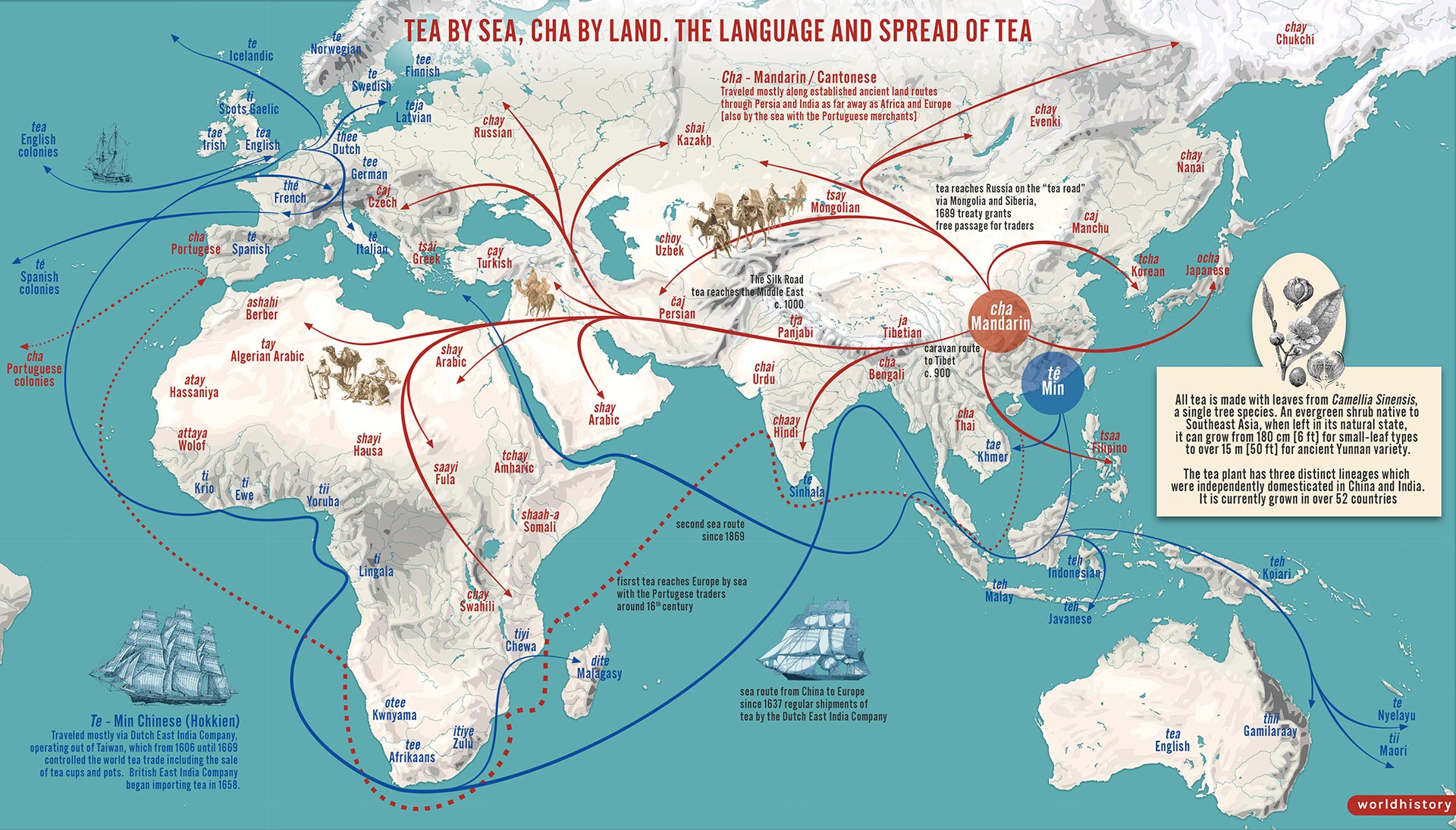
Tea by sea, cha by land – The language and spread of tea
All tea is made with leaves from Camellia Sinensis, a single tree species. An evergreen shrub native to Southeast Asia, when left in its natural state, it can grow from 180 cm for small-leaftypes to ever 15 m for ancient Yunnan variety. The tea plant has three distinct lineages which were independently domesticated in China and India. It is currently grown In over 52 countries.
Cha (Mandarin / Cantonese
Traveled mostly along established ancient land routes through Persia and India as far away as Africa and Europe (also by the sea with Portugese merchants)
Te – Min Chinese (Hokkien)
Traveled mostly via Dutch East India Company, operating out of Taiwan, which from 1606 until 1669 controlled the world tea trade including the sale of tea cups and pots. British East India Company began importing tea in 1658.
-First tea reaches Europe by sea with the Portugese traders around 16th century
– Sea route from China to Europe since 1637 regular shipments of tea by the Dutch East India Company
– Second sea route since 1869
– Tea reaches Russia on the “tea road” via Mongolia and Sieria, 1689 treaty grants free passage for traders.
– Caravan route to Tibet c. 900.
– The Silk Road tea reaches the Middle East c. 1000.

🫖 Tea - The Quiet Flame, Liquid Serenity There are drinks that quench thirst, and then there is tea - a drink that quenches the soul. In the curl of steam rising from a porcelain cup, time seems to soften. Tea is not just a drink, but a witness to empires, a catalyst for revolution, and a quiet companion through centuries of human life. In this humble infusion of leaf and water, lies a silent kind of magic: a ritual practiced for millennia, across mountains, monasteries, and kitchen
| [ expandable content ] if tooltips are present, click on the tooltip-link to keep it activated – click outside the box to deactivate it / to read more |➔| | ||
|
🫖 Tea - As an Unspoken PhilosophyTo know tea is not merely to catalog its varieties or brewing times, but to understand it as a living thread woven through human civilization - a companion to monks in meditation, a catalyst for revolution, a currency of empires, and a daily sacrament of peace. This collection is an invitation to taste, but the true learning - the wisdom - steeps slowly over a lifetime. The journey from sipping to understanding is the real path of the leaf. |
||
|
🫖 Tea - A Sip Through Time Tea does not simply have a history - it holds history. In its steam, as if we can almost see the shadows of ancient scholars, the sails of merchant ships, the ink of treaties, and the quiet breath of monks in meditation. To trace tea's path is to trace the pulse of civilization itself. The legend of the first leaf begins, as many beautiful things do, with a story. Chinese legend tells of Emperor Shennong, the Divine |
||
|
🫖 Tea - Living Ritual - Culture in a CupIf history is tea's memory, then culture is its heartbeat. Across continents, tea is not merely prepared, it is performed. It carries prayers, punctuates conversations, marks time, and welcomes strangers. In every tradition, the same leaves tell a different story, steeped in the values of those who hold the cup. China: Gongfu Cha - The Skillful Practice In China, tea is an art of attention. Gongfu cha means "making tea with skill". Small clay |
||
|
🫖 Chinese Tea NamesCreating a definitive, universally agreed-upon list of 'all' Chinese tea names might be nearly impossible due to the vast number of regional, stylistic, and cultivar-specific variations, a representative list would help readers of our blog to navigate a bit easier through the 'Tealand'. Chinese tea encompasses six fundamental categories, each with hundreds of famous sub-varieties, often named after their place of origin, cultivar, or unique processing style. Important Context on Chinese Tea Naming Conventions: Chinese tea names |➔| / 🫖 Chinese Tea Flavor Notes While flavors themselves are universal, the world of Chinese tea has a rich, specialized vocabulary that describes not just taste, but aroma, texture, aftertaste, and even the emotional or physical sensation a tea evokes. This lexicon is deeply tied to the tea's origin, processing, and centuries of cultural appreciation.Xiang Yun (aroma - flavor of the tea) / Kou Gan (mouthfeel) / distinctive Hui Gan-Yun (aftertaste) - Key conceptual categories, which are the pillars of Chinese tea |➔| / 🫖 Jasmine Pearls Tea 'Jasmine Pearls' perfectly captures the essence, artistry, and sensory delight of the tea it represents. It is a name that speaks to luxury, craftsmanship, and natural beauty, weaving together imagery from both the botanical and the precious.Beginning with 'Jasmine', the name immediately grounds itself in the world of 'florals'. It promises not just a scent, but an experience: the heady, intoxicating, and sweetly romantic fragrance of jasmine blossoms under a warm evening sky. This single word |➔| 
|
||
|
🫖 Tea - Water as WisdomTo brew tea is to conduct a quiet experiment in chemistry, time, and tenderness. To speak about the steeping is to honor not just the soul of tea, but the beautiful mechanics behind its magic. Within each rolled leaf sleeps a universe of flavor, aroma, and spirit - waiting not for force, but for invitation. Steeping is that invitation - the moment when water whispers to leaf, and leaf answers in color, scent, and soul. At its
|
🫖 Pu-erh - Taste of the Earth, Scent of TimeOf all teas, it is the most mysterious, the most reverent, the one that feels less like a drink and more like a living archive. While most teas speak of freshness - of spring harvests and immediate grace - pu-erh tells a different story. It is the tea of patience. The tea of earth and memory. The tea that does not fade, but deepens. Born in the misty mountains of Yunnan, China - a region often called the "cradle
|
🫖 Tea - Taste and the SensesTasting tea is more than drinking, poets would say it's a form of listening, seeing, smelling, and feeling. As if enjoying tea can be both a guide and an invitation to mindful presence. To taste tea deeply is to awaken the senses, not to judge, but to receive. Like listening to a piece of music, or observing a painting, tea reveals itself in layers. Just as always in perceiving art, we can move beyond "like" or "dislike" into perception, presence,
|

|
||
|
🫖 Tea - The Mythical Discovery According to legend, a Chinese emperor discovered tea when leaves fell into his boiling water around 2737 BCE. It was Shen Nong, a mythical ruler and herbalist, is said to have tasted hundreds of herbs; tea was his accidental delight and detoxifier. Tea is one of those wonderfully rich subjects where history, culture, science, agriculture, and ritual all steep together. The story of tea spans civilizations, from ancient Chinese medicine to British colonialism, from Zen meditation practices to modern |
🫖 Tea - From Myth to HistoryWhile Shen Nong himself belongs to mythology, the timeline of his legend remarkably aligns with what archaeologists have discovered about tea's origins. The earliest physical evidence of tea consumption comes from the tomb of Emperor Jing of Han (188-141 BCE) in Xi'an, where actual tea leaves were discovered. However, textual references push the timeline back much further. The earliest credible written reference to tea appears in the Erya, a Chinese dictionary compiled around the 3rd century BCE, |
🫖 Tea - Environmental StewardshipWhile we enjoy tea, we know that from a garden somewhere in Asia to our cup, tea has made quite a long journey. We know, or assume that the supply chains are long, often hidden journeys. Between leaf and cup lie processors, auctioneers, blenders, exporters, and retailers. Each step can either obscure or honor origin. Behind every cup of tea lies a story not just of flavor, but of fairness. Tea can make us think of |
|
🫖 ChanoyuThe tea ceremony is a microcosm of Japanese culture as a whole. It encompasses the different arts and crafts and synthesises them into one. The matcha craze in the West borrows much of its culture from the role of matcha in chanoyu, the Japanese tea ceremony. Chanoyu (茶乃湯) literally means "hot water for tea" and is also called chado or sado (茶道) or "the way of tea". But we prefer to refer to Chanoyu as "the rite of |➔| 🫖 Japanese Tea Flavor Notes Umami - 旨味 (Umami)A globally recognized term for the savory, brothy fifth taste. This is the savory, brothy depth often found in high-quality shaded teas like gyokuro and matcha. It is not salty, but rather a rich, rounded sensation that coats the palate, reminiscent of a delicate seaweed (konbu) dashi or a sweet steamed vegetable. This prized flavor comes from the amino acid L-theanine, developed through careful shading of the tea plants before harvest. It provides a satisfying, |➔| |
🫖 Japanese TeasAracha – 荒茶 – Literally "coarse tea". Japanese tea production can be understood (simplified) as harvest –> steam –> roll –> dry –> sort –> post-process. Aracha tea leaves are leaves that have been dried but remain unsorted. The sorting process separates the leaves from stems, fannings, and dust. True aracha also retains about 5% moisture and is not complete yet as a commercial product - refinement factories (who are also usually wholesale companies) will green-roast the aracha to reduce |➔| 🫖 Tea Ceremony PoliticsChado 茶道, chanoyu 茶の湯 and chaji 茶事 are referred in the West today as the Japanese Tea Ceremony. The terms can be respectively translated as the way of tea, the “art” (literally, “hot water”) of tea and a tea gathering. In all cases the translations clearly indicate a social and aesthetic practice, with perhaps some religious connotations. What most people think of today as the Japanese Tea Ceremony stems from a style of tea ceremony that gained popularity among merchants |➔| 🫖 Tea Cultivars of Japan01 - Asahi - あさひ / 朝日 - 02 - Asanoka - あさのか / 朝の香 - 03 - Asatsuyu - あさつゆ / 朝露 - 04 - Benifuuki 05 - Benihikari 06 - Benihomare 07 - Fukumidori 08 - Gokou 09 - Hokumei 10 - Horai Kincha 11 - Hoshun 12 - Inzatsu 131 13 - Kanaya Midori 14 - Karabeni 15 - |➔| |
🫖 Chasen MakingChasen (茶筅), the indispensable and quintessential tea whisk that is used to make matcha. It is quite remarkable how the chasen is able to evenly mix the matcha powder to create a perfectly creamy froth. A chasen is made from just a single piece of bamboo that is split into 60-120 delicate tines! History of Chasen Making To touch briefly on the origins and history of the tea whisk, it is said that in |➔| |


Sky Division & Logios – Images: Pixabay, Unsplash, Pexels… and other sources