
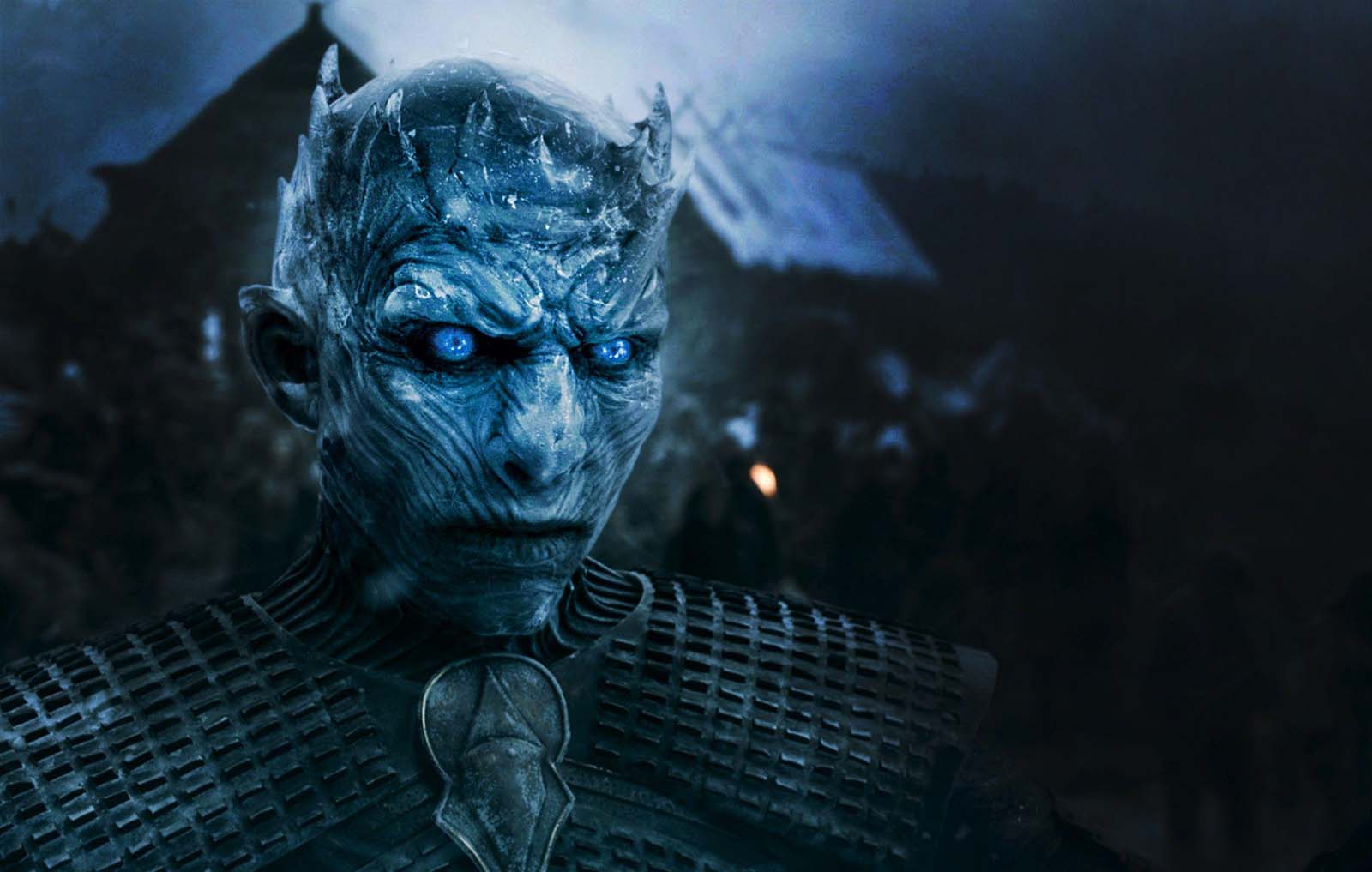
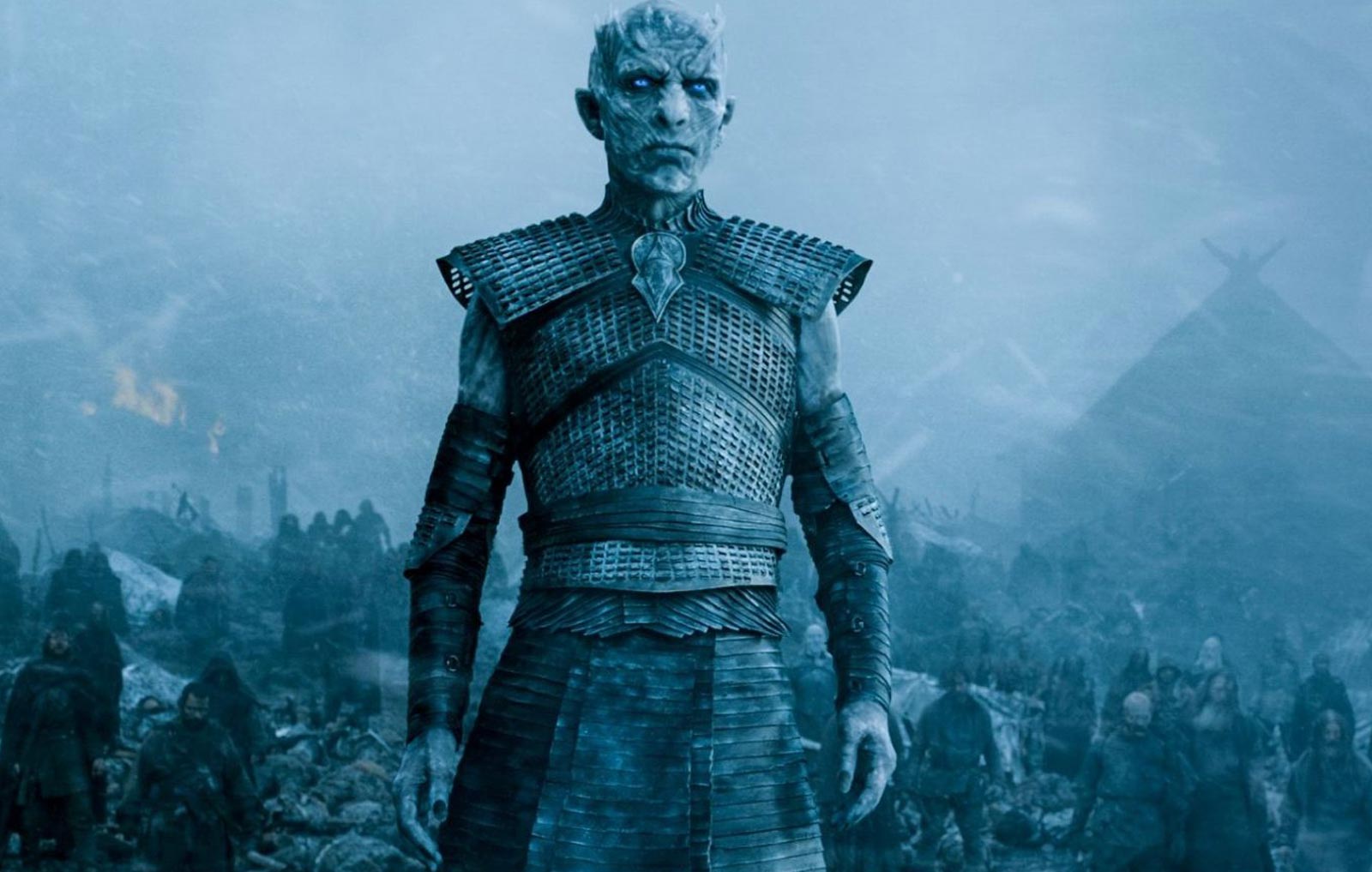
Skroth is the language spoken by the White Walkers (also called the Others) in the television adaptation of Game of Thrones. The White Walkers are the ancient, supernatural antagonists of the series – icy, terrifying beings from north of the Wall who command an army of the dead (wights) and represent an existential threat to all life in Westeros. Their language sounds like the breaking and grinding of ice: a harsh, cracking, deeply alien tongue that conveys ancient malice.

Skroth was developed for the television series by sound designer Peter Brown, who created the language by recording actual breaking ice, glacier sounds, and other frozen textures, then layering and manipulating these recordings into something that resembles structured speech. The result is one of fantasy television’s most effective constructed languages precisely because it doesn’t sound human – it sounds geological, ancient, and utterly inhuman.
Skroth is a fascinating case of a “lost” language that technically exists in two very different forms. While it is famously known for that haunting sound of cracking ice, it actually began as a fully structured spoken language developed by David J. Peterson, the linguist who created Dothraki and High Valyrian. Peterson designed a complete grammar and lexicon intended to be spoken by actors and then digitally manipulated to sound inhuman. However, this spoken version was largely scrapped after the show’s pilot in favor of the purely auditory approach.
The version that actually made it to screen is the work of sound designer Peter Brown, who won an Emmy for his contributions to the series. Rather than using Peterson’s phonetic rules, Brown focused on the description from George R.R. Martin’s books, which described the Others’ voices as the “cracking of ice on a winter lake”. He achieved this by recording real glaciers and breaking ice, then meticulously layering those organic textures to create a “language” that feels geological rather than biological. This shift transformed Skroth from a traditional conlang that fans could potentially learn into a piece of pure sound design that emphasizes the White Walkers’ role as an elemental, ancient force.
Because the “spoken” version was never used in the main series, most of Peterson’s work on the language remains unreleased, though he has occasionally shared small clips or grammar samples with the community. The show’s producers ultimately felt that the less “human” the Walkers sounded, the more terrifying they became, which is why Skroth stands out as one of the few examples of a language defined entirely by its texture rather than its words.
The Sound of Ice – Skroth’s Phonology
Skroth is unique among constructed languages in being built from environmental sound rather than human phonemes. Its characteristics:
Creator [ Peter Brown, Game of Thrones sound department ]
Source material [ Recorded cracking ice and glacier movement ]
Tone [ Deep, resonant, ancient – no warm frequencies ]
Rhythm [ Slow, measured – each word carries weight ]
First appearance [ Season 2 of Game of Thrones ]
Speaker [ The Night King and White Walker generals ]
Script [ No written form – purely spoken/sonic ]
Intelligibility [ Understood by other White Walkers; alien to humans ]
The White Walkers (Game of Thrones)
The White Walkers are ancient beings who first appeared during the Long Night – a period of darkness and cold thousands of years before the events of the series – and were defeated by a coalition of the First Men and the Children of the Forest. The Wall, a massive structure of ice and magic stretching across the northern border of Westeros, was built to keep them out. By the time of Game of Thrones, most people in Westeros consider the White Walkers myths or children’s stories.

The White Walker lore was significantly expanded in Game of Thrones compared to George R.R. Martin’s novels. The Night King – their leader in the TV series – was revealed to have been created by the Children of the Forest as a weapon against the First Men, a weapon that escaped their control. His ability to raise the dead and his supernatural connection to Jon Snow (through Valyrian steel) made him the series’ ultimate antagonist, culminating in the Battle of Winterfell in Season 8.
The Long Night and the Wall
The mythology of the Long Night – the White Walkers’ first great assault on the living world – is one of Game of Thrones’s richest pieces of worldbuilding, drawing on real-world mythological traditions of a great winter or darkness (Norse Fimbulwinter, various apocalyptic winter myths). The Wall’s magical properties – its ability to prevent the dead from crossing – were maintained partly by the Night’s Watch and partly by the ancient spells woven into its foundation by the Children of the Forest.
The destruction of the Wall in the Season 7 finale – brought down by the Night King riding the resurrected dragon Viserion – remains one of the most spectacular sequences in television history. With the Wall gone, Skroth-speaking White Walkers marched south for the first time in thousands of years, and the final war for the living world began.
***
Constructed Languages
A constructed language (or “conlang”) is a language intentionally created by an individual or group, featuring designed phonology, grammar, and vocabulary rather than evolving naturally. Often developed for fiction (e.g., Klingon, Elvish), international communication (Esperanto), or experimentation (Ithkuil), conlangs facilitate studies in linguistics, logic, and creative world-building.
Types of Constructed Languages – Core Categories
Conlangs are generally grouped into three main categories based on their purpose:
– Artistic Languages (Artlangs): Created for aesthetic pleasure or to enrich fictional universes.
Examples: J.R.R. Tolkien’s Elvish (Quenya and Sindarin) for The Lord of the Rings, the Na’vi language from Avatar, and Klingon from Star Trek.
– International Auxiliary Languages (Auxlangs): Designed to facilitate communication between people from different native language backgrounds.
Examples: Esperanto, the world’s most widely spoken conlang, was created by L.L. Zamenhof in 1887 to promote global unity.
– Engineered / Philosophical Languages: Built to test a specific linguistic theory or to achieve high logical precision.
Examples: Lojban, which aims to be totally unambiguous, and Ithkuil, designed for extreme brevity and cognitive clarity.
There is no single “known” number of constructed languages (conlangs) because the definition of a language is subjective – ranging from simple “sketches” to fully functional systems—and anyone can create one privately. However, experts and repositories provide several “ballpark” estimates depending on how strict you are with the criteria:
Documented “Complete” Languages (~300–1,000): Estimates often land around 312 for active, recognizable conlangs. Academic and historical records, such as Arika Okrent’s research, document roughly 900 to 1,000 languages created over the last millennium.
Only about 50 to 100 of these are considered “robust” enough to express the full complexity of a natural language.
While thousands of conlangs exist, only a handful have moved beyond “hobby projects” to develop vibrant, self-sustaining communities. Esperanto, Toki Pona, and Interslavic are often cited as the current “Big Three” in terms of active participation.
1. Esperanto
The most successful conlang in history, created in 1887 to be a universal second language.
Success: It is the only conlang with native speakers (roughly 1,000–2,000 people raised with it).
Community: Total speakers are estimated between 60,000 and 2 million. It has a massive presence on Duolingo, its own Wikipedia, and an annual World Congress that has met for over 100 years.
2. Toki Pona
A minimalist “philosophical” language created in 2001 with only ~120 core words.
Success: It has exploded in popularity recently due to its simplicity, which allows learners to become conversational in just weeks.
Community: It has a highly active community of tens of thousands, particularly on Discord and Reddit.
3. Interslavic (Medžuslovjanski)
A “zonal auxiliary language” designed to be instantly understood by speakers of any Slavic language (like Polish, Russian, or Czech).
Success: It gained massive attention after being used in the 2019 film The Painted Bird.
Community: Tens of thousands of users; it is actively used in online forums and news sites to bridge communication across Eastern Europe.
4. Klingon (tlhIngan Hol)
The most famous “fictional” language, created for the Star Trek franchise.
Success: It is a fully functional language with its own Klingon Language Institute.
Community: While fewer than 100 people are truly fluent, thousands of fans use it at conventions and in dedicated online spaces.
5. Other Notable Active Communities
Lojban: A “logical” language designed to be entirely unambiguous; it maintains a small but dedicated community of intellectuals and programmers.
Quenya & Sindarin: Tolkien’s Elvish languages have a large following, though the community often focuses more on linguistic study and calligraphy than spoken conversation.
Na’vi: The language from Avatar has a dedicated core of learners who work directly with the language’s creator, Dr. Paul Frommer, to expand its vocabulary.
 Sky Division & Logios