
The ultimate calendar of Earth’s history, a chronological framework that organizes the planet’s vast 4.6-billion-year existence into manageable segments of time. Just as human history is divided into centuries and eras, geological time is partitioned based on monumental shifts recorded in rock layers, including major climate changes, tectonic upheavals, and massive evolutionary breakthroughs or extinction events. This immense timeline is structured hierarchically into four primary nesting tiers: Eons represent the largest blocks of hundreds of millions of years; these are divided into Eras, which fracture further into Periods, and finally into localized Epochs. By reading this scale from the deep, fiery depths of the ancient Hadean Eon up to the modern, human-dominated Quaternary Period, scientists can decode how a barren, molten rock evolved into a vibrant, oxygen-rich planet. For web users, navigating this scale provides a profound map of our origins, tracking the slow, resilient march of life from microscopic marine cells to the complex, diverse ecosystems that carpet the modern globe today.
| Earth’s 4.6-Billion-year Existence | ||||
| Scale | Eon | Era | Period | Epochs |
| 0 — 1 — 2.6 — |
PhanerozoicThe Phanerozoic Eon represents the current segment of Earth's history, spanning from roughly 541 million years ago to the present day. Derived from the Greek words meaning "visible life," this eon is defined by the rapid proliferation, diversification, and preservation of complex multicellular organisms with hard shells and skeletons. It stands in stark contrast to the preceding billions of years of micro-organism dominance. The Phanerozoic is split into three major geological eras: the Paleozoic, Mesozoic, and Cenozoic. Throughout this eon, |➔| 541–0 Ma |
CenozoicThe Cenozoic Era is the current segment of geological time, beginning 66 million years ago following the catastrophic mass extinction that wiped out the non-avian dinosaurs. Often dubbed the "Age of Mammals", this era saw small, surviving mammal species rapidly diversify and expand into the ecological niches vacated by giant reptiles. Birds, insects, and flowering plants also flourished across the planet. Geologically, continents drifted into their modern configurations; the collision of India with Asia thrust up the Himalayas, while the |➔| 66–0 Ma |
QuaternaryThe Quaternary Period spans from 2.58 million years ago to the present day, representing the latest chapter of Earth's history. It is characterized by dramatic climate shifts, defined by cyclical ice ages where massive glaciers repeatedly advanced and retreated across North America and Eurasia. These climate cycles heavily influenced global sea levels and shaped the modern landscape. Biologically, the Quaternary witnessed the rise and expansion of large mammals, such as mammoths and saber-toothed cats, many of which went extinct at |➔| |
Pleistocene > Holocene Ice ages · Humans |
| 2.6 — 5 — 15 — 23 — |
NeogeneThe Neogene Period lasted from 23.03 to 2.58 million years ago, a time when Earth’s geography and ecosystems closely approached their modern states. Geologically, land bridges formed, notably connecting North and South America, which triggered a massive exchange of animal species between continents. The climate experienced a gradual cooling and drying trend, causing tropical forests to recede. In their place, vast grasslands and savannas expanded across the globe. This environmental shift drove the evolution of long-legged grazing mammals, swift predators, |➔| |
Miocene > Pliocene First hominids · Grasslands expand |
||
| 23 — 30 — 40 — 50 — 66 — |
PaleogeneThe Paleogene Period began 66 million years ago and ended 23.03 million years ago, marking the dawn of the Cenozoic Era. It commenced immediately after the asteroid impact that wiped out the non-avian dinosaurs, leaving a planet full of vacant ecological niches. In this wake, small, surviving mammals rapidly diversified and grew in size, evolving into the ancestors of modern rodents, primates, carnivores, and hoofed herbivores. Birds also diversified into new ecological roles. Earth’s climate during the early Paleogene was |➔| |
Paleocene > Eocene > Oligocene First primates · First whales · Mammals diversify |
||
| 66 — 80 — 100 — 120 — 145 — |
MesozoicThe Mesozoic Era, lasting from roughly 252 to 66 million years ago, is famously celebrated as the "Age of Reptiles". It is bounded by two of Earth's most severe mass extinctions: the Permian-Triassic extinction at its start and the Cretaceous-Paleogene event at its close. The Mesozoic is characterized by the absolute dominance of dinosaurs on land, pterosaurs in the skies, and massive marine reptiles like ichthyosaurs in the oceans. This era also witnessed the origin of the first true mammals, |➔| 252–66 Ma |
CretaceousThe Cretaceous Period, spanning from 145 to 66 million years ago, was the longest and final period of the Mesozoic Era. It was a time of exceptionally warm global climates, high sea levels, and vast shallow inland seas. Dinosaurs reached their peak diversity and size, with iconic species like Tyrannosaurus rex and Triceratops dominating the landscape. In the oceans, massive marine reptiles like mosasaurs ruled, while pterosaurs patrolled the skies. A major biological revolution occurred on land with the appearance |➔| |
– Late Cretaceous 100.5 to 66.0 Ma 0 Dominance of large dinosaurs; significant geological changes; mass extinction event at the end. – Early Cretaceous 145.0 to 100.5 Ma – Appearance of flowering plants; diverse marine life; initial stages of continental drift. |
|
| 145 — 160 — 180 — 201 — |
JurassicThe Jurassic Period lasted from 201 to 145 million years ago, thriving as a golden age of planetary biodiversity. Following a major extinction event at the end of the Triassic, the supercontinent Pangea began splitting into two smaller landmasses, Laurasia and Gondwana. This tectonic breakup altered ocean currents and transformed the global climate into a warm, humid, and tropical greenhouse environment. Lush forests of ferns, cycads, and massive conifers blanketed the land. These abundant plants supported giant herbivorous sauropod dinosaurs, |➔| |
Late Jurassic (163.5 to 145 Ma) – Oxfordian – Kimmeridgian – Tithonian Middle Jurassic (174.1 to 163.5 Ma) – Aalenian – Bajocian – Bathonian – Callovian Early Jurassic (201.3 to 174.1 Ma) – Hettangian – Sinemurian – Pliensbachian -Toarcian |
||
| 201 — 210 — 230 — 252 — |
TriassicThe Triassic Period, spanning from 252 to 201 million years ago, marked the opening chapter of the Mesozoic Era. It began in the bleak aftermath of the Permian mass extinction, which had wiped out most life on Earth. The planet's landmasses were clustered into a single, vast supercontinent called Pangea, surrounded by an immense ocean named Panthalassa. The interior of Pangea was largely an arid, scorching desert. Life slowly recovered from the extinction crisis, giving rise to the very first |➔| |
– Late Triassic 237.0 – 201.3 Ma – Further evolution of dinosaurs; significant climatic changes; ended with a mass extinction event. – Middle Triassic 246.0 – 237.0 Ma – Cooler temperatures; diversification of marine life; development of more complex ecosystems. – Early Triassic 251.9 – 246.0 Ma – Marked by recovery from the Permian extinction; hot and dry climate; emergence of early reptiles and the first dinosaurs. |
||
| 252 — 260 — 280 — 299 — |
PaleozoicThe Paleozoic Era spans from 541 to 252 million years ago, representing a transformative era that witnessed an unprecedented explosion and diversification of life. It began with the Cambrian Explosion, a rapid evolutionary event where nearly all major animal phyla first appeared in the fossil record. Life, which had been strictly marine, evolved dramatically over six geological periods. Arthropods, mollusks, and the earliest vertebrates - fish - dominated the oceans. Eventually, plants and fungi colonized land, followed closely by insects, |➔| 541–252 Ma |
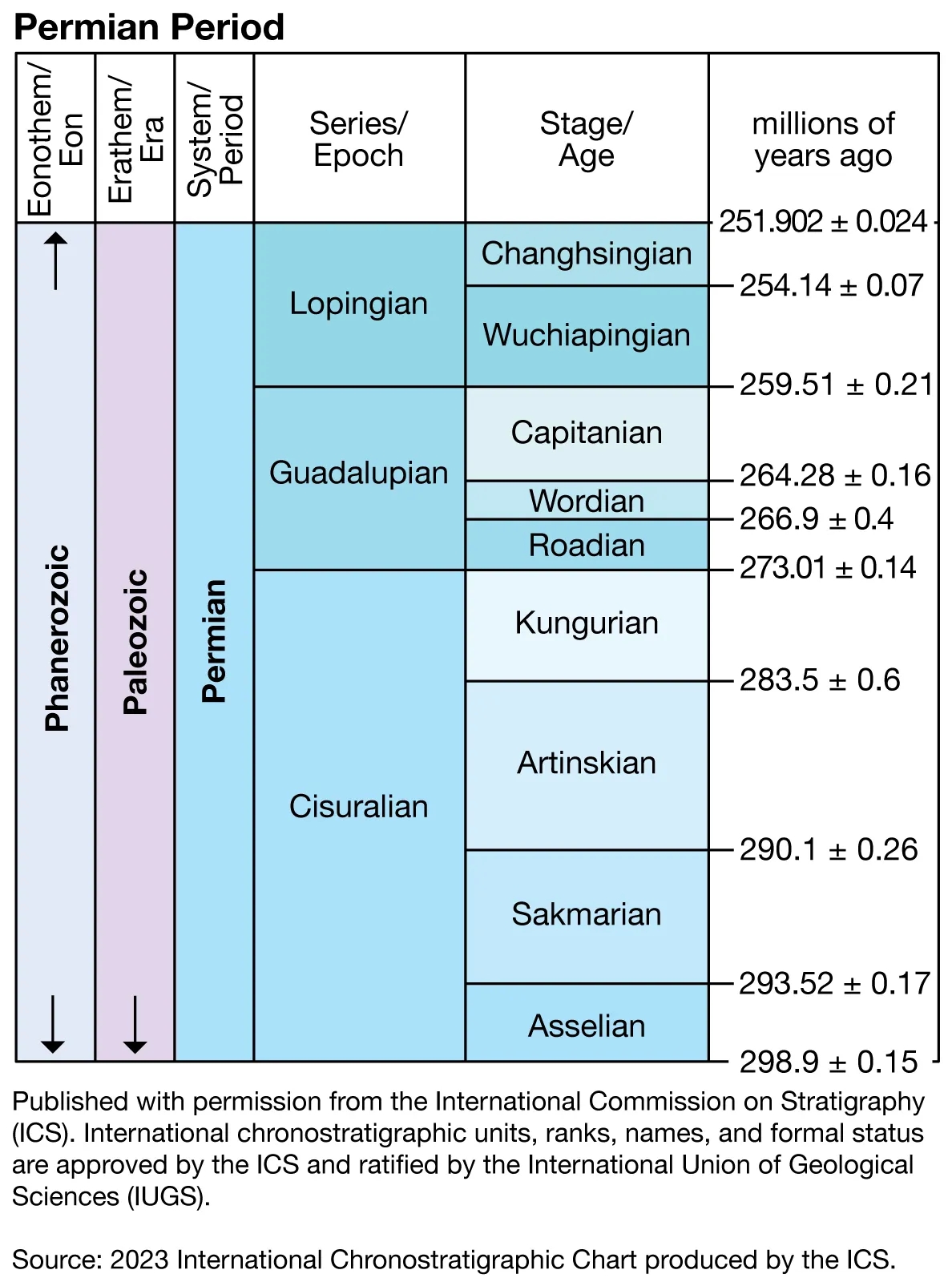
PermianThe Permian Period lasted from 299 to 252 million years ago, representing the final chapter of the Paleozoic Era. During this time, Earth's continents fully merged into the singular, immense supercontinent of Pangea. This vast landmass created extreme inland climates, ranging from frozen wastes to scorching deserts. On land, seed-bearing plants like conifers flourished, and advanced reptile-like ancestors called synapsids became the dominant terrestrial vertebrates. Among them was Dimetrodon, a creature featuring a large dorsal sail. The Permian closed with |➔| |
– Lopingian (Late Permian) – Marked by the end-Permian extinction event, the largest mass extinction in Earth’s history. – Guadalupian (Middle Permian) – Notable for the emergence of therapsids and the Capitanian mass extinction event. – Cisuralian (Early Permian) – Characterized by the dominance of pelycosaurs and significant faunal shifts. |
|
| 299 — 320 — 340 — 359 — |
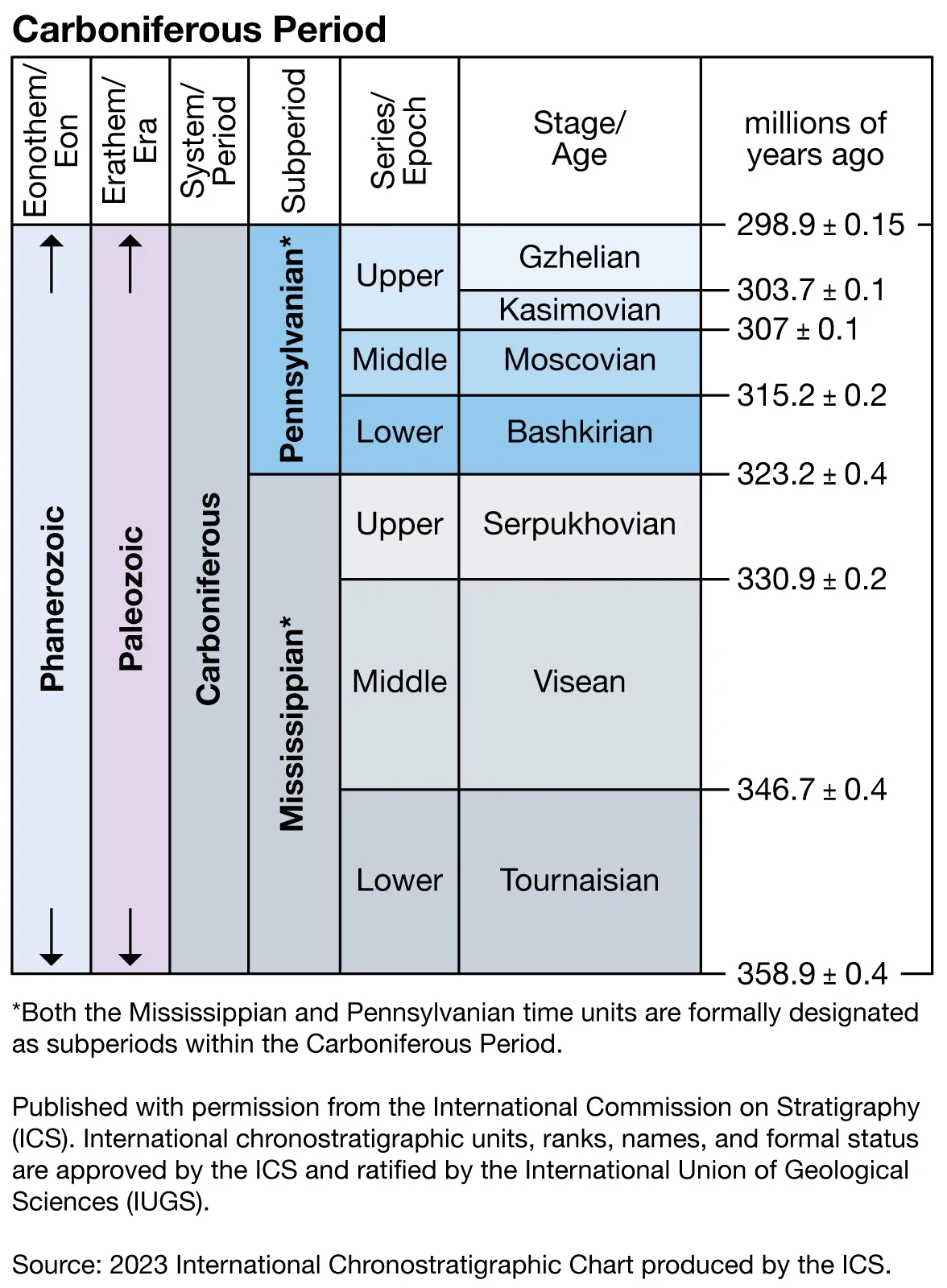
CarboniferousThe Carboniferous Period, spanning from 359 to 299 million years ago, is famous for its vast, swampy forests that transformed the planet. Named after its rich carbon deposits, the dead vegetation from these massive jungles did not fully decay, eventually turning into the extensive coal beds mined by humans today. The proliferation of these dense forests pumped immense amounts of oxygen into the atmosphere, pushing levels to historic highs. This oxygen-rich air allowed land-dwelling arthropods to grow to monstrous sizes, |➔| |
– Pennsylvanian 323.2 to 298.9 Ma – Known for the formation of coal beds and the rise of terrestrial ecosystems, including vast swampy forests. – Mississippian (358.9 to 323.2 Ma – This period is marked by the development of extensive limestone deposits and the flourishing of marine life. |
||
| 359 — 380 — 400 — 419 — |
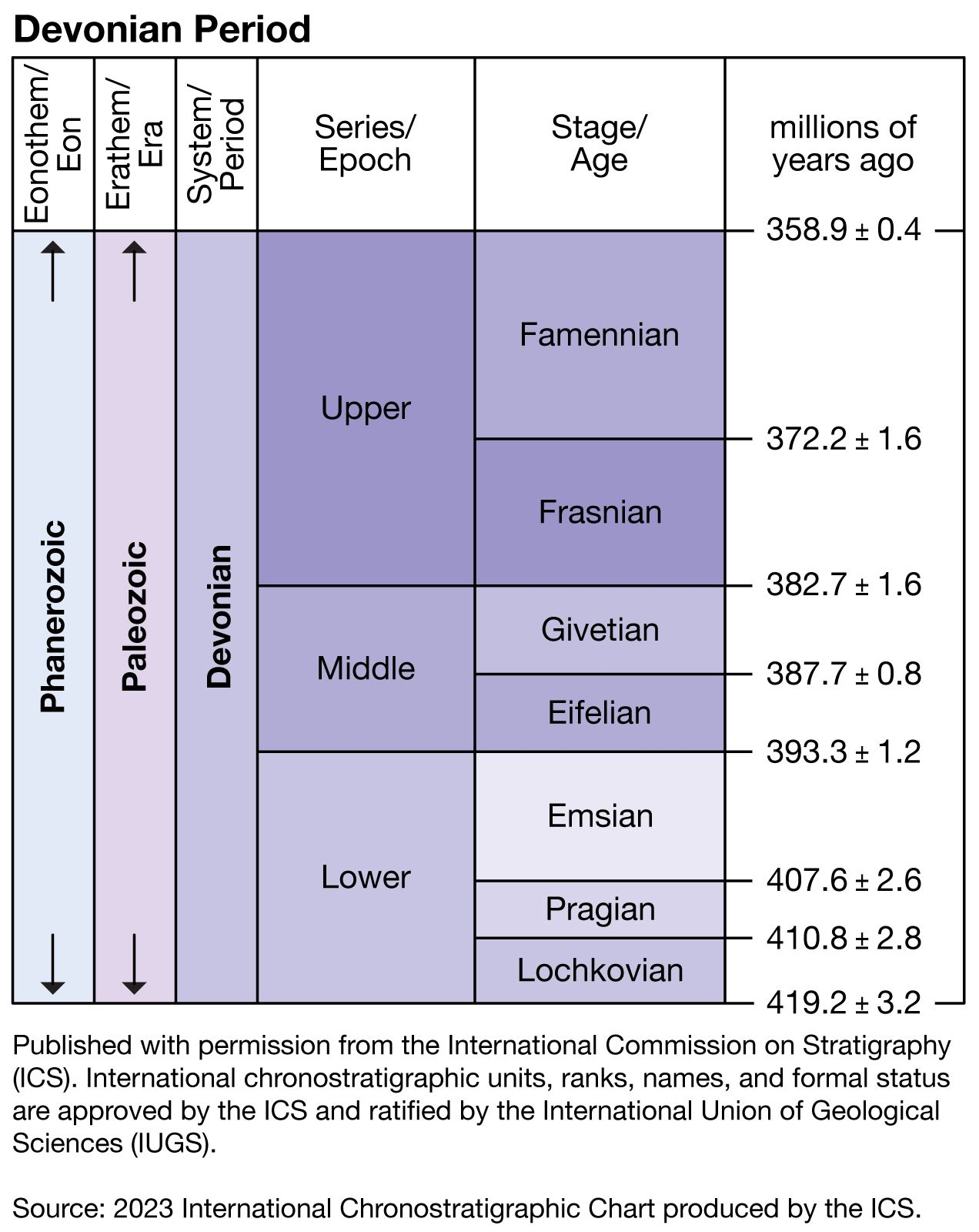
DevonianThe Devonian Period lasted from 419 to 359 million years ago and is famously celebrated as the "Age of Fishes". The global oceans teemed with an astonishing variety of fish, including jawless forms, early sharks, and massive armored predators like Dunkleosteus. It was also a time of profound ecological transition on land. The first extensive forests emerged, dominated by primitive vascular plants like giant horsetails and clubmosses. This greening of the continents stabilized soils and altered global climates. Crucially, lobe-finned |➔| |
– Late Devonian (~383 to 358.9 Ma – Stages: Frasnian – Famennian) – Appearance of the first forests and tetrapods; significant extinction events. – Middle Devonian (~393.3 to 383 Ma – Stages: Eifelian – Givetian) – Decline of jawless fish and diversification of jawed fish. – Early Devonian (~419.62 to 393.3 Ma – Stages: Lochkovian – Pragian – Emsian) – Emergence of the first ammonoids and early land plants. |
||
| 419 — 430 — 443 — |
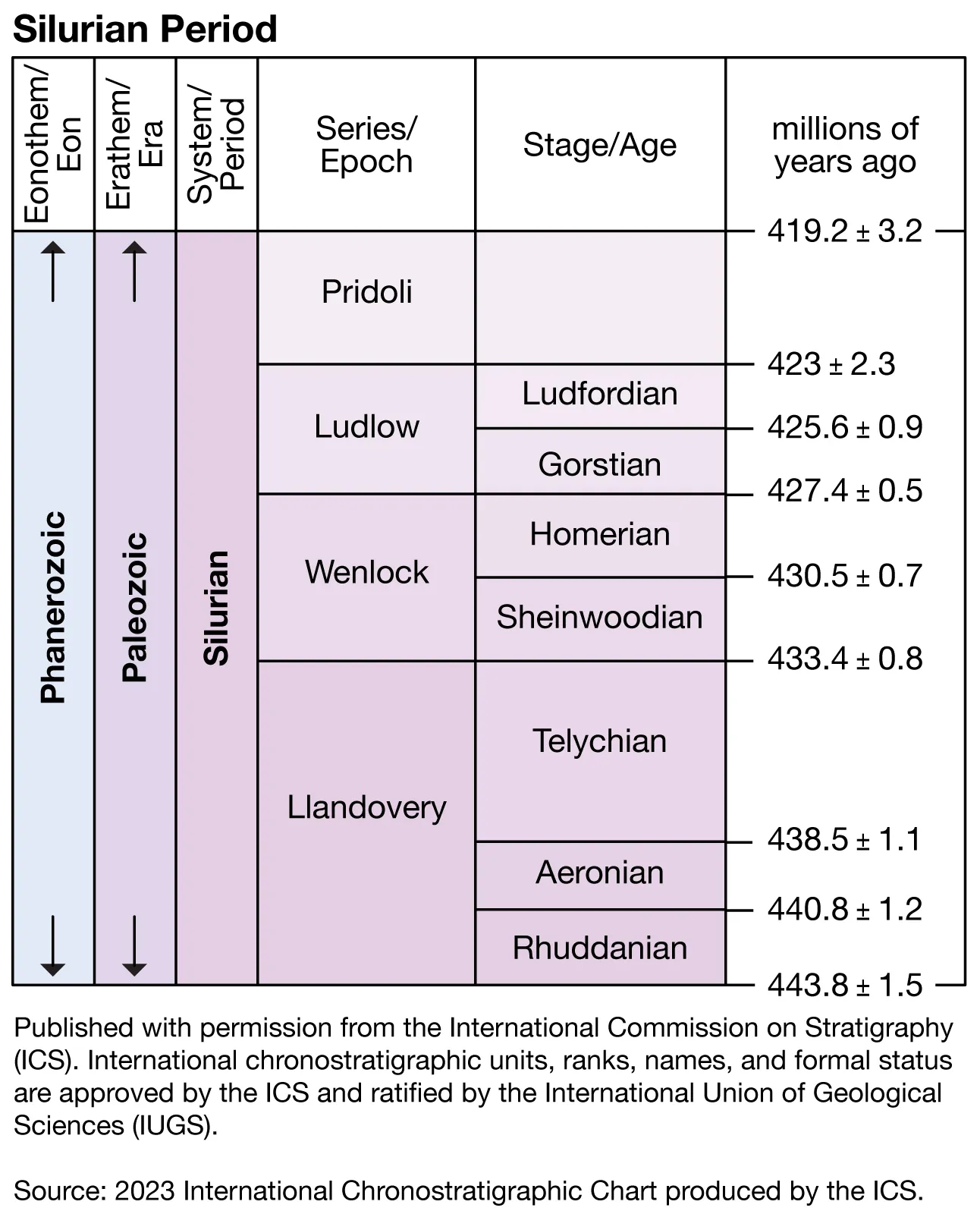
SilurianThe Silurian Period spanned from 443 to 419 million years ago, serving as a time of significant environmental stabilization and evolutionary recovery following a severe end-Ordovician extinction. As melting glaciers caused sea levels to rise, vast, warm, shallow seas spread across the continents. These marine environments hosted booming coral reefs, sea lilies, and fierce predatory sea scorpions known as eurypterids. Jawed fish made their definitive appearance, marking a major milestone in vertebrate evolution. On land, life took its first permanent |➔| |
– Wenlock (433.4 Ma) – Appearance of the oldest-known tracheophytes and terrestrial animals – Ludlow (427.4 Ma) – Diversification of jawed fish and further terrestrial life – Pridoli (423 Ma) – Final stages of the Silurian, leading into the Devonian Period – Llandovery (443.8 Ma) – Emergence of early vascular plants and marine life |
||
| 443 — 450 — 470 — 485 — |
OrdovicianThe Ordovician Period lasted from 485 to 443 million years ago, a time when global oceans experienced an unprecedented surge in biodiversity known as the Great Ordovician Biodiversification Event. Marine life tripled in variety, dominated by trilobites, brachiopods, snails, and massive, shelled cephalopods that acted as the apex predators of their time. The first primitive, jawless fish also continued to evolve in these shallow, tropical seas. On land, the very first adventurous organisms - likely simple, moss-like plants and fungi |➔| |
– Late Ordovician (458.4 – 443.8 Ma) – Middle Ordovician (470 – 458.4 Ma) – Significant geological events, during the transition between the Middle and Late Ordovician stages, including massive glaciers forming on Gondwana, which caused sea levels to drop, and the Ordovician–Silurian extinction events, leading to the loss of over 85% of marine species – Early Ordovician (485.4 – 470 Ma) – Significant diversification of marine life, including the appearance of many new species of invertebrates. |
||
| 485 — 500 — 520 — 541 — |
CambrianThe Cambrian Period, spanning from 541 to 485 million years ago, marks the explosive beginning of the Phanerozoic Eon. It is defined by the "Cambrian Explosion", a spectacular evolutionary event where nearly all major animal body plans appeared in a relatively short geological window. For billions of years, life had been simple and microscopic; suddenly, the oceans teemed with complex, multicellular organisms. Creatures developed hard external skeletons, eyes, and advanced hunting strategies, initiating the planet's first complex predator-prey dynamics. The |➔| |
– Upper Cambrian (497 to 486.85 Ma) – Continued evolution of life, leading to the first representatives of many modern animal phyla. – Middle Cambrian (510 to 497 Ma) – Further diversification of marine life and development of complex ecosystems. – Lower Cambrian (538.8 to 510 Ma) – Emergence of early multicellular life forms, including trilobites. |
||
| 541 — 600 — 800 — 1000 — |
Precambrian4.6 billion - 541 million years ago - The Precambrian is an informal "super-eon" that encompasses the vast majority of Earth's history, accounting for roughly 88 percent of geological time. Spanning from the formation of the planet about 4.6 billion years ago to the beginning of the Cambrian Period 541 million years ago, it is subdivided into the Hadean, Archean, and Proterozoic eons. During this massive stretch of time, Earth transitioned from a molten, volatile sphere into a stable planet |➔| 4.6 Ga – 0.541 Ga |
ProterozoicThe Proterozoic Eon spans an immense timeframe from 2.5 billion to 541 million years ago, marking the final chapter of the Precambrian. This eon witnessed some of the most critical environmental and biological transitions in Earth's history. Most notably, the proliferation of photosynthetic cyanobacteria triggered the Great Oxidation Event, flooding the atmosphere with oxygen and transforming global chemistry. This shift enabled the evolution of more complex, eukaryotic life-forms and, eventually, multicellular organisms. Geologically, the Proterozoic saw the stabilization of modern |➔| 2.5 – 0.541 Ga |
NeoproterozoicThe Neoproterozoic Era, spanning from 1.0 billion to 541 million years ago, was a chaotic yet foundational era at the end of the Precambrian. Geologically, it witnessed the dramatic fracturing of the supercontinent Rodinia. The climate experienced some of the most severe disruptions in planetary history, triggering multiple global glaciations known as "Snowball Earth", where ice sheets likely reached equatorial regions. Despite this freezing adversity, life took a massive evolutionary leap forward. As the planet warmed, oxygen levels rose, fueling |➔| |
– Ediacaran (635 to 541 Ma) – Appearance of the Ediacaran biota, early complex life forms. – Cryogenian (720 to 635 Ma) – Major glaciation events, including “Snowball Earth”, lasting around 100 million years. – Tonian (1000 to 720 Ma) – Development of early multicellular organisms, with early forms such as primitive sponges. |
| 1000 — 1200 — 1400 — 1600 — |
MesoproterozoicThe Mesoproterozoic Era lasted from 1.6 to 1.0 billion years ago, a period often characterized by profound tectonic restructuring and crucial biological milestones. The era was highlighted by the assembly of the massive supercontinent Rodinia, an event driven by widespread mountain-building activity across the globe. Biologically, life remained predominantly microscopic and marine, but it achieved a monumental breakthrough: the widespread definitive evolution of sexual reproduction. This evolutionary shift vastly accelerated genetic diversity and variation among organism lineages. Photosynthetic stromatolites continued |➔| |
– Stenian (1200 to 1000 Ma) – Formation of orogenic belts and further complexity in life forms. – Ectasian (1400 to 1200 Ma) – Continued geological activity and development of life. – Calymmian (1600 to 1400 Ma) – Stabilization and expansion of cratonic covers. |
||
| 1600 — 1800 — 2000 — 2200 — 2500 — |
PaleoproterozoicThe Paleoproterozoic Era spans from 2.5 to 1.6 billion years ago, marking the momentous opening chapter of the Proterozoic Eon. This era was defined by the Great Oxidation Event, a catastrophic atmospheric shift triggered by billions of photosynthetic cyanobacteria releasing free oxygen. This sudden oxygen surge was toxic to the dominant anaerobic microbes of the time, causing a massive planetary die-off. However, it also enabled the evolution of more complex, energy-efficient eukaryotic life-forms. The shifting atmospheric chemistry reacted with greenhouse |➔| |
– Statherian (1800 – 1600 Ma) – Emergence of eukaryotic life and the first evidence of multicellular organisms. – Orosirian (2050 – 1800 Ma) – Further development of the atmosphere and oceans, along with the diversification of life. – Rhyacian (2300 – 2050 Ma) – Appearance of more complex life forms and the stabilization of continental crust. – Siderian (2500 – 2300 Ma) – Formation of significant iron deposits and the development of early photosynthetic organisms. |
||
| 2500 — 2600 — 2700 — 2800 — |
ArcheanThe Archean Eon spans from 4.0 billion to 2.5 billion years ago, representing the era when Earth's crust cooled sufficiently for continents to begin forming. The planet looked vastly different than today, featuring a faint young sun, a toxic atmosphere lacking free oxygen, and high volcanic activity. Despite these harsh, volatile conditions, the Archean is monumental because it marks the definitive origin of life on Earth. The earliest fossil evidence, found in ancient rock formations like stromatolites, reveals that simple, |➔| 4.0–2.5 Ga |
Neoarchean2.8 - 2.5 billion years ago - The Neoarchean Era, lasting from 2.8 to 2.5 billion years ago, was a highly dynamic phase that closed out the Archean Eon. During this era, Earth's internal heat flow began to cool slightly, allowing modern-style plate tectonics to establish a stronger foothold. Small crustal plates rapidly collided, forming massive granite-greenstone belts and building Earth's very first true supercontinent, Kenorland. Biologically, a massive revolution was quietly brewing in the global oceans. Oxygenic photosynthesis evolved |➔| |
Time Span (2.8 to 2.5 Ga) – Continental Development (Formation of supercontinent Kenorland – debated) – Oxygen Increase (Significant rise in atmospheric oxygen levels) – Early Complex Life (Potential eukaryote fossils found in South Africa, 2.8 to 2.7 Ga) | |
| 2800 — 3000 — 3200 — |
Mesoarchean3.2 - 2.8 billion years ago - The Mesoarchean Era spanned from 3.2 to 2.8 billion years ago, a deep geological period defined by a gradually stabilizing planet. The global climate was generally warm, and the atmosphere remained thick with methane and carbon dioxide, lacking any free oxygen. Oceans covered the vast majority of the planet's surface, though early continental landmasses, such as the ancient craton of Ur, began to expand through intense volcanic activity and tectonic collisions. Microscopic life |➔| |
Time Span (3.5 to 2.8 Ga) – First evidence of modern-style plate subduction. Expansion of microbial life, indicating a diversification of early life forms. The atmosphere during the Mesoarchean was rich in methane and carbon dioxide, contributing to high temperatures. | ||
| 3200 — 3400 — 3600 — |
Paleoarchean3.6 - 3.2 billion years ago - The Paleoarchean Era lasted from 3.6 to 3.2 billion years ago, representing a deeply ancient period when Earth's crust was still actively solidifying. The planet was a volatile world dominated by an immense global ocean, high volcanic activity, and an atmosphere composed of toxic gases. No large continents existed yet; instead, the very first stable crustal fragments, or cratons, were just beginning to form. Despite these incredibly harsh conditions, life managed to take |➔| |
– Isuan (3.81 to 3.49 Ga) – Period notable for the emergence of the oldest known macroscopic fossils, such as stromatolites. – Acastan (4.03 to 3.81 Ga) – The earliest part of the Paleoarchean, during which some of the oldest rocks on Earth were formed. |
||
| 3600 — 3800 — 4000 — |
ArcheanThe Archean Eon spans from 4.0 billion to 2.5 billion years ago, representing the era when Earth's crust cooled sufficiently for continents to begin forming. The planet looked vastly different than today, featuring a faint young sun, a toxic atmosphere lacking free oxygen, and high volcanic activity. Despite these harsh, volatile conditions, the Archean is monumental because it marks the definitive origin of life on Earth. The earliest fossil evidence, found in ancient rock formations like stromatolites, reveals that simple, |➔| |
– Neoarchean (2.80 – 2.50 Ga) – Transition towards modern plate tectonics; more complex geological formations. – Mesoarchean (3.20 – 2.80 Ga) – Increased volcanic activity; development of greenstone belts. – Paleoarchean (3.60 – 3.20 Ga ) – Continued crust formation; emergence of simple life forms. – Eoarchean (4.031 – 3.60 Ga) – Formation of the oldest known rocks; development of the early crust. |
||
| 4000 — 4200 — 4400 — 4600 — |
Hadean4.6 - 4.0 billion years ago - The Hadean Eon represents the earliest chapter of Earth's history, beginning with the planet’s formation around 4.6 billion years ago and ending 4.0 billion years ago. Named after Hades, the Greek underworld, this informal eon describes a hellish, chaotic, and volatile world. Earth was initially a molten sphere of magma generated by frequent collisions with planetesimals and intense radioactive decay. During this time, a Mars-sized body collided with Earth, ejecting debris that eventually |➔| |
Duration ~4.54 to 4.0 Ga) – Lack of fossil record, extreme conditions, the Earth was extremely hot and largely molten during this time. Frequent collisions with other celestial bodies contributed to this intense heat. | ||
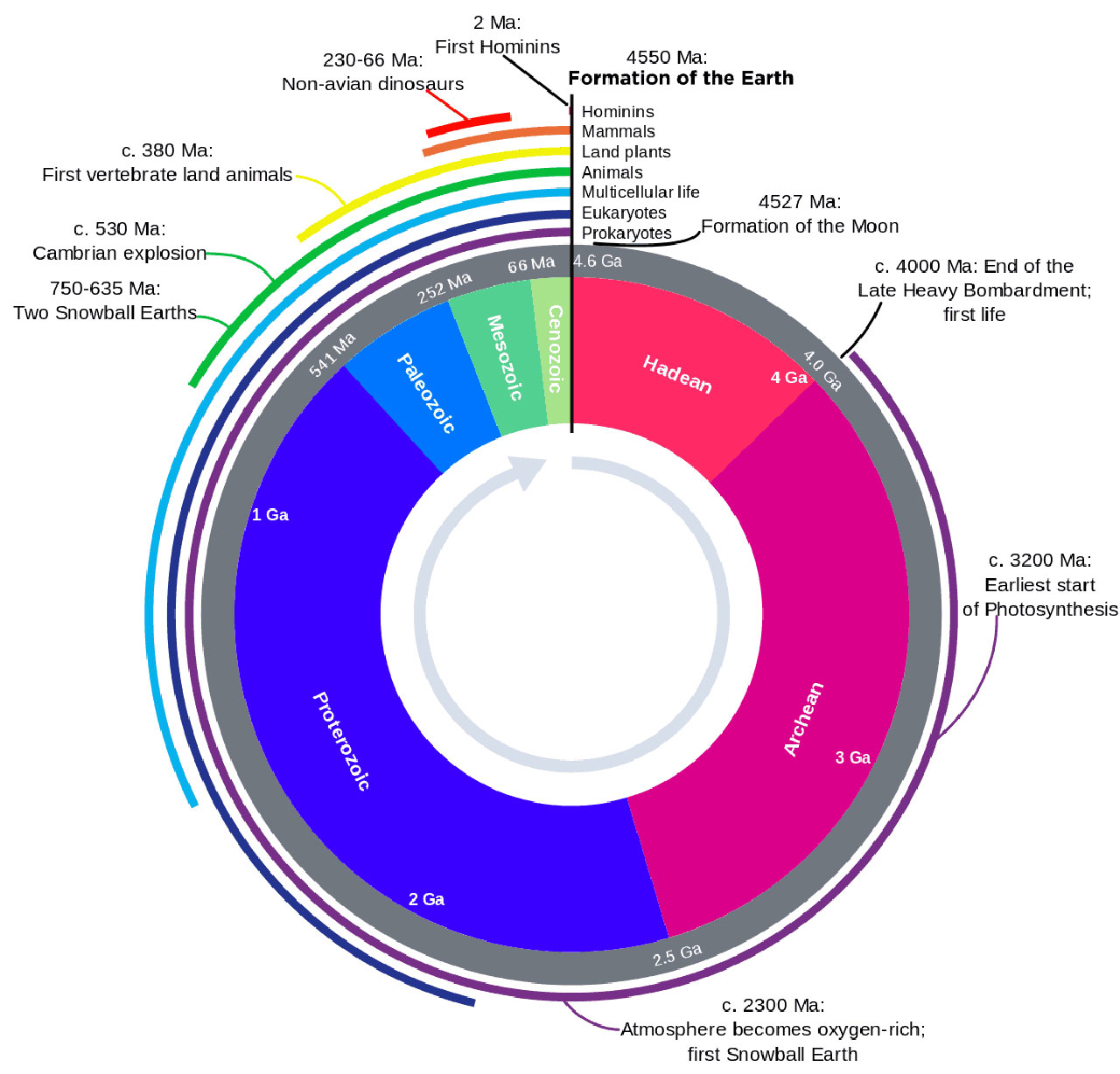 Scale (left) – Numbers represent millions of years ago (Ma). – Ka: “kilo anum” (one-thousand years) Kya = thousand years ago – Ma: “mega anum” (one-million years) Mya = million years ago – Ga: “giga anum” (one-billion years) Bya = billion years ago The timeline reads from present at the top down to the formation of Earth at the bottom. About this timeline – Based on the International Chronostratigraphic Chart (v2024/10). Dates are approximate. Hover on any era or period for details. Part of the Logios System – see tooltip-links for more info / to read more |➔|
|
||||

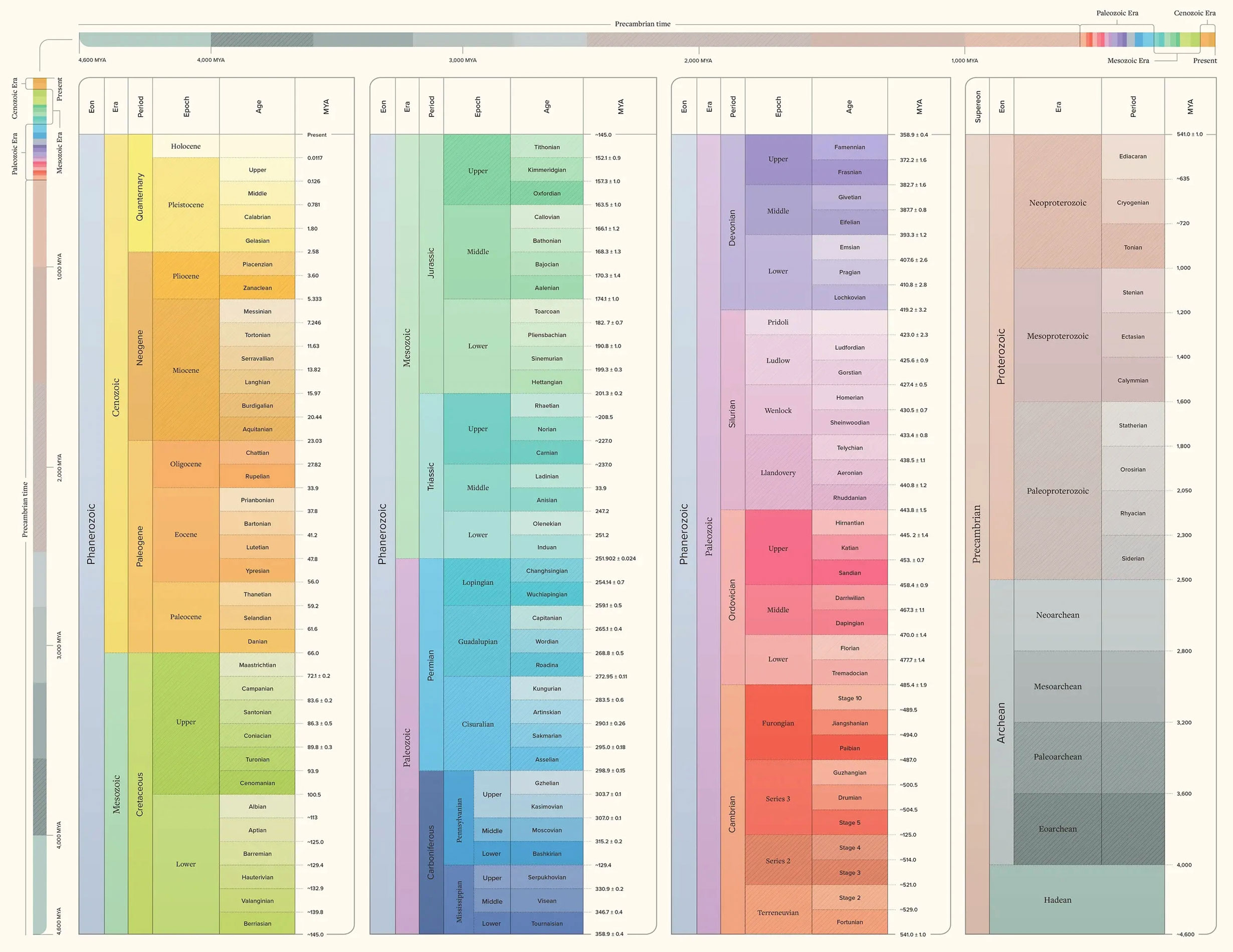
[ Geologic Time Scale Poster – by Todd Cook ]
The geologic time scale (GT5) is a system of chronological dating that relates geological strata (stratigraphy) to time. it is used by geologists, paleontologists. and other Earth scientists to describe the timing and relationships of events that have occurred during Earth’s history. The table of geologic time spans, presented here, agree with the nomenclature. dates and standard color codes set forth by the international Commission on Stratigraphy (ICS).
Evidence from radiometric dating indicates that Earth is about 4.54 billion years old. The geology or deep time of Earth’s past has been organized into various units according to events which took place. Different spans of time on the GT5 are usually marked by corresponding changes in the composition of strata which indicate major geological or paleontological events, such as mass extinctions. For example, the boundary between the Cretaceous period and the Paleogene period is defined by the Cretaceous – Paleogene extinction event, which marked the demise of the non-avian dinosaurs and many other groups of life. Older time spans, which predate the reliable fossil record (before the Proterozoic eon). are defined by their absolute age.
Geologic units from the same time but different parts of the world often look different and contain different fossils, so the same time-span was historically given different names in different locales. For example, in North America, the Lower Cambrian is called the Waucoban series that is then subdivided into zones based on succession of trilobites. In East Asia and Siberia, the same unit is split into Alexian, Atdabanian, and Botomian stages. A key aspect of the work of the International Commission on Stratigraphy is to reconcile this conflicting terminology and define universal horizons that can be used around the world.
Some other planets and moons in the Solar System have sufficiently rigid structures to have preserved records of their own histories. for example, Venus. Mars and the Earth’s Moon. Dominantly fluid planets, such as the gas giants, do not preserve their history in a comparable manner. Apart from the Late Heavy Bombardment events on other planets had little direct influence on the Earth, and events on Earth had correspondingly little effect on those planets. Construction of a time scale that links the planets is. therefore, of only limited relevance to the Earth’s time scale, except in a Solar System context. The existence, timing, and terrestrial effects of the Late Heavy Bombardment are still a matter of debate.
The first serious attempts to formulate a geologic time scale that could be applied anywhere on Earth were made in the late 18th century. The most influential of those early attempts (championed by Werner, among others) divided the rocks of Earth’s crust into four types: Primary, Secondary, Tertiary, and Quaternary. Each type of rock, according to the theory, formed during a specific period in Earth history, it was thus possible to speak of a “Tertiary Period” as well as of “Tertiary Rocks”. Indeed, “Tertiary” (now Paleogene and Neogene) remained in use as the name of a geological period well into the 20th century and “Quaternary” remains in formal use as the name of the current period.

The identification of strata by the fossils they contained, pioneered by William Smith, Georges Cuvier, Jean d’Omalius d’Halloy, and Alexandre Brongniart in the early 19th century. enabled geologists to divide Earth history more precisely. It also enabled them to correlate strata across national (or even continental) boundaries”. two strata (however distant in space or different in composition) contained the same fossils, chances were good that they had been laid down at the same time. Detailed studies between 1820 and 1850 of the strata and fossils of Europe produced the sequence of geologic periods still used today.
When William Smith and Sir Charles Lyell first recognized that rock strata represented successive time periods. time scales could be estimated only very imprecisely since estimates of rates of change were uncertain. While creationists had been proposing dates of around six or seven thousand years for the age of Earth based on the Bible, early geologists were suggesting millions of years for geologic periods, and some were even suggesting a virtually infinite age for Earth. Geologists and paleontologists constructed the geologic table based on the relative positions of different strata and fossils, and estimated the time scales based on studying rates of various kinds of weathering, erosion, sedimentation, and Iithification. Until the discovery of radioactivity in 1896 and the development of its geological applications through radiometric dating during the first half of the 20th century, the ages of various rock strata and the age of Earth were the subject of considerable debate.