
S. Guraziu – Ars Poetica, J 2026
(…Greek mythology never “pretends” to be more accurate than, let’s say, modern Hollywood hero-ology – in both cases we have thousands of heroes and important figures, many of them sometimes duplicated : )
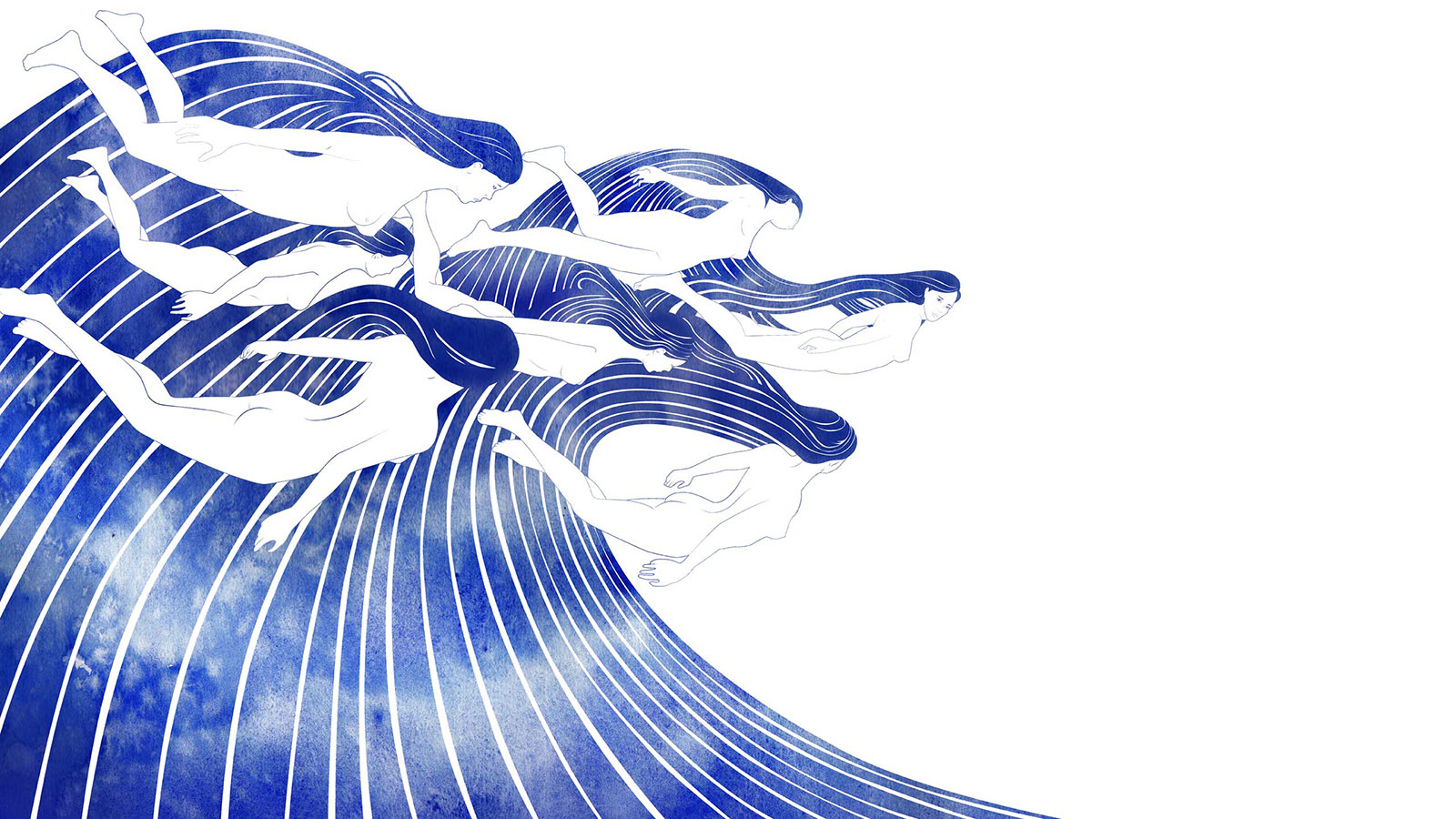
[ Illustration: Stevyn Llewellyn – Seven Nereids (Digital art, Aquarel), 2019 ]
Nereids are sea nymphs (female aquatic spirits) who personify the different aspects of the ocean – from calm waves and sandy beaches, to the skills of sailors. Unlike many types of nymphs, the Nereids are immortal – they are like “minor” goddesses. They are the 50 daughters of the sea god Nereus and the Oceanid Doris, and sisters of their brother Nerites. The Nereids symbolized everything beautiful and pleasant about the sea. They were depicted as beautiful females, crowned with small red coral branches and dressed in white silk robes embroidered with gold. In classical art, they are shown as exceptionally beautiful young maidens riding on the backs of dolphins, hippocamps (sea horses), and other sea creatures.
Their melodious voices sang as they danced around their father. It is not known whether the name Nereus was known to Homer – the name of the Nereids is attested earlier than Nereus, and 34 Nereid names are mentioned by Homer in the Iliad (as an ancient source). So it turns out that Nereus has “mythological importance” only as the father of the Nereids – no other mythological “role” is known for him, and it has been suggested that his name may actually have derived from that of his daughters – just as it has also been suggested that the name of the Nereids derived from Nereus, i.e. as a patronymic name (inherited from the father).
The name of the Nereids survives in Greek folklore as neráides (νεράιδες), meaning ‘water fairies’, although the meaning has changed over the centuries to include all kinds of fairies, sirens, and nymphs. In astronomy, the third largest moon of Neptune is called Nereid, thus keeping the celestial theme of naming moons after figures associated with water deities.
In mythology, the Nereids often accompany Poseidon, the lord of the sea, and can be friendly and helpful to sailors (e.g., to the Argonauts during their quest-voyage). Sailors and fishermen of ancient Greece deeply honored them. Temples and shrines were built in ports to worship and pray to them for protection during dangerous storms. In one story, Cassiopeia boasted that her daughter Andromeda was more beautiful than the Nereids, and the beautiful nymphs were angered. In solidarity with them, Poseidon sent a flood and a sea monster to the land of the Ethiopians, even demanding the sacrifice of the princess. It was also said that these sea goddesses revealed the mysteries of Dionysus and Persephone to humans.
The Nereids are particularly associated with the Aegean, where they lived with their father, somewhere deep in the sea, in a golden palace. The most famous among them are Thetis, Amphitrite, Galatea, Psamathe. Thetis was loved by Zeus and also by Poseidon (the Olympian brotherhood sometimes shared sweets among themselves : ). But beautiful Thetis was to marry the mortal king Peleus, because a prophecy said her son would surpass his father in power. This detail “frightened” the Zeus-Poseidon brotherhood, and they supposedly “cooled off” – they didn’t visit her anymore. Mighty Olympian gods, but also a bit “cowardly” about prophecies – or perhaps they just pretended they’d had enough sweets.
Then Thetis married Peleus and became the mother of the legendary hero of the Trojan War, Achilles. In Homer’s Iliad, when Thetis weeps in anguish over Achilles’ grief – Achilles, that great hero, that unprecedented crybaby, weakened and miserable over Patroclus killed by the Trojan prince Hector – moved by their sister’s pain, some of her sisters appear, perhaps 12–13 sister-goddesses come to comfort her. Four of the sisters, Cymodoca, Thalia, Nesaea, and Spio, later, together with the other sisters and the goddesses Thetis, Melita, and Panopea, would help the hero Aeneas and his crew during a storm.
Amphitrite was the wife of Poseidon and mother of Triton – Poseidon fell in love with her and chose her as his divine spouse. Beside him, Amphitrite rules the oceans and helps calm destructive winds. It’s interesting that Homer does not mention Amphitrite, Poseidon’s wife – even though she is an important name among the Nereids, if only for the fact that she is Poseidon’s spouse (Amphitrite is also the name of one of the 3000 Oceanids, daughters of the Titan Oceanus and the Titaness Tethys). Homer does not mention Asia either (who, besides being a Nereid nymph, is also the name of one of the Oceanids). Amphitrite is mentioned only by Hesiod and Apollodorus, while neither of them mentions Asia. Asia is mentioned only a few centuries later, by Hyginus.
Galatea, a beautiful nymph who personified the white foam of the sea, was the unrequited love of the Cyclops Polyphemus. She was aggressively pursued by the clumsy one-eyed giant, though her heart belonged to the mortal youth Acis. Polyphemus was the son of Poseidon and had been blinded by Odysseus, losing his only eye – after which Poseidon became enraged and tried to destroy Odysseus. The sea would darken, the sky would blacken, and poor Penelope suffered too, wasting away while waiting stoically for Odysseus for 20 years. After the 10 years of the Trojan War, Odysseus needed another 10 years to escape Poseidon’s wrath and reach home.
Sister-goddess, the Nereid Psamathe became the mother of Phocus with King Aeacus of Aegina, and also the mother of Theoclymenus and Theonoe with Proteus, a water god or king of Egypt – not known for certain.

[ Artwork: Friedrich Ernst Wolfrom (1857-1920) – Poseidon and Nereids, 1920 ]
***
In mythology, 50 sometimes becomes 100 – it seems that’s how the math of mythology works, and Greek mythology in particular has pretty tangled “mathematics”. Anyway, by the way, Greek mythology never “pretends” to be more accurate than, let’s say, modern Hollywood hero-ology (Marvel & DC, etc.) – in both cases we have thousands of heroes and important figures, many of them sometimes duplicated. As for modern Hollywood hero-ology, we’re not so sure – what with numberless Marvel heroines and Spider-Men, Batmen and Bananamen… perhaps even the complete Fandomiad (of continents & icenents) can’t be 100% sure : ) but in Greek mythology, you can sometimes have even more than 3, 4, 5, 6, or 7 versions of the same name.
It is said that the Nereids were the 50 daughters of the sea god Nereus and the Oceanid Doris. However, because the list of Nereids is usually woven together from four main sources – Homer’s Iliad, Hesiod’s Theogony, the Library of Apollodorus (or Pseudo-Apollodorus), and Hyginus’ Fabulae – the number of their names reaches almost 100 – in total 97 Nereid names. Yes, in mythology it happens like this: 50 becomes ~100 : )
Only Hesiod (in his Theogony) mentions exactly 50 names – lucky Hesiod. Homer (in his Iliad) mentions 34 Nereid names [let’s note them, since they are a popular source – Actaea, Agave, Amatheia, Amphinomē, Amphithoē, Apseudēs, Calianassa, Calianira, Clymenē, Cymodocē, Cymothoē, Dexamenē, Doris, Dōtō, Dynamenē, Galatea, Glauconome, Halia, Iaera, Ianassa, Ianira, Limnoreia, Maera, Melita, Nemertes, Nēsaea, Ōrityia, Panopēa, Pherousa, Prōtō, Speio, Thaleia, Thetis, Thoē]. Pseudo-Apollodorus (in the Library) mentions 45 Nereid names, Hyginus (in the Fabulae) mentions 47 Nereid names. The four sources together mention 97 Nereid names.
Hyginus (Latin author, c. 64 BCE – 17 CE, in his ‘Fabulae’) mentions a total of 47 Nereid names. He adds +13 other names that Homer (who lived 7–8 centuries before Hyginus, c. 800–700 BCE) had not mentioned. And not only Homer… neither Hesiod (c. 750–650 BCE) nor the Library (of Apollodorus, written c. 100–200 CE) mentions them. Hyginus mentions +13 Nereids [Arethusa, Asia, Beroe, Clia, Creneis, Cydippe, Diopaea, Dimo, Ephyra, Eurydice, Leucothoe, Ligea, Opis, Phyllodoce] – so where did he find these +13 names that no source had mentioned before him?! But still, Hyginus was “missing” 3 names to reach the full number 50.
As we mentioned above, only Hesiod managed to compile exactly and worthily 50 Nereid names. Well done, uncle Hesiod! May his pipe be blessed, no need to undermine mythological meritocracy. Meritocracy is always honored, it must be honored in some way – for example, it would be some modest honor if mythologists agreed and coined the phrase “as accurate as uncle Hesiod in mythology” : ) A modest, terribly late and simple honor – but it’s not nothing: better something than nothing.
All the names of the Nereids, from all 4 sources, in a row > Amatheia – Amphinome – Amphithoe – Amphitrite – Apseudes – Arethusa – Asia – Autonoe – Beroe – Calianassa – Calianira – Calypso – Ceto – Clio – Clymene – Cranto – Creneis – Cydippe – Cymatolege – Cymo – Cymodoce – Cymothoe – Deiopea – Dero – Dexamene – Dione – Doris – Doto – Driemo – Dynamene – Eione – Ephyra – Erato – Eugora – Euarna – Eucranta – Eudora – Eulimena – Eumolpe – Eunice – Eupompe – Eurydice – Galene – Galatea – Glauconome – Glauconoma – Halia – Halimeda – Hipponoe – Hippothoe – Iaera – Ianassa – Ianira – Ione – Isphianassa – Laomedeia – Leiagora – Leucothea – Ligea – Limnoreia – Lycorias – Lysianassa – Maera – Melita – Menippe – Nausithoe – Neaera – Nemertes – Neomeris – Nesaea – Neso – Opis – Orityia – Panopea – Pasithea – Pherousa – Phyllodoce – Plexaura – Ploto – Polynoe – Polynoma – Pontomedusa – Pontoporeia – Pronoe – Proto – Protomedeia – Psamathe – Sao – Speio – Thaleia – Themisto – Thetis – Thoē – Xantho ]
[ AI-translated, Logios, 2026 – The original, in Albanian ➔ Nereidat – 50 Motër-Perëndeshat e Bukura Akuatike ]