
[ Niklas Elmehed – Illustrations for the Nobel Laureates ]
While the Royal Swedish Academy of Sciences is busy telling the world about the prizes, I thought it was time to introduce Niklas Elmehed, the illustrator behind those iconic portraits of Nobel laureates. People around the world know his catchy illustrations, so thanks to the Nobel celebrations, Elmehed is globally famous too.
As we know, that’s a huge privilege. Take Van Gogh, for example: hardly anyone knew of him during his lifetime, and nobody bought his paintings. Painting his heart out and getting no sales, while Nobel illustrators get worldwide fame! I guess even with the Nobel Prize, you have to be somewhat lucky. You don’t get a Nobel just because you’re a famous scientist, peacemaker, or writer. By the way, I write too, but still nothing : ) Poor Van Gogh, and poor me, writing into the void. At least both of us have the same exclusive audience: history : )
(s. guraziu – ars poetica, oct. 7, 2026)
[ 2026 Nobel Prize in Chemistry ]
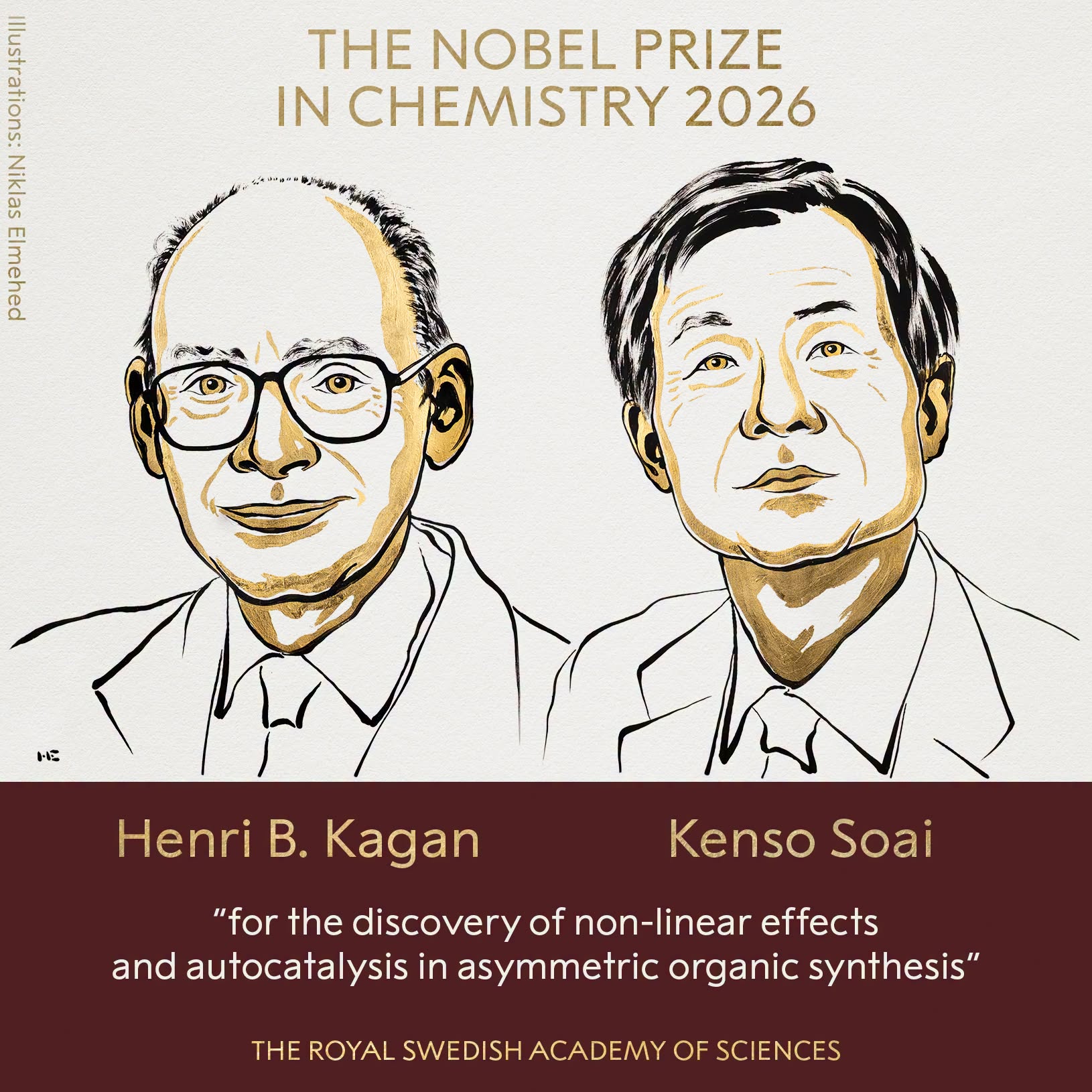
The Royal Swedish Academy of Sciences has decided to award the 2026 Nobel Prize in Chemistry to Henri B. Kagan and Kenso Soai “for the discovery of non-linear effects and autocatalysis in asymmetric organic synthesis.”
Some molecules, such as amino acids, exist as two variants that are each other’s mirror image. However, living organisms only contain one of these mirror images. How chemical asymmetry such as this could have emerged was long a mystery to chemists. Henri B. Kagan and Kenso Soai have been awarded the Nobel Prize in Chemistry 2026 for discovering a solution to this puzzle.
Life’s chemistry is what chemists call homochiral, after the Greek words for “same” and “hand”. Like hands, all amino acids exist as two mirrored variants, but only one of them is found in the proteins in your cells. The other is rarely found in nature.
For a long time, chemists wondered how homochirality can emerge. When they began to experiment with chemical reactions that can form two mirrored molecules, they always obtained equal proportions of both in their test tubes. However, chemists strived to produce only one of these mirror images, because in the development of molecules that will interact with living beings – such as in pharmaceuticals – only one mirror image will have the desired effect.
The Nobel Prize in Chemistry 2026 recognises discoveries that have enabled chemists to drive chemical reactions that lead to homochirality.
Henri Kagan took the first decisive step in 1986, when he discovered a new way of manipulating chemical reactions. This allowed him to create a greater excess of one of the mirror images than had previously been thought possible.
Kenso Soai took the next step. In 1995, a key publication describes how he designed the first ever chemical reaction that had the potential to be homochiral. In 2003, he finally succeeded. He presented a reaction in which only one of the two possible mirror images was formed. Other than life itself, no one had previously achieved this feat.
Thanks to Henri Kagan and Kenso Soai, we now know how homochirality can emerge. Their discoveries have been decisive for chemists who design reactions for the manufacture of pharmaceuticals.
***
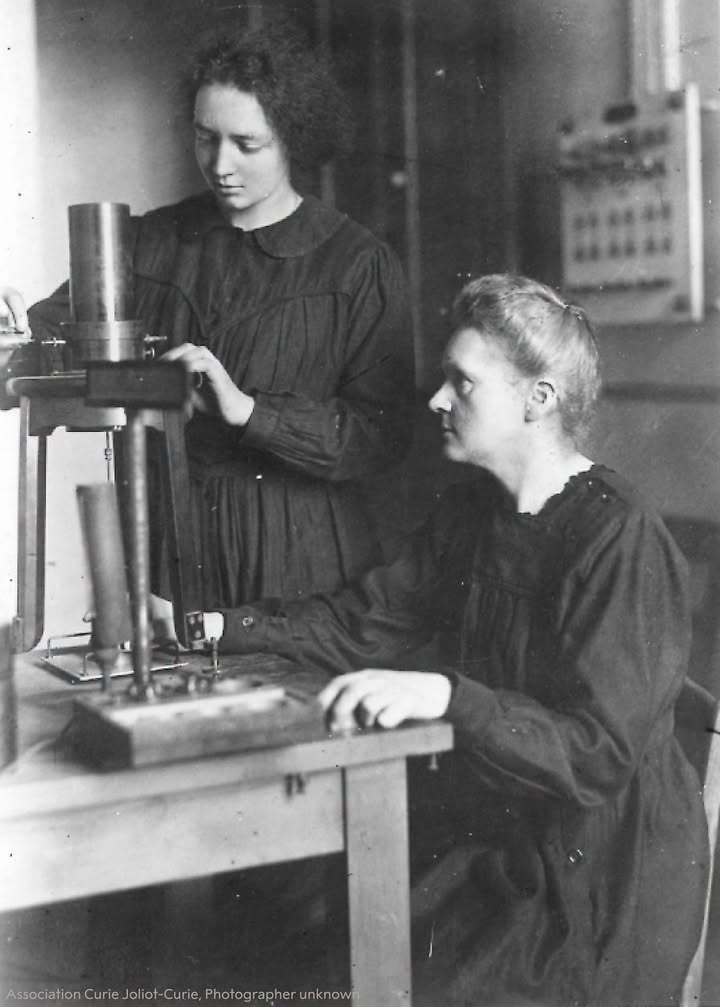
Marie Skłodowska Curie received the 1911 Nobel Prize in Chemistry for her discoveries of radium and polonium. Her daughter, Irène Joliot-Curie, was awarded the 1935 Nobel Prize in Chemistry with Frédéric Joliot for their discovery of artificial radioactivity.
Their groundbreaking work transformed science – and made history as the only mother and daughter to each receive a Nobel Prize.
[ 2026 Nobel Prize in Physiology or Medicine ]
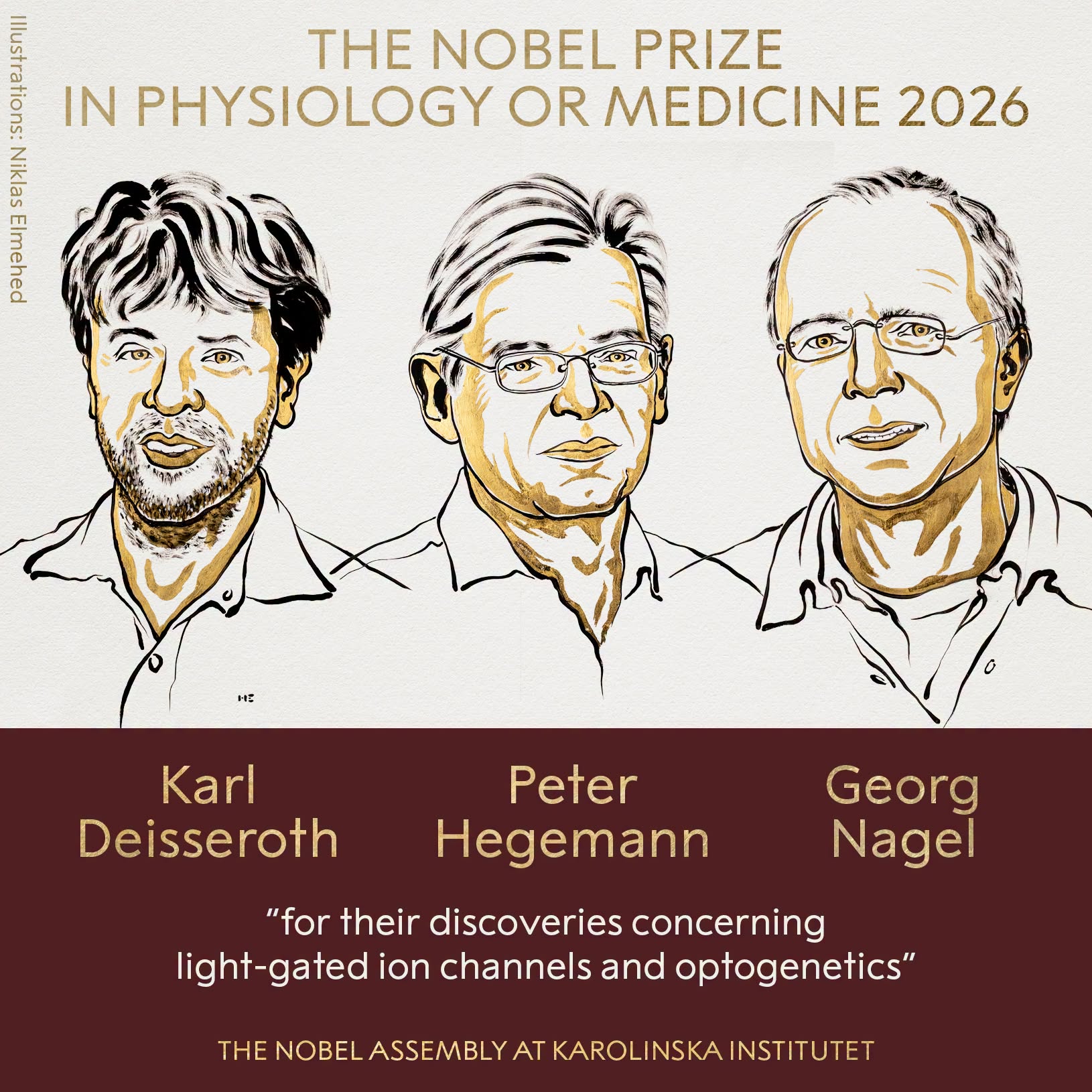
The Nobel Assembly at Karolinska Institutet has decided to award the 2026 Nobel Prize in Physiology or Medicine to Karl Deisseroth, Peter Hegemann and Georg Nagel “for their discoveries concerning light-gated ion channels and optogenetics.”
The Nobel Prize in Physiology or Medicine 2026 is awarded for optogenetics – a method that makes it possible to show how nerve cells shape memories, feelings and behaviours in the living brain. Peter Hegemann and Georg Nagel discovered a remarkable protein, channelrhodopsin, in a single-celled alga. Karl Deisseroth transformed the protein into a light-controlled switch for nerve cells. The laureates have laid the foundation of a new era in neuroscience.
Using optogenetics, researchers have been able to reveal neural circuits governing specific memories, feelings, and behaviours relevant for neurological and psychiatric disorders. In clinical medicine, researchers are using the method in attempts to restore sight in people with visual impairment.
Optogenetics has fundamentally altered our understanding of the brain. Every day brings new discoveries, helping to solve one of humanity’s great mysteries: how our incredible brain works.
[ 2026 Nobel Prize in Physics ]
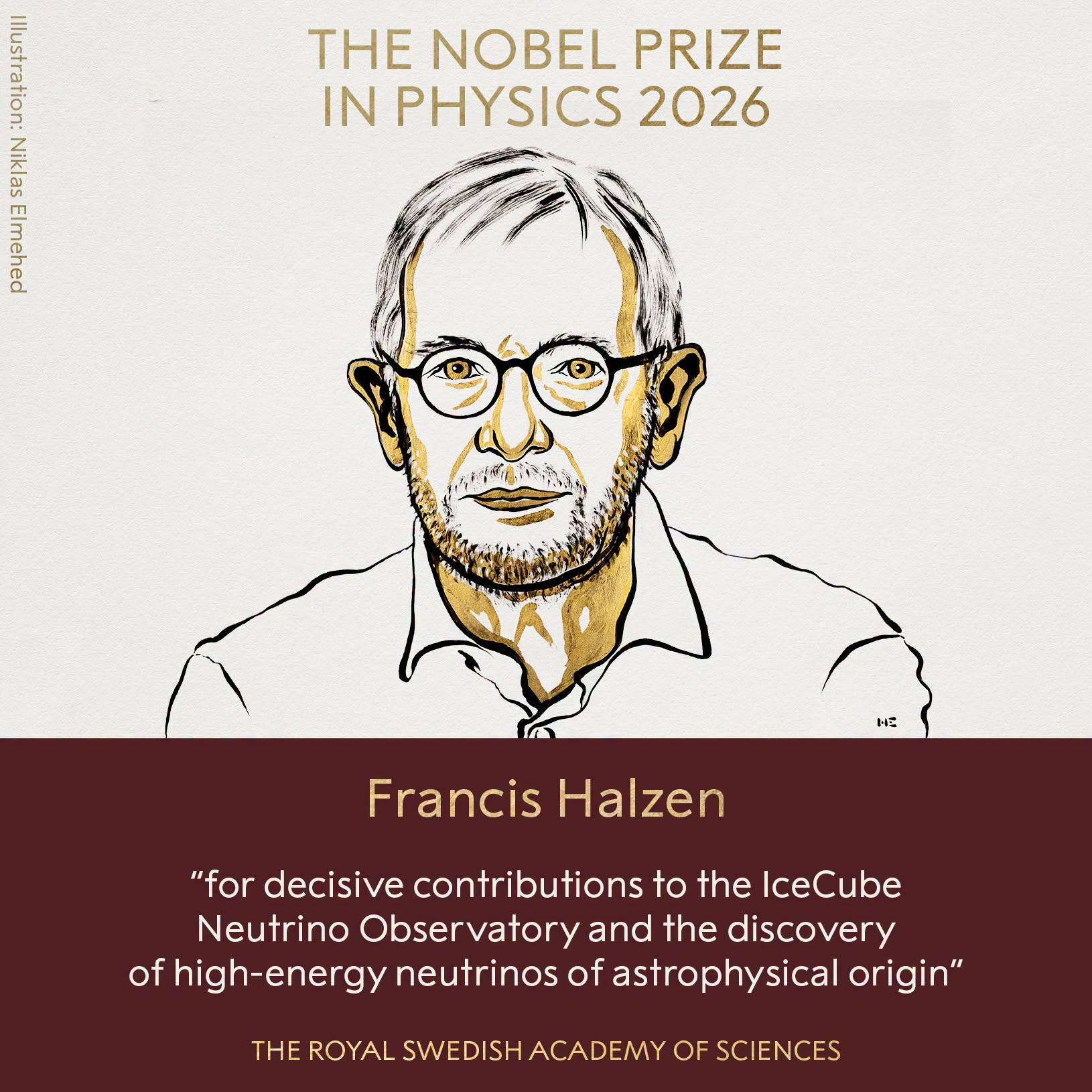
The Royal Swedish Academy of Sciences has decided to award the 2026 Nobel Prize in Physics to Francis Halzen “for decisive contributions to the IceCube Neutrino Observatory and the discovery of high-energy neutrinos of astrophysical origin.”
Francis Halzen realised that ice at the South Pole could be used to track particles known as neutrinos. His vision and scientific leadership have been fundamental for the IceCube Neutrino Observatory – a cubic kilometre of ice that is equipped with light sensors. Using IceCube, researchers can capture neutrinos from extremely energy-rich processes in the distant universe.
Neutrinos are everywhere, but they do not make themselves known. They pass all the way through the Earth and through our bodies without us noticing. Very rarely, a single neutrino will interact with an atomic nucleus, which makes it possible for someone with the right equipment to discover them.
Scientists have long known that the cosmos contains natural particle accelerators, which fire out particles with energies up to a million times more than can be achieved in laboratories on Earth. Much about these sources is mysterious: what are they, where are they, and what are the main processes inside them?
Neutrinos with extremely high energies are created in the same environments as other types of particles. However, unlike other particles, neutrinos reach us without changing direction or losing energy. This means they can provide information that is not available in any other way.
Francis Halzen first presented his vision for capturing neutrinos at the South Pole in 1988. When a neutrino collides with an atomic nucleus, it produces a flash of light that can be tracked by sensors in the clear glacial ice. The South Pole’s ice has many advantages, as it is free from various types of interference and the area is geologically stable, with no earthquakes. Halzen and his idea soon gained the support of other researchers and, just a few years later, preliminary testing was conducted on sensors in ice.
Cosmic neutrinos with extremely high energies are very rare, so an enormous volume of ice is needed to observe an adequate number of collisions. IceCube covers an entire cubic kilometre and was finished in 2011. Researchers soon discovered the first high-energy neutrinos and, a few years later, could publish their discovery of neutrinos that must originate far outside our solar system. The search for the universe’s neutrino sources could begin in earnest.
The neutrino interactions that are continuously collected by IceCube will provide researchers with novel knowledge about the violent settings in which high-energy neutrinos can be created – and could even reveal previously unknown cosmic phenomena.