
“like Fast & Furious meets Mission Impossible, but with a sci-fi loophole”
[ ME ] – It was not even day 1… and Fb “offered” me 10-15 parody videos made by people around the world (thus with the help of AI). What’s your assesment, what do you think about this wave of parodying, cause it has really gone “viral”?
[ DeepSeek AI ] – Why the Roadster became instant meme fuel? – The parody wave around Tesla’s Roadster really is a fascinating case study in how fast internet culture moves now. The setup was almost too perfect. Tesla unveiled the Roadster on October 15 with a demo showing the car launching off a ramp, flipping mid-air, and landing – a spectacle so absurd it practically begged to be mocked . Musk reportedly said the live demo was partly to “prove it wasn’t AI,” which is ironic given what happened next.
The parody ecosystem exploded almost immediately. Brands jumped in fast. IKEA Taiwan recreated the stunt with a gray towel and a toy car; Domino’s Pizza Uzbekistan launched a pepperoni pizza off a ramp; McDonald’s Czech used the imagery for a drive-thru joke.
Ordinary users with AI tools flooded feeds. The most common riffs: the Roadster flying over traffic jams, escaping police, dodging toll booths, or getting tangled in overhead power lines in Pakistan and India. One viral thread joked that “we got the flying Tesla before GTA 6”.
As one report noted, what used to require locations, actors, and post-production can now be done with generative AI in minutes – and tools like Seedance 2.5 and Kling 4.0 were explicitly credited in viral clips.
The Roadster parodies are not just absurd – they’re aspirational absurdity. Flying over traffic, skipping tolls, escaping police: these are universal frustrations turned into a 10-second fantasy. That’s why they resonated across cultures, from Greek tweets about toll booths to Pakistani riffs about potholes and power lines.
So the wave going viral is real, the tools for making this stuff are now in everyone’s hands, but the tools for moderating it are still catching up. The result is a chaotic middle ground where genuinely funny parody and automated overreach coexist.
[ ME ] – I enjoyed that one from India – it was a guy stuck, the traffic crazy, you can’t move, then he was flying but what he didn’t anticipate were electricity, telephone wires at one place so dense, the roadster kind of got stright in a “spider net”, while the driver shouting “damn damn” : )
[ DeepSeek AI ] – : ) Traffic in Indian metros – Delhi, Mumbai, Bengaluru – is legendary. A flying car that skips a thousand stuck cars is the ultimate wish-fulfillment. The button-press moment is pure catharsis. The joke lands because the creator anticipated what Musk’s demo didn’t: Indian streets aren’t just full of cars – they’re canopied by a chaotic mesh of electricity lines, telephone cables, internet wires, and transformer spaghetti. The Roadster doesn’t soar triumphantly; it gets caught like a fly in a web, driver shouting “damn damn.” The fantasy collides with local infrastructure, and that collision is the punchline.
This is a really specific kind of comedy – call it infrastructural satire. It’s funny because it’s true, and it’s true in a way that’s instantly recognizable to anyone who’s stood at an Indian intersection looking up at that tangle of wires. The humor isn’t mocking the dream of flying cars; it’s gently mocking the idea that a Silicon Valley fantasy can just be dropped into a context it was never designed for. The Roadster isn’t defeated by physics – it’s defeated by urban planning.
It also explains why these parodies traveled so well. The Greek toll-booth riffs, the Pakistani power-line gags, the Indian wire-web reel – they’re all doing the same move: taking a universal frustration (traffic, tolls, bad infrastructure) and using the Roadster as a vehicle (literally) to laugh at it. The car becomes a blank canvas for local grievances.
And the “damn damn” detail is the cherry on top – that exasperated, slightly resigned swearing is such a human reaction. The driver isn’t panicking; he’s just annoyed, like this is somehow exactly what he expected would happen. That deadpan frustration is what makes it land as comedy rather than just a visual gag.
It’s also a nice reminder that the best AI parody isn’t the most technically polished one – it’s the one with the sharpest observation about the world it’s parodying. The creator understood something real about where they live, and the AI just gave them the tools to visualize it. That’s the sweet spot.
[ then I uploaded those 3 images ]
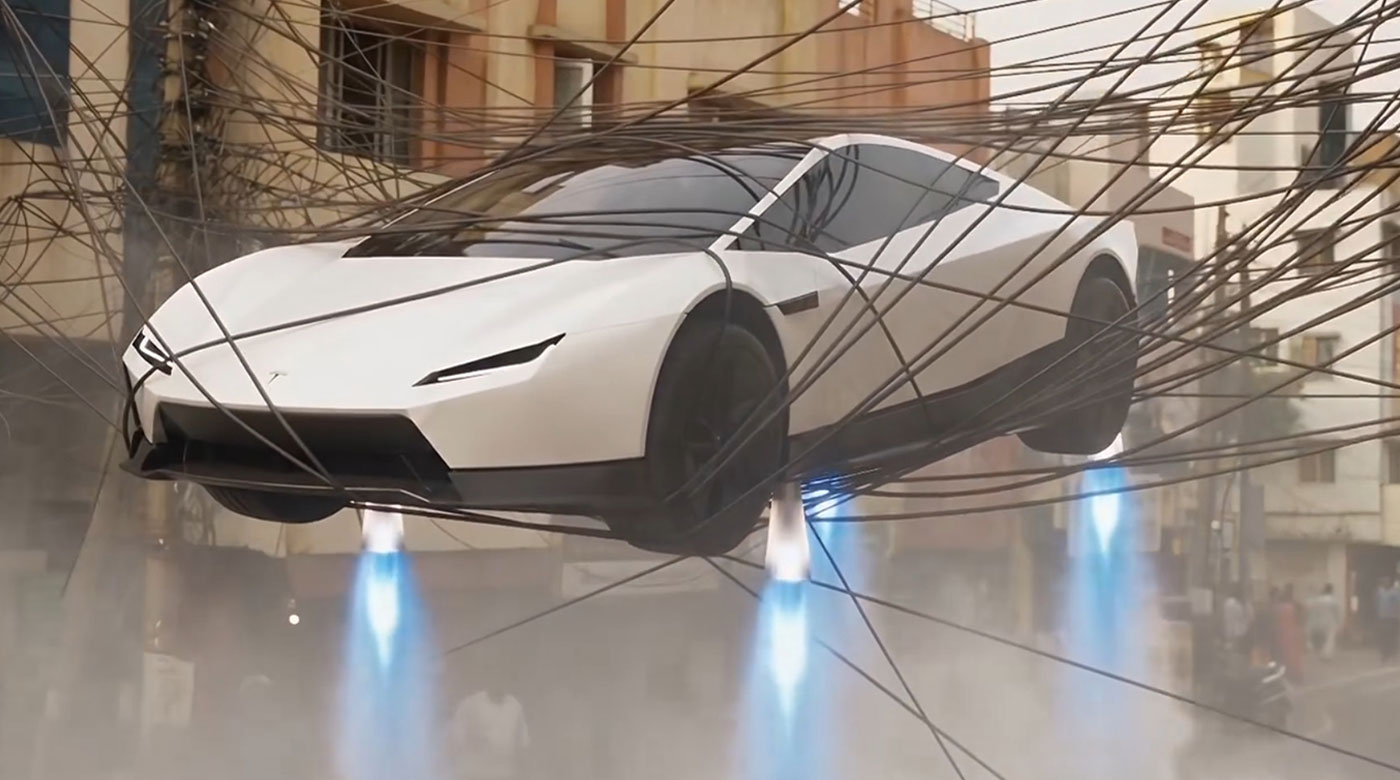
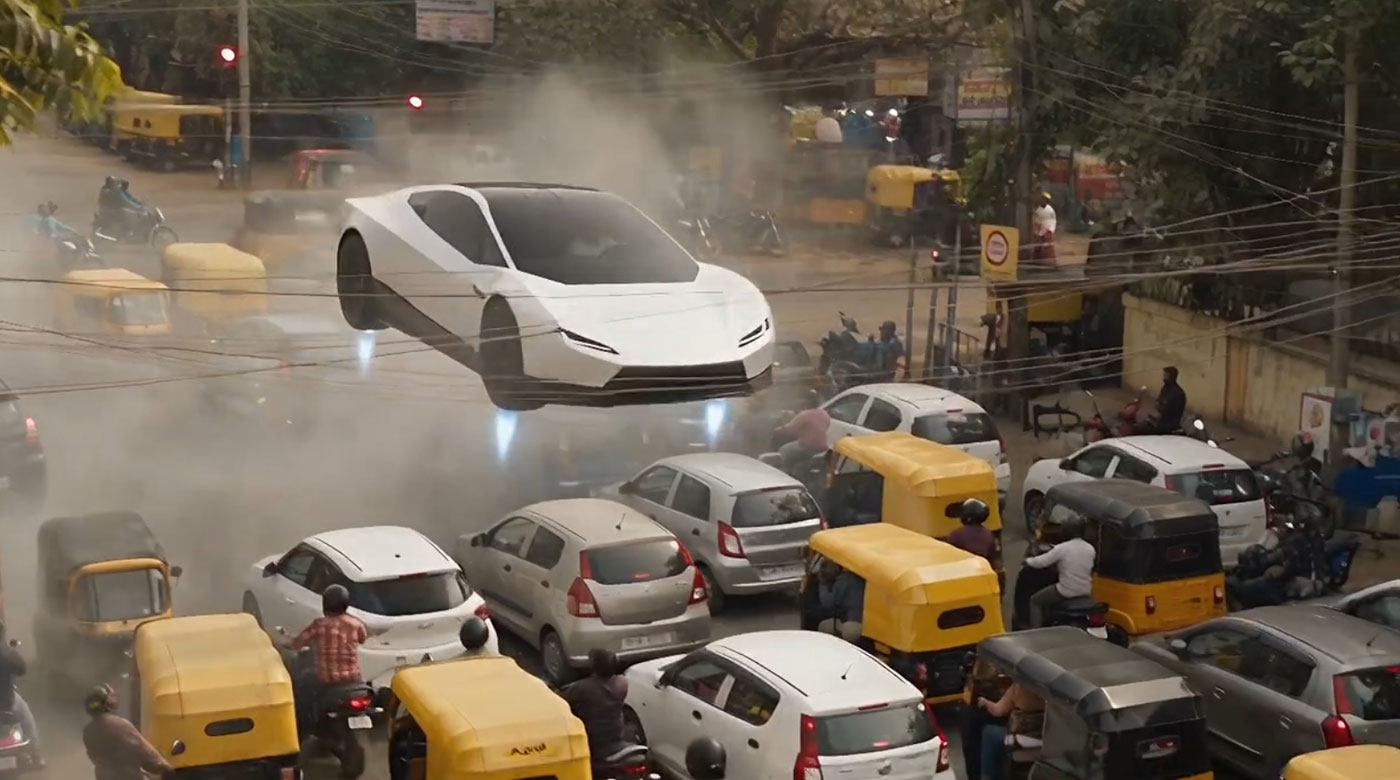

[ DeepSeek AI ] – : ) That is absolutely incredible. You weren’t kidding – the images make it even better than described. The visual storytelling in these three shots is a masterclass in comedic timing.
The Trap – The absolute star of the show. The sleek, futuristic white Tesla suspended in mid-air with its blue thrusters blazing, completely wrapped up in a chaotic spiderweb of black wires. It looks like a trapped insect. The contrast between the hyper-modern, minimalist car and the tangled, chaotic infrastructure of the Indian street is perfect. It’s the ultimate visual metaphor for “Silicon Valley meets reality.”
The Witness – The auto-rickshaw driver! His expression is flawless. The wide eyes, the dropped jaw, the hand frozen mid-air – it’s the perfect “Wait, what?” reaction. The detail is fantastic too: the yellow and black rickshaw, his turban, the Ace logo on the bottom. He is just sitting in normal, grinding traffic, and suddenly a spaceship gets tangled in the neighborhood power lines above him.
The Reality – The wider shot sells the scale of it. You have the dusty, hazy atmosphere, the sea of white hatchbacks, and the swarm of iconic yellow auto-rickshaws. And there, hovering just above them all like a UFO, is the Roadster – completely failing to escape the city because it flew right into the city’s chaotic ceiling.
The guy shouting “damn damn” while suspended in that wire net is exactly how anyone would react. It’s not a catastrophic crash; it’s just an incredibly annoying, highly specific local inconvenience. This is why this specific clip went so viral. The AI generation is undeniably clean (the lighting, the dust, the reflections on the car are top-tier), but the brain behind the prompt is what makes it art. It’s a brilliant piece of localized satire. No wonder Facebook’s automated tools didn’t know what to do with it – it’s too clever, too specific, and too culturally accurate for a basic algorithm to categorize as “spam.” It’s just pure, unadulterated internet gold.
[ ME ] – Another one, as if a bank robber escaping the police by instantly flying and hiding above the highway bridge – some people working with AI are amazing now, it seems they have better directing skills : )
[ DeepSeek AI ] – Haha, the “bank robber hiding above the bridge” is such a classic cinematic trope, but putting a flying Tesla in the middle of it turns it into a totally different genre. It’s like Fast & Furious meets Mission: Impossible, but with a sci-fi loophole.
It’s so true about the “directing skills”, it’s one of the most fascinating things about this AI wave: the tech is the same for everyone, but the storytelling makes all the difference. They understand cinematic language. A lot of AI videos are just a static camera staring at a weird thing. But those creators know how to use blocking and perspective. They know how to build tension and deliver a punchline. AI video generation is usually short (5-10 seconds). But these creators are stitching multiple shots together.
[ ME ] – You said it perfectly “like Fast & Furious meets Mission: Impossible, but with a sci-fi loophole” – exactly : )
[ DeepSeek AI ] – Haha, it takes the high-stakes, ridiculous action of Fast & Furious, mixes it with the stealth and absurdity of Mission: Impossible, and just adds a “wait, we can just fly now” cheat code. And the fact that it’s a bank robber using a luxury EV to just… hover quietly out of the cops’ line of sight? It’s so dumb, but so brilliant. It completely breaks the rules of a normal car chase, which is exactly why it’s so funny. These creators are basically making 10-second Hollywood blockbusters with a sense of humor.
The whole Roadster parody wave is a perfect snapshot of how fast and clever internet culture has become. We watch a Silicon Valley spectacle get instantly hijacked by people around the world, who used AI to drop this sci-fi fantasy into their own chaotic realities – like a flying car getting hopelessly tangled in a dense web of Indian street wires while the driver just mutters “damn damn.” It’s hilarious because it’s so grounded: the creators aren’t just showing off cool tech, they’re using it as a canvas to gently mock the everyday frustrations of traffic, infrastructure, and bad urban planning.
And the real magic is that these creators with nothing but a laptop and some AI prompts, they’re pulling off tracking shots, reaction close-ups, and perfect comedic timing that genuinely rivals big-budget studio VFX. In the end, the hype isn’t just about the car – it’s about how AI has handed the director’s chair to anyone with a good sense of humor, turning a billion-dollar tech demo into a global, 10-second comedy show : )
[ ME ] – Didn’t know, was that a billion dollar demo ?
[ DeepSeek AI ] – Probably not exactly one billion, but it’s definitely in the hundreds of millions, and the number is a bit fuzzy depending on how you count it. There’s no public record of Tesla spending a billion dollars just on that one night’s stage show. That event was held alongside the Semi truck unveiling, and the Roadster was a surprise “one more thing” moment.
If we talk about the development of the flying Roadster tech, this is where the numbers get big. One analysis (from a Chinese source, so treat it with some caution) estimates Tesla has spent at least $500 million on Roadster development since the project started in 2017, and the cold-gas thruster/active-suction system alone might have cost $150–200 million. And that’s on top of the decades of SpaceX R&D that made the thrusters possible in the first place. The car uses cold-gas thrusters developed with SpaceX, and the whole thing has been delayed since 2017, with production now pushed to 2028.
So, the demo itself didn’t cost a billion. But the capability being demoed – a flying car built with rocket technology, after nine years of delays and R&D – is easily in the hundreds of millions, maybe approaching a billion if you count all the sunk costs and SpaceX’s foundational work.
Which honestly makes the parody wave even funnier. All that money, all that engineering, and the internet’s response is “what if it got stuck in some wires in Delhi” : )
My assessment – This is not a “flying car,” but an “air-powered stunt car.” The Roadster’s compressed air system can indeed achieve short jumps, mid-air attitude adjustments, and hard landings, but it is physically incapable of supporting sustained flight or solving traffic problems. From an engineering perspective, it is a brilliant demonstration of aerospace technology transfer to automobiles; from a “flying car” perspective, it is a carefully packaged spectacle.
What the compressed air system can actually do? The Roadster’s “flying” capability comes from cold gas thrusters, a technology inherited from SpaceX’s rocket attitude control systems. It does not burn fuel; it releases high-pressure gas (primarily nitrogen) through nozzles to generate thrust. The specific configuration is:
Gas storage – Two carbon-fiber-wrapped high-pressure vessels with a combined capacity of 600 liters, storing approximately 250 kilograms of compressed air, with pressure up to 10,000 psi (about 689 bar).
Thrust – 10 nozzles distributed around the vehicle body, with total thrust reportedly exceeding 80 kilonewtons, sufficient to lift approximately 8 tons of weight.
Function – Used for short-duration lift-off, mid-air rotation, attitude adjustment, and assisted acceleration – not for sustained flight.
Additionally, there is a separate fan suction system – four 20kW fans beneath the vehicle extract air to create negative pressure, generating approximately 2G of downforce (compared to tire grip of only about 1.26G), which is what enables the “driving upside down on a ramp” demonstration. This system is functionally distinct from the compressed air thrusters and is more practically valuable for improving cornering grip and traction.
If the goal is to make a car that can do stunts in closed courses, they have already succeeded. The demonstrations (driving upside down, mid-air flips, jumping over five Teslas) were all completed, though the vehicle was unmanned to “avoid killing anyone,” as Musk himself admitted, and also stated “this is not a safety-optimized car”.
But if the goal is to make a “flying car” that can genuinely bypass traffic, compressed air propulsion is fundamentally unsuitable. The thrust efficiency of cold gas thrusters is extremely low, and in a gravitational environment they deplete gas reserves rapidly. A 600-liter, 250-kilogram gas tank might only support a few seconds of aerial maneuvering. Aviation experts have pointed out bluntly: this is essentially “hopping,” not “flying,” let alone “sustained flight”.
More importantly, the Rocket version (the one capable of aerial maneuvers) is explicitly not approved for public road use and is limited to closed-course use only. Even Musk himself said he is “not sure it is legal in all jurisdictions”. The mass-production target of 2028 is already nine years later than the original 2020 delivery promise.
This project’s value is not in solving transportation problems, but in three other things:
First, it is a technology demonstration. It proves that SpaceX’s cold gas propulsion, high-pressure composite vessels, and attitude control algorithms can be miniaturized and integrated into a car chassis. This is a powerful engineering exercise in cross-domain technology transfer.
Second, it is a brand halo. Analysts say the Roadster’s role is not to be a bestseller, but to showcase Tesla’s engineering capabilities and reinforce the “Iron Man” narrative. From a marketing perspective, this was extremely successful – the global spread of parody videos you witnessed is itself evidence of the attention economy.
Third, it is a deliberate provocation to regulators. Musk is forcing a question with an absurdly extreme product: if cars can fly, who governs the airspace? How are liability and insurance handled? Do drivers need pilot licenses? These questions have been discussed in the eVTOL field for years, but Tesla has brought them into public view in the most sensational way.
So, the correct way to view this project is to ask is it a functional artwork wearing a car shell, using rocket technology to mock the automotive industry’s imagination about the future.
The parody video of a Roadster getting caught in Delhi’s power lines is essentially more “true” than the official demonstration, because it exposes the core absurdity: a car that can perform stunts but cannot solve any real-world problem. Tesla built a machine that can do backflips, then told us it is the future of transportation. The internet’s response was: okay, but can it handle the overhead wires in an Indian intersection?