
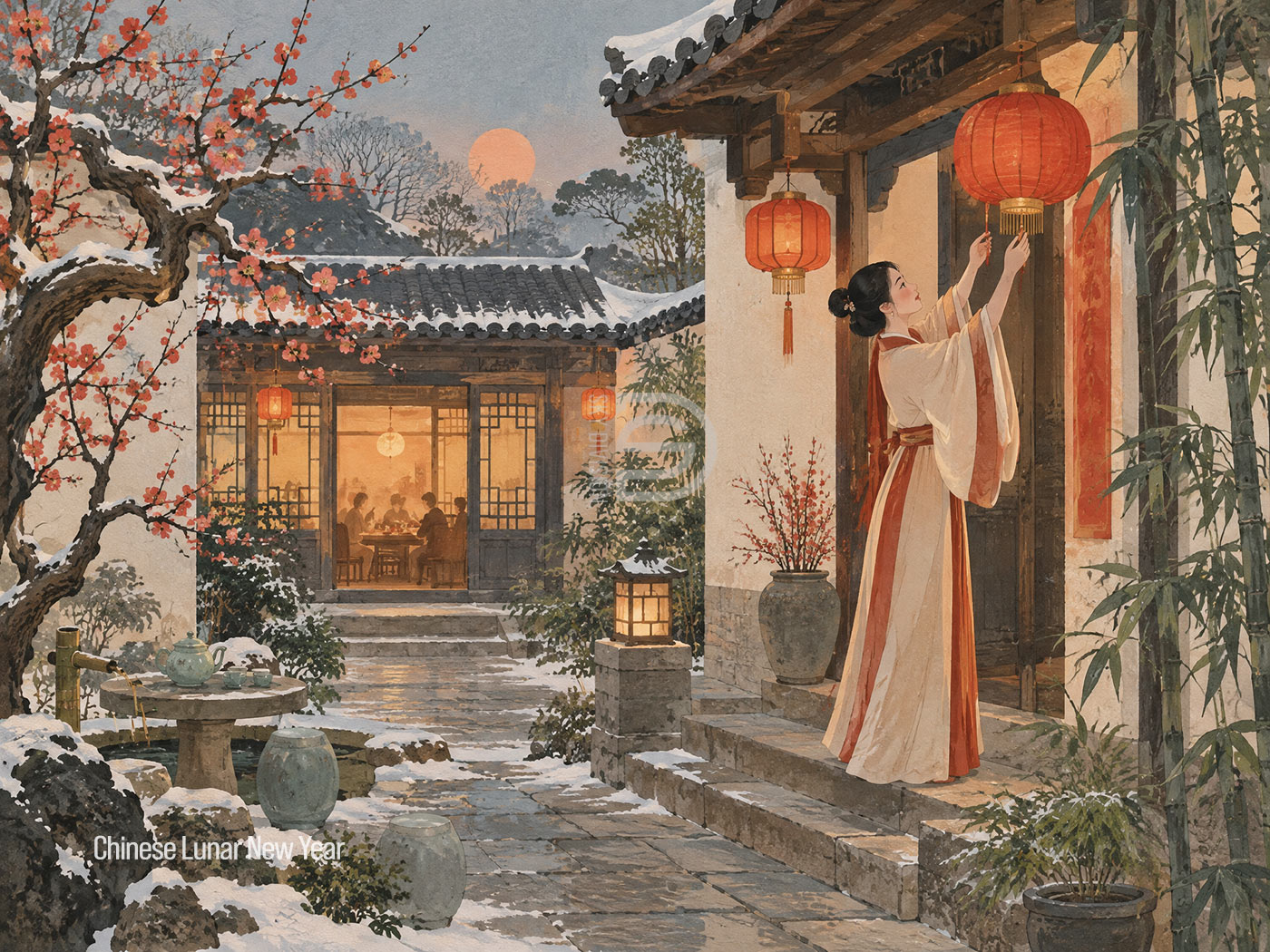
The Most Important Celebration of Family and Renewal – The Chinese Lunar New Year is the most important traditional festival in China. Celebrated on the first day of the first lunar month, the Chinese Lunar New Year (Spring Festival) is the most significant and widely observed holiday in Chinese culture, marking the transition from winter to spring and the beginning of a new zodiac cycle. Rooted in ancient agrarian traditions and legends – most notably the myth of the ferocious beast Nian, which was said to be frightened away by loud noises and the color red – the festival is a profound celebration of family reunion, ancestral reverence, and the renewal of life. It is a time when millions of people travel across the country to return home, embodying the deeply held cultural value of togetherness.
The celebration spans fifteen days, each with its own distinct customs, culminating in the Lantern Festival. Preparations begin weeks in advance with thorough house cleaning to sweep away bad luck, the hanging of red couplets and paper cuttings on doorways, and the preparation of symbolic foods. The New Year’s Eve reunion dinner is the emotional heart of the holiday, featuring dishes whose names and shapes carry auspicious meanings – such as fish for abundance and dumplings for wealth. Other cherished traditions include the giving of red envelopes (hongbao) filled with money to children and elders, setting off firecrackers to ward off evil spirits, and honoring ancestors with offerings. Ultimately, the Chinese Lunar New Year is a powerful cultural anchor that reinforces familial bonds, celebrates shared heritage, and welcomes the future with hope and joy.
|
Traditional Chinese festivals are a cyclical rhythm woven into the fabric of life, intimately connected to the agricultural seasons, ancestral reverence, and the emotional bonds of family and community. Most festivals follow the lunar calendar, and their dates shift within the Gregorian year, yet their core remains unchanged: the Spring Festival celebrates reunion and renewal, Qingming balances mourning with the vitality of spring, the Dragon Boat Festival commemorates loyalty and community, and the Mid-Autumn Festival extols completeness and gratitude.
Beyond these major celebrations, festivals such as the Double Ninth, Winter Solstice, and Xiaonian each carry their own unique rituals and emotional tones, collectively forming a cultural map that spans the entire year. Through food, ritual, and storytelling, these festivals pass down values from generation to generation – respect for ancestors, cherishing of loved ones, awe of nature, and hope for the future. For anyone seeking to understand Chinese culture, festivals are the most vivid and heartfelt entry point. |
|||||||||||||||||||||||||||||||||||||||||||||||||||||||||||||
|
14 festivals arranged in chronological order according to the lunar calendar (with the Winter Solstice noted by its solar calendar timing, as it is a solar term rather than a lunar date). This order follows the traditional Chinese festival cycle from the start of the lunar year through to its end.
Notes: |
|||||||||||||||||||||||||||||||||||||||||||||||||||||||||||||
 Sky Division & Logios'Logios' represents an AI entity, helping with data, stats, knowledge, words, calculations, helping human creator in exploring and developing content. 'Logios' sometimes can be a single AI-platform, or many of them. If a code-script is used somewhere then credits for assistance belong exclusively to DeepSeek AI.
Logios - from the Greek λόγιος (lógios), meaning "learned, eloquent, one who speaks with reason"., 2026 |
|||||||||||||||||||||||||||||||||||||||||||||||||||||||||||||