
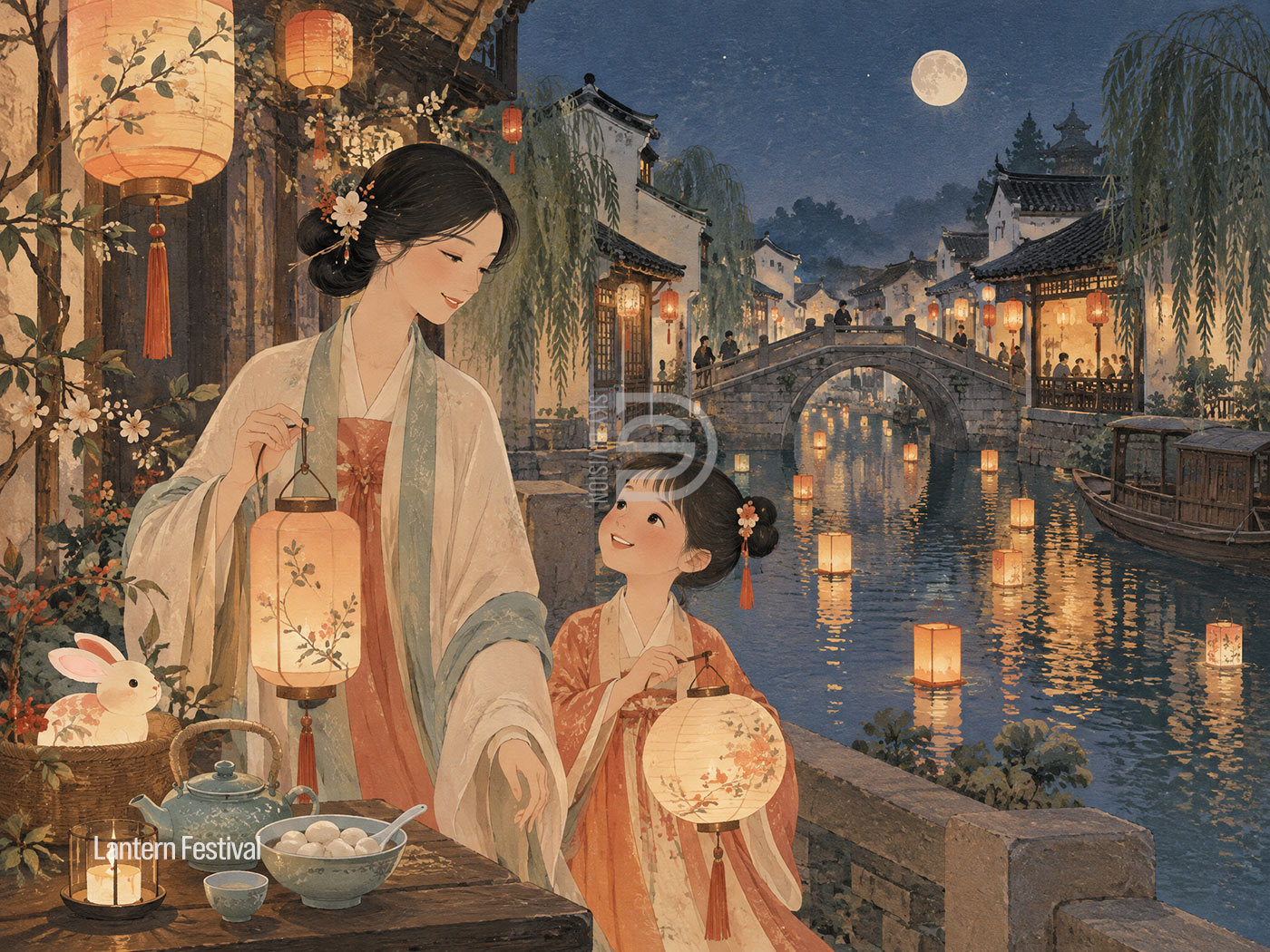
The Grand Finale of the Lunar New Year – Celebrated on the 15th day of the 1st lunar month – the first full moon of the new year – the Lantern Festival (Yuanxiao Jie) marks the official conclusion of the extended Chinese New Year celebrations. With origins dating back over two thousand years to the Han Dynasty, the festival was historically rooted in the worship of the supreme deity Taiyi and the Buddhist practice of lighting lamps to honor the Buddha. Over centuries, it evolved into a vibrant, deeply communal celebration centered on light, unity, and the hopeful energy of the spring season.
The festival is defined by its dazzling array of illuminated lanterns, which are hung in homes, streets, and temples, often featuring intricate designs and riddles written on them for entertainment. A central culinary tradition is the consumption of yuanxiao or tangyuan – sweet, round glutinous rice balls filled with sesame, peanut, or red bean paste, whose spherical shape and sticky texture symbolize family reunion and harmony. Other cherished customs include the lively dragon and lion dances, stilt walking, and the releasing of floating river lanterns to guide spirits and carry wishes for good fortune. Ultimately, the Lantern Festival is a radiant celebration of community, romance, and the collective hope for a bright and prosperous year ahead.
|
Traditional Chinese festivals are a cyclical rhythm woven into the fabric of life, intimately connected to the agricultural seasons, ancestral reverence, and the emotional bonds of family and community. Most festivals follow the lunar calendar, and their dates shift within the Gregorian year, yet their core remains unchanged: the Spring Festival celebrates reunion and renewal, Qingming balances mourning with the vitality of spring, the Dragon Boat Festival commemorates loyalty and community, and the Mid-Autumn Festival extols completeness and gratitude.
Beyond these major celebrations, festivals such as the Double Ninth, Winter Solstice, and Xiaonian each carry their own unique rituals and emotional tones, collectively forming a cultural map that spans the entire year. Through food, ritual, and storytelling, these festivals pass down values from generation to generation – respect for ancestors, cherishing of loved ones, awe of nature, and hope for the future. For anyone seeking to understand Chinese culture, festivals are the most vivid and heartfelt entry point. |
|||||||||||||||||||||||||||||||||||||||||||||||||||||||||||||
|
14 festivals arranged in chronological order according to the lunar calendar (with the Winter Solstice noted by its solar calendar timing, as it is a solar term rather than a lunar date). This order follows the traditional Chinese festival cycle from the start of the lunar year through to its end.
Notes: |
|||||||||||||||||||||||||||||||||||||||||||||||||||||||||||||
 Sky Division & Logios'Logios' represents an AI entity, helping with data, stats, knowledge, words, calculations, helping human creator in exploring and developing content. 'Logios' sometimes can be a single AI-platform, or many of them. If a code-script is used somewhere then credits for assistance belong exclusively to DeepSeek AI.
Logios - from the Greek λόγιος (lógios), meaning "learned, eloquent, one who speaks with reason"., 2026 |
|||||||||||||||||||||||||||||||||||||||||||||||||||||||||||||