
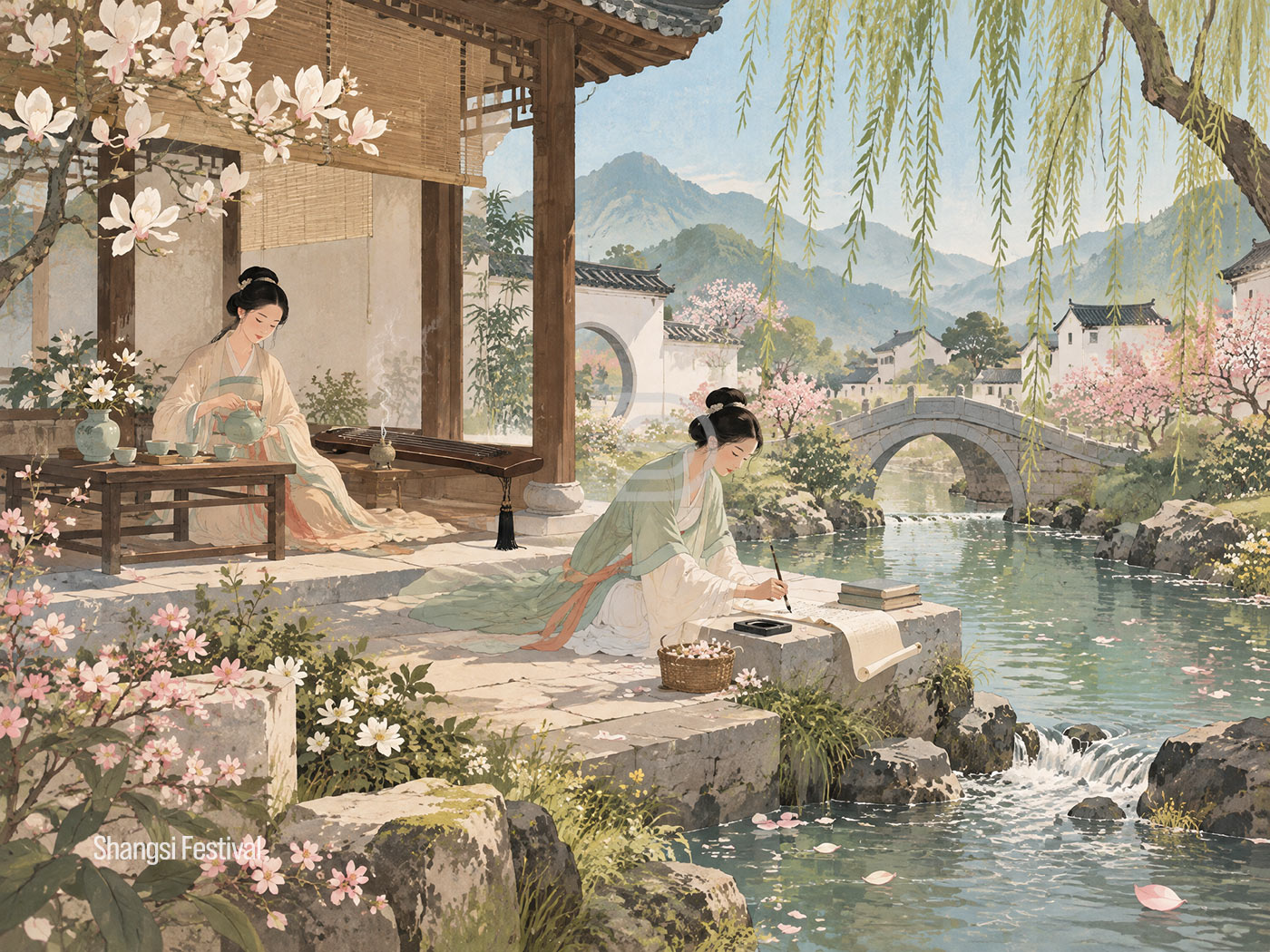
The Ancient Spring Rite of Purification and Renewal – Inspired by the concept of “floating cups along winding streams,” the Shangsi Festival is depicted through scenes of Jiangnan gardens, streams, tea ceremonies, calligraphy, and spring gatherings, showcasing the poetic lifestyle in traditional Chinese culture. Celebrated on the third day of the third lunar month, the Shangsi Festival (also known as the Double Third Festival) is one of China’s most ancient holidays, rooted in rituals of purification and the welcoming of spring. Historically, people would gather by riversides to perform sacrificial ceremonies honoring ancestors, then bathe in herb-infused waters to cleanse away misfortune and disease, a practice described in the ancient Book of Songs. The festival is also traditionally regarded as the possible birthday of the Yellow Emperor, with the saying “San yue san, Xuan Yuan sheng” linking the date to the mythical ancestor of the Chinese people.
Over centuries, the festival evolved into a refined occasion for spring outings and scholarly pursuits, most famously immortalized by calligrapher Wang Xizhi’s Preface to the Poems Composed at the Orchid Pavilion, which describes literati floating wine cups along a winding stream and composing poetry. In modern times, the festival has seen a cultural revival, particularly as a celebration of traditional Hanfu (Chinese national costume) – since 2018, the date has been designated as China Huafu Day. In regions like Guangxi, the same date is celebrated as Sanyuesan, a vibrant ethnic festival featuring antiphonal singing, bamboo pole dances, and five-color glutinous rice, recognized as national intangible cultural heritage. Ultimately, Shangsi embodies a timeless embrace of spring’s vitality, blending ancient cleansing rites with joyous community celebration.
|
Traditional Chinese festivals are a cyclical rhythm woven into the fabric of life, intimately connected to the agricultural seasons, ancestral reverence, and the emotional bonds of family and community. Most festivals follow the lunar calendar, and their dates shift within the Gregorian year, yet their core remains unchanged: the Spring Festival celebrates reunion and renewal, Qingming balances mourning with the vitality of spring, the Dragon Boat Festival commemorates loyalty and community, and the Mid-Autumn Festival extols completeness and gratitude.
Beyond these major celebrations, festivals such as the Double Ninth, Winter Solstice, and Xiaonian each carry their own unique rituals and emotional tones, collectively forming a cultural map that spans the entire year. Through food, ritual, and storytelling, these festivals pass down values from generation to generation – respect for ancestors, cherishing of loved ones, awe of nature, and hope for the future. For anyone seeking to understand Chinese culture, festivals are the most vivid and heartfelt entry point. |
|||||||||||||||||||||||||||||||||||||||||||||||||||||||||||||
|
14 festivals arranged in chronological order according to the lunar calendar (with the Winter Solstice noted by its solar calendar timing, as it is a solar term rather than a lunar date). This order follows the traditional Chinese festival cycle from the start of the lunar year through to its end.
Notes: |
|||||||||||||||||||||||||||||||||||||||||||||||||||||||||||||
 Sky Division & Logios'Logios' represents an AI entity, helping with data, stats, knowledge, words, calculations, helping human creator in exploring and developing content. 'Logios' sometimes can be a single AI-platform, or many of them. If a code-script is used somewhere then credits for assistance belong exclusively to DeepSeek AI.
Logios - from the Greek λόγιος (lógios), meaning "learned, eloquent, one who speaks with reason"., 2026 |
|||||||||||||||||||||||||||||||||||||||||||||||||||||||||||||