
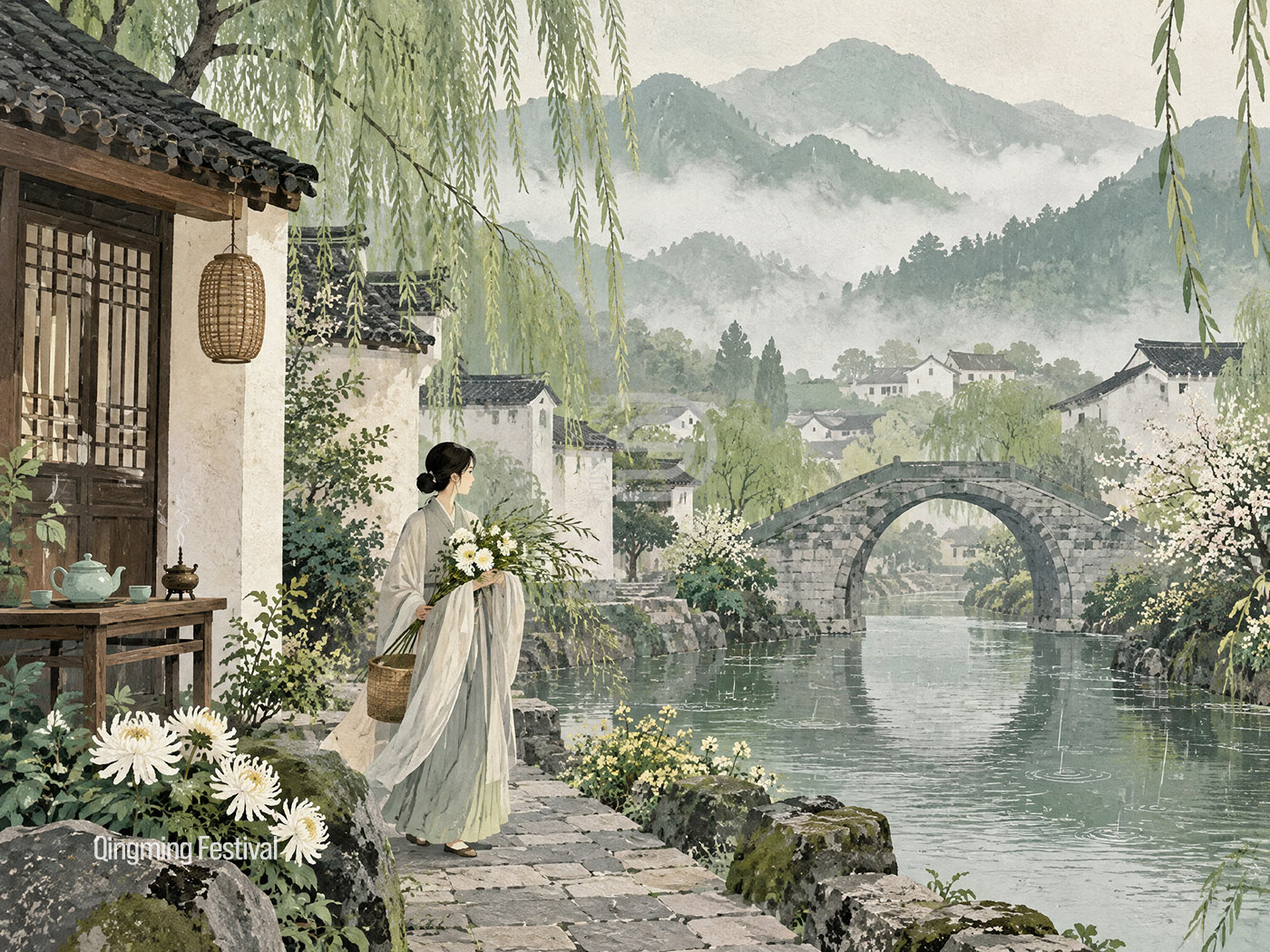
Honoring Ancestors and Embracing Spring – Observed in early April, the Qingming Festival (Tomb-Sweeping Day) is one of the most important traditional Chinese holidays, falling on the 15th day after the Spring Equinox. Its name, meaning “clear and bright,” reflects the season’s transition from the cold, dormant winter to the vibrant, blossoming spring. Rooted in ancient agrarian rituals and later formalized during the Tang Dynasty, the festival is a profound expression of filial piety – the cornerstone of Chinese cultural values – dedicated to remembering and honoring deceased ancestors. The central tradition of the festival is tomb sweeping, when families visit the graves of their ancestors to clean the sites, remove weeds, repaint inscriptions, and offer food, tea, wine, and paper money. It is a solemn yet communal act of respect that reinforces the enduring bond between generations.
Alongside this solemnity, Qingming is also a celebration of life and renewal. Families often take advantage of the spring weather to fly kites (sometimes cutting the strings to release misfortune), enjoy outdoor excursions, and eat traditional foods such as qingtuan – sweet green rice balls made with mugwort juice. Ultimately, the Qingming Festival beautifully balances mourning and joy, reminding people to honor the past while embracing the vitality of the present and the season of new beginnings. Qingming Festival is not only a traditional holiday for paying respects to ancestors but also a significant time in spring for outings and new growth.
|
Traditional Chinese festivals are a cyclical rhythm woven into the fabric of life, intimately connected to the agricultural seasons, ancestral reverence, and the emotional bonds of family and community. Most festivals follow the lunar calendar, and their dates shift within the Gregorian year, yet their core remains unchanged: the Spring Festival celebrates reunion and renewal, Qingming balances mourning with the vitality of spring, the Dragon Boat Festival commemorates loyalty and community, and the Mid-Autumn Festival extols completeness and gratitude.
Beyond these major celebrations, festivals such as the Double Ninth, Winter Solstice, and Xiaonian each carry their own unique rituals and emotional tones, collectively forming a cultural map that spans the entire year. Through food, ritual, and storytelling, these festivals pass down values from generation to generation – respect for ancestors, cherishing of loved ones, awe of nature, and hope for the future. For anyone seeking to understand Chinese culture, festivals are the most vivid and heartfelt entry point. |
|||||||||||||||||||||||||||||||||||||||||||||||||||||||||||||
|
14 festivals arranged in chronological order according to the lunar calendar (with the Winter Solstice noted by its solar calendar timing, as it is a solar term rather than a lunar date). This order follows the traditional Chinese festival cycle from the start of the lunar year through to its end.
Notes: |
|||||||||||||||||||||||||||||||||||||||||||||||||||||||||||||
 Sky Division & Logios'Logios' represents an AI entity, helping with data, stats, knowledge, words, calculations, helping human creator in exploring and developing content. 'Logios' sometimes can be a single AI-platform, or many of them. If a code-script is used somewhere then credits for assistance belong exclusively to DeepSeek AI.
Logios - from the Greek λόγιος (lógios), meaning "learned, eloquent, one who speaks with reason"., 2026 |
|||||||||||||||||||||||||||||||||||||||||||||||||||||||||||||