
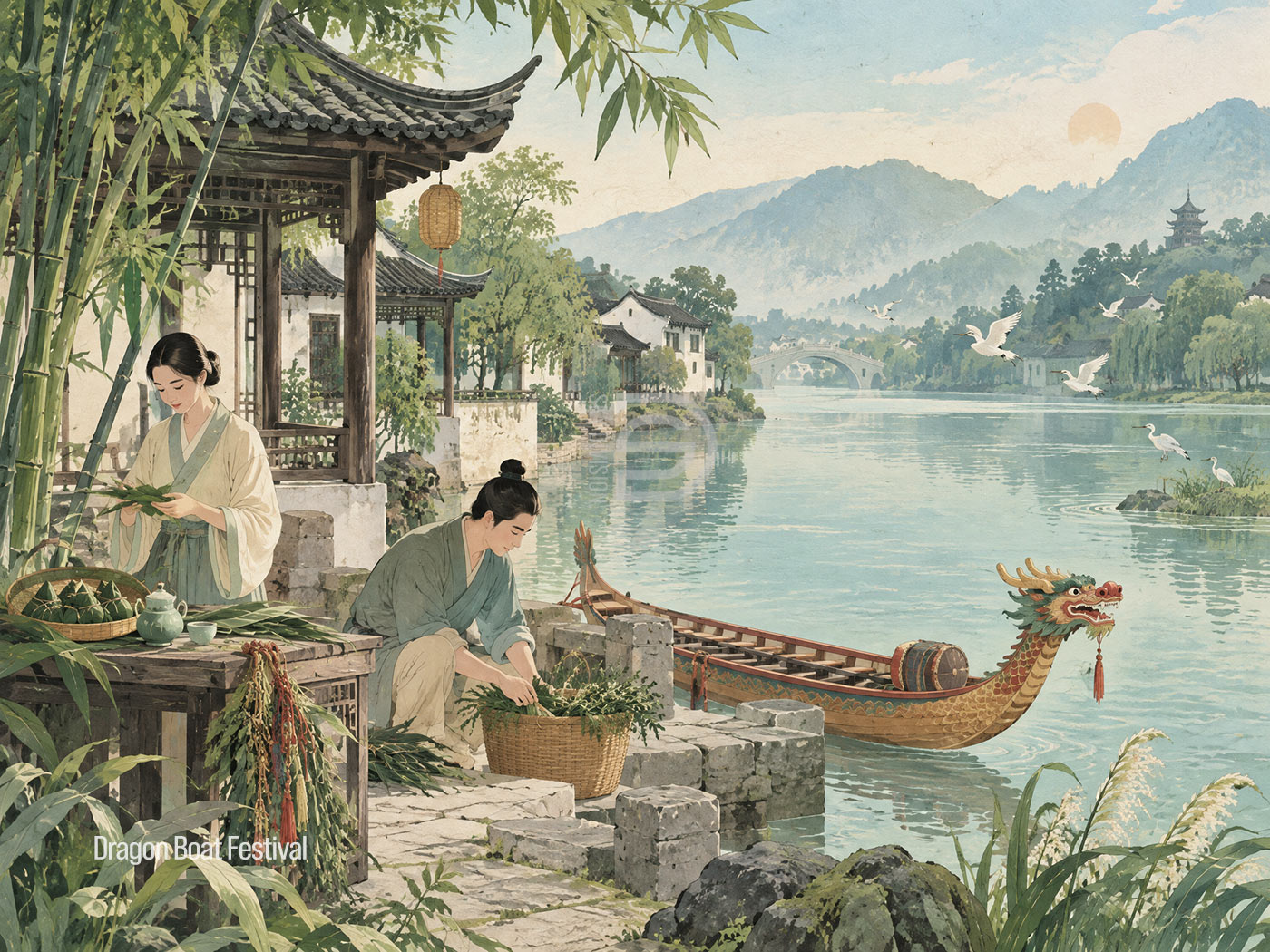
Honoring a Poet and Warding Off Evil – The Dragon Boat Festival is not only a commemoration of Qu Yuan but also carries the cultural meanings of courage, protection, health, unity, and welcoming the height of summer. Celebrated on the 5th day of the 5th lunar month, the Dragon Boat Festival (Duanwu Jie) is one of China’s most ancient and culturally significant holidays, recognized by UNESCO as Intangible Cultural Heritage. Its origins are multifaceted, blending ancient agricultural rituals for warding off disease during the hot summer months with the tragic legend of Qu Yuan, a revered poet and statesman of the Warring States period who drowned himself in the Miluo River in protest against political corruption. The festival is most famous for its thrilling dragon boat races, where teams paddle in unison to the beat of drums, symbolizing the desperate efforts of villagers to rescue Qu Yuan and scare away fish from his body.
Beyond the spectacular races, the festival is deeply associated with the traditional food known as zongzi – pyramid-shaped glutinous rice dumplings wrapped in bamboo leaves, which were originally thrown into the river as offerings to Qu Yuan. The holiday is also rich in customs aimed at protection and purification, such as hanging mugwort and calamus on doorways to ward off evil spirits, wearing colorful fragrant sachets, and drinking realgar wine. These practices reflect the ancient belief that the fifth lunar month is a time of heightened vulnerability to illness and misfortune, making the festival a powerful blend of commemoration, community bonding, and the collective pursuit of health and harmony.
|
Traditional Chinese festivals are a cyclical rhythm woven into the fabric of life, intimately connected to the agricultural seasons, ancestral reverence, and the emotional bonds of family and community. Most festivals follow the lunar calendar, and their dates shift within the Gregorian year, yet their core remains unchanged: the Spring Festival celebrates reunion and renewal, Qingming balances mourning with the vitality of spring, the Dragon Boat Festival commemorates loyalty and community, and the Mid-Autumn Festival extols completeness and gratitude.
Beyond these major celebrations, festivals such as the Double Ninth, Winter Solstice, and Xiaonian each carry their own unique rituals and emotional tones, collectively forming a cultural map that spans the entire year. Through food, ritual, and storytelling, these festivals pass down values from generation to generation – respect for ancestors, cherishing of loved ones, awe of nature, and hope for the future. For anyone seeking to understand Chinese culture, festivals are the most vivid and heartfelt entry point. |
|||||||||||||||||||||||||||||||||||||||||||||||||||||||||||||
|
14 festivals arranged in chronological order according to the lunar calendar (with the Winter Solstice noted by its solar calendar timing, as it is a solar term rather than a lunar date). This order follows the traditional Chinese festival cycle from the start of the lunar year through to its end.
Notes: |
|||||||||||||||||||||||||||||||||||||||||||||||||||||||||||||
 Sky Division & Logios'Logios' represents an AI entity, helping with data, stats, knowledge, words, calculations, helping human creator in exploring and developing content. 'Logios' sometimes can be a single AI-platform, or many of them. If a code-script is used somewhere then credits for assistance belong exclusively to DeepSeek AI.
Logios - from the Greek λόγιος (lógios), meaning "learned, eloquent, one who speaks with reason"., 2026 |
|||||||||||||||||||||||||||||||||||||||||||||||||||||||||||||