
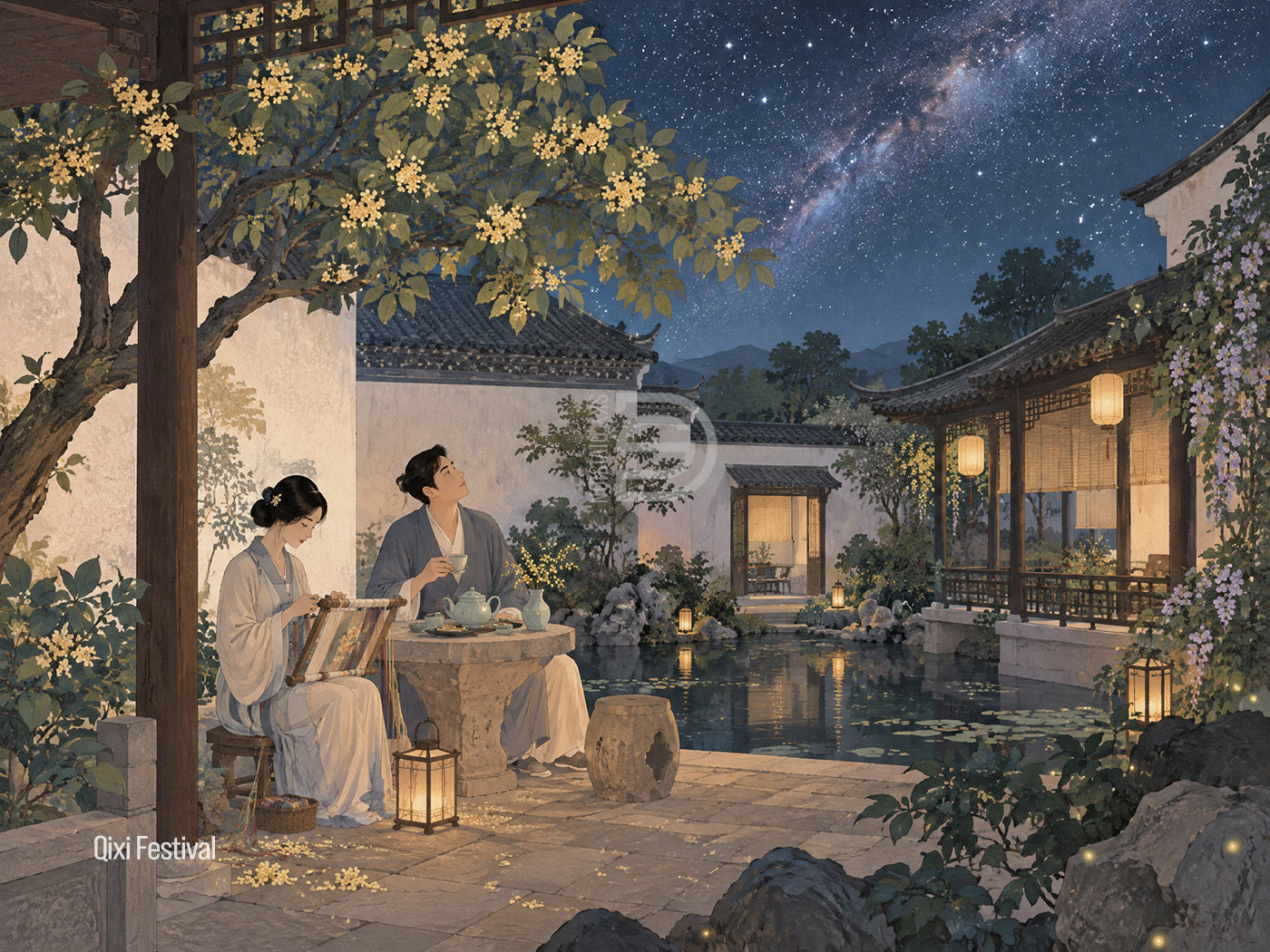
The Chinese Valentine’s Day – The Celebration of Love and Celestial Reunion – Celebrated on the 7th day of the 7th lunar month, the Qixi Festival is often referred to as the Chinese Valentine’s Day, rooted in one of the most enduring and romantic legends of East Asian folklore. The festival commemorates the tragic yet beautiful love story of Zhinü (the Weaver Girl), a celestial maiden, and Niulang (the Cowherd), a mortal man. Separated by the Milky Way as punishment for their forbidden love, the couple is permitted to reunite only once a year on this very night, when a bridge formed by magpies spans the river of stars. This myth has inspired countless poems, operas, and works of art across centuries, making Qixi a profound symbol of enduring love and fidelity.
The Qixi Festival is not only the love legend of the Cowherd and Weaver Girl, but it also symbolizes encounters, companionship, commitment, time, and the starry sky. Historically, the festival was deeply connected to women’s craftsmanship and domestic skills. Young women would pray to the Weaver Girl for wisdom, dexterity in needlework, and a happy marriage, a custom known as qiaoqiao. Traditional observances included threading needles under the moonlight, offering fruits and flowers to the celestial couple, and gazing at the stars to witness the reunion. Today, while many ancient rituals have faded, the festival has evolved into a celebration of romance and devotion, with couples exchanging gifts and expressing their affection. Ultimately, Qixi is a poetic reminder of the power of love to transcend distance, time, and even the vastness of the heavens.
|
Traditional Chinese festivals are a cyclical rhythm woven into the fabric of life, intimately connected to the agricultural seasons, ancestral reverence, and the emotional bonds of family and community. Most festivals follow the lunar calendar, and their dates shift within the Gregorian year, yet their core remains unchanged: the Spring Festival celebrates reunion and renewal, Qingming balances mourning with the vitality of spring, the Dragon Boat Festival commemorates loyalty and community, and the Mid-Autumn Festival extols completeness and gratitude.
Beyond these major celebrations, festivals such as the Double Ninth, Winter Solstice, and Xiaonian each carry their own unique rituals and emotional tones, collectively forming a cultural map that spans the entire year. Through food, ritual, and storytelling, these festivals pass down values from generation to generation – respect for ancestors, cherishing of loved ones, awe of nature, and hope for the future. For anyone seeking to understand Chinese culture, festivals are the most vivid and heartfelt entry point. |
|||||||||||||||||||||||||||||||||||||||||||||||||||||||||||||
|
14 festivals arranged in chronological order according to the lunar calendar (with the Winter Solstice noted by its solar calendar timing, as it is a solar term rather than a lunar date). This order follows the traditional Chinese festival cycle from the start of the lunar year through to its end.
Notes: |
|||||||||||||||||||||||||||||||||||||||||||||||||||||||||||||
 Sky Division & Logios'Logios' represents an AI entity, helping with data, stats, knowledge, words, calculations, helping human creator in exploring and developing content. 'Logios' sometimes can be a single AI-platform, or many of them. If a code-script is used somewhere then credits for assistance belong exclusively to DeepSeek AI.
Logios - from the Greek λόγιος (lógios), meaning "learned, eloquent, one who speaks with reason"., 2026 |
|||||||||||||||||||||||||||||||||||||||||||||||||||||||||||||