
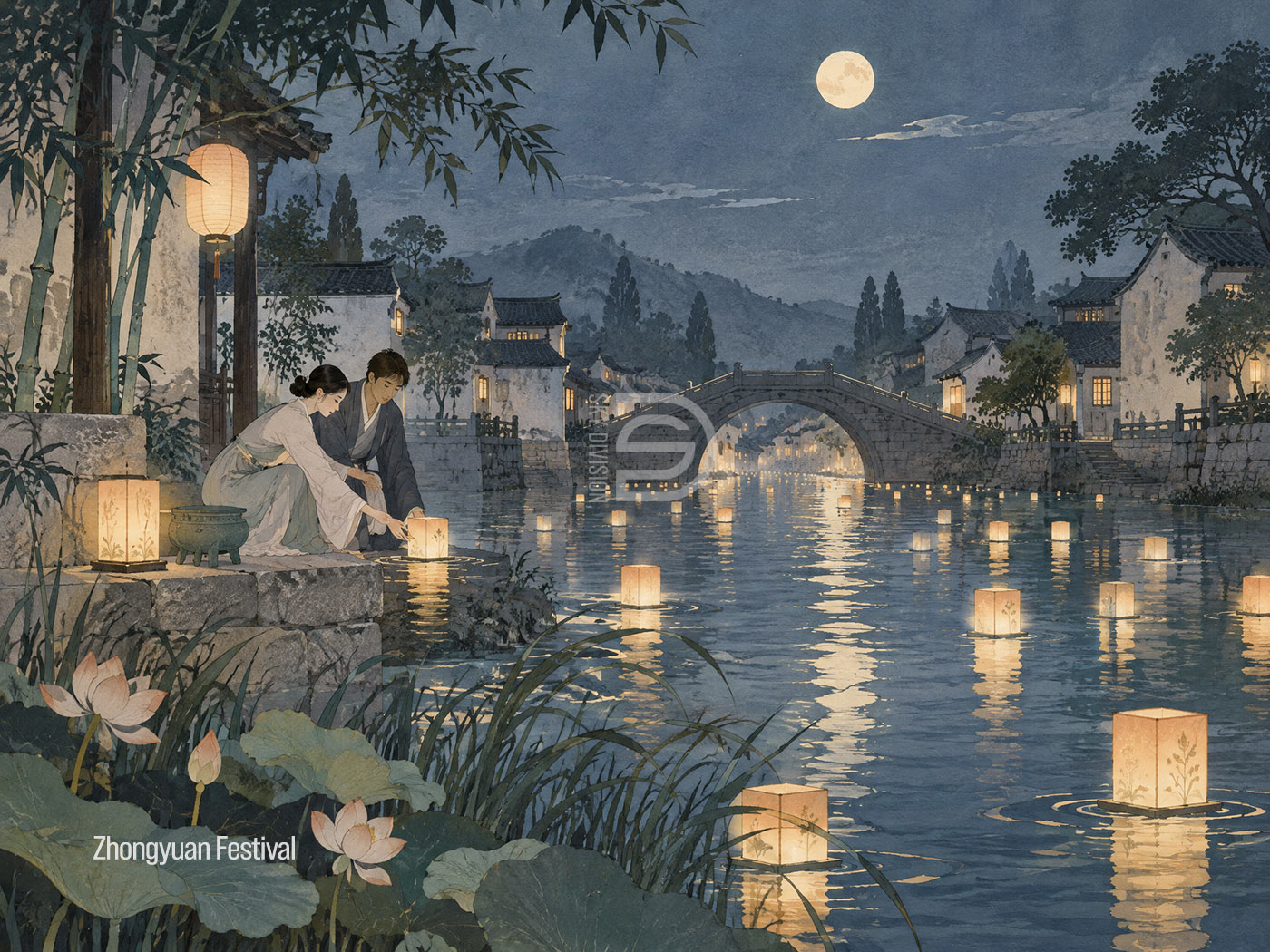
The Festival of Ancestors and Floating Lights – The Day of Ancestral Remembrance and Compassion – Falling on the 15th day of the 7th lunar month, the Zhongyuan Festival – often referred to as the Ghost Festival – is a deeply spiritual and solemn occasion rooted in the traditional East Asian concept of filial piety. According to folk belief, the gates of the afterlife open during this month, allowing spirits to visit the living world. The festival is closely tied to the Buddhist story of Maudgalyayana, who used his supernatural powers to save his mother from suffering in the underworld, giving rise to the tradition of offering prayers and sustenance to the deceased. It is a time when families honor their ancestors, tend to their graves, and extend compassion to wandering spirits who have no one to remember them.
The most iconic and visually striking tradition is the releasing of water lanterns, which are set adrift on rivers and lakes to guide lost or wandering spirits toward the light, helping them find peace or reincarnation. Families also honor their deceased ancestors by burning incense, offering food, and burning paper money and paper effigies as provisions for the afterlife. While the festival carries a somber and mysterious atmosphere, it is ultimately a celebration of charity, forgiveness, and the enduring bond between the living and the dead. It serves as a powerful reminder of the importance of honoring one’s roots, practicing compassion for all beings, and respecting the eternal cycle of life and death. The Zhongyuan Festival is not only a traditional festival of remembrance for ancestors but also reflects respect for life, family, and the cycles of nature in Chinese culture.
|
Traditional Chinese festivals are a cyclical rhythm woven into the fabric of life, intimately connected to the agricultural seasons, ancestral reverence, and the emotional bonds of family and community. Most festivals follow the lunar calendar, and their dates shift within the Gregorian year, yet their core remains unchanged: the Spring Festival celebrates reunion and renewal, Qingming balances mourning with the vitality of spring, the Dragon Boat Festival commemorates loyalty and community, and the Mid-Autumn Festival extols completeness and gratitude.
Beyond these major celebrations, festivals such as the Double Ninth, Winter Solstice, and Xiaonian each carry their own unique rituals and emotional tones, collectively forming a cultural map that spans the entire year. Through food, ritual, and storytelling, these festivals pass down values from generation to generation – respect for ancestors, cherishing of loved ones, awe of nature, and hope for the future. For anyone seeking to understand Chinese culture, festivals are the most vivid and heartfelt entry point. |
|||||||||||||||||||||||||||||||||||||||||||||||||||||||||||||
|
The complete list of all 14 festivals, arranged in chronological order according to the lunar calendar (with the Winter Solstice noted by its solar calendar timing, as it is a solar term rather than a lunar date). This order follows the traditional Chinese festival cycle from the start of the lunar year through to its end.
Notes: |
|||||||||||||||||||||||||||||||||||||||||||||||||||||||||||||
 Sky Division & Logios'Logios' represents an AI entity, helping with data, stats, knowledge, words, calculations, helping human creator in exploring and developing content. 'Logios' sometimes can be a single AI-platform, or many of them. If a code-script is used somewhere then credits for assistance belong exclusively to DeepSeek AI.
Logios - from the Greek λόγιος (lógios), meaning "learned, eloquent, one who speaks with reason"., 2026 |
|||||||||||||||||||||||||||||||||||||||||||||||||||||||||||||