
China – The “Green” Giant (Science Photoessay, 2025 – Breakthrough of the Year)
China’s clean energy infrastructure – Images reveal a transformation of unmatched scale and speed – says “Science”.
Did you know that China produces 70% of global electric cars – China made more than 12 million electric cars in 2024, and exported 1.25 million of them. Trade barriers have prevented Chinese electric cars from entering the US-market, but ie. Han models can travel as far as 700 km on a charge, and cost as little as $25,000 in China.
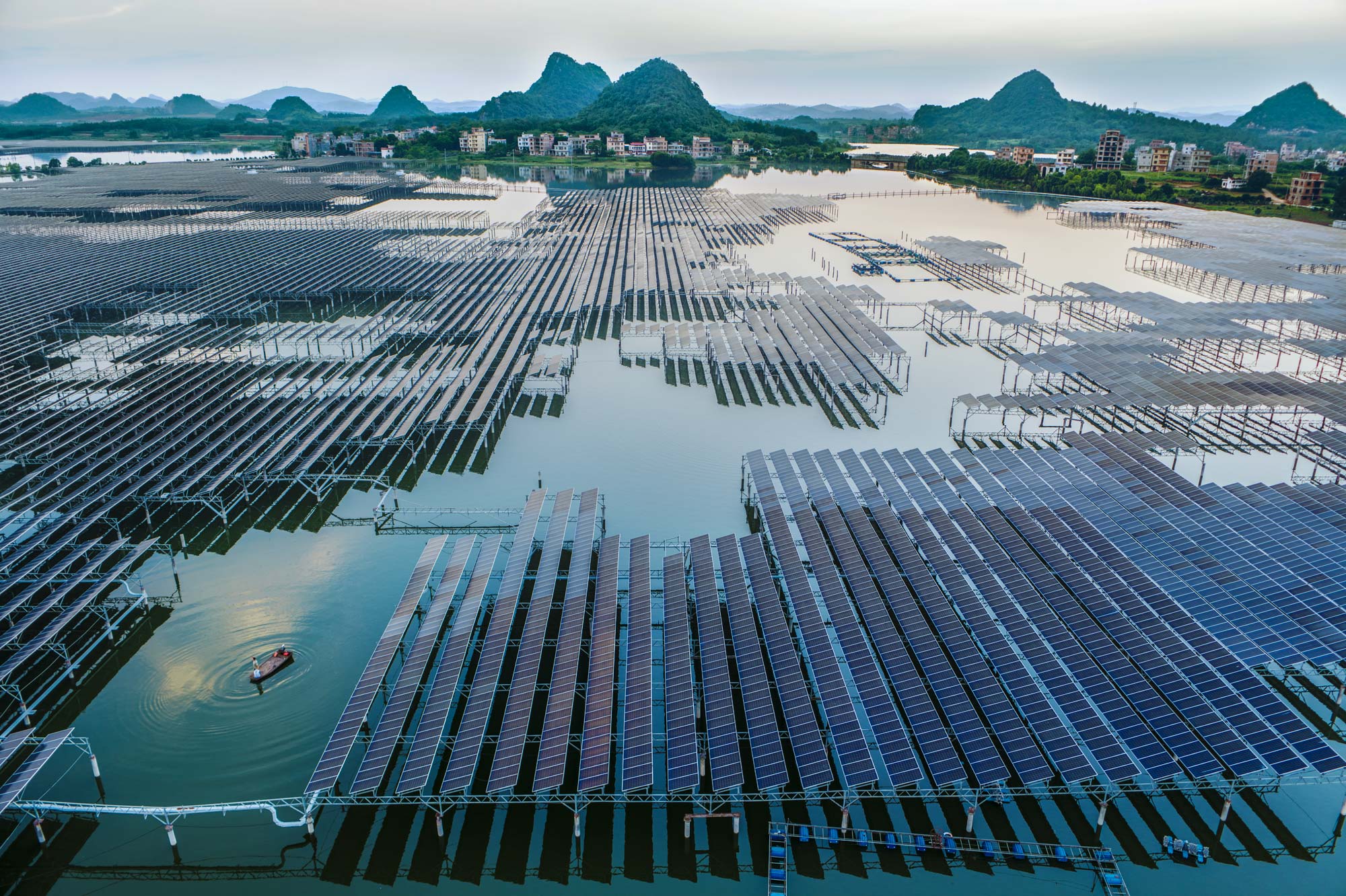
Qianjiadong Reservoir in the southern part of China’s Hunan province produces a double harvest: solar energy and yellow carp. The solar farm produces up to 80 megawatts of power while the fish forage beneath the panels. (Image: George Steinmetz)
***
Good Morning, Sunshine
The seemingly unstoppable growth of renewable energy is Science’s 2025 Breakthrough of the Year
By Tim Appenzeller
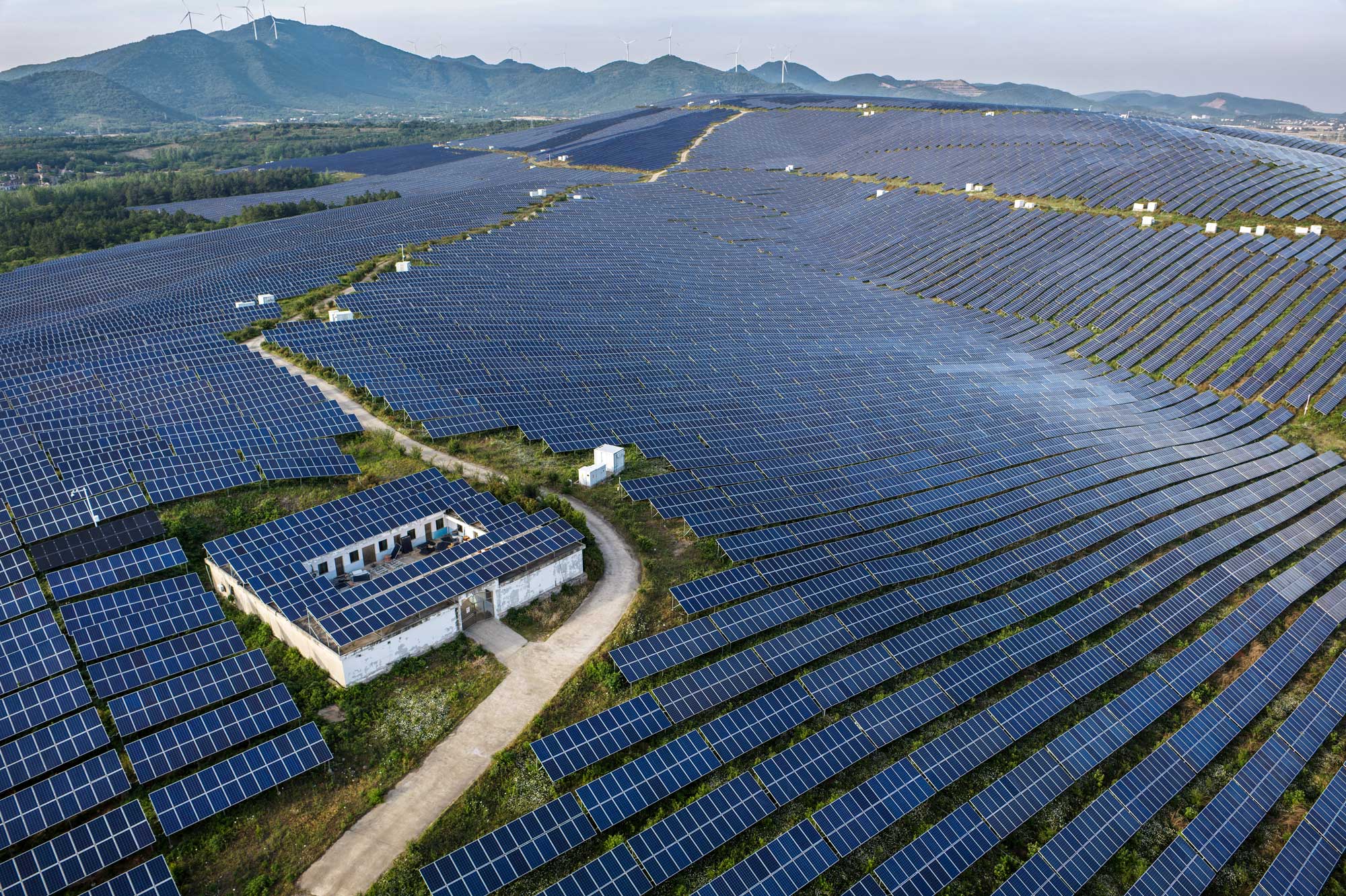
Since the Industrial Revolution, human society has run on ancient solar energy – captured by plants hundreds of millions of years ago, stored in fossil fuels, and dug and drilled from the earth. But this year momentum shifted unmistakably toward the energy that streams from the Sun today. Renewable energy, most of it from sunlight itself or from wind, ultimately driven by the Sun, overtook conventional energy on multiple fronts.
This year, renewables surpassed coal as a source of electricity worldwide, and solar and wind energy grew fast enough to cover the entire increase in global electricity use from January to June, according to energy think tank Ember. In September, Chinese President Xi Jinping declared at the United Nations that his country will cut its carbon emissions by as much as 10% in a decade, not by using less energy, but by doubling down on wind and solar. And solar panel imports in Africa and South Asia have soared, as people in those regions realized rooftop solar can cheaply power lights, cellphones, and fans. To many, the continued growth of renewables now seems unstoppable – a prospect that has led Science to name the renewable energy surge its 2025 Breakthrough of the Year.
That promise comes against a backdrop of downbeat news, highlighted at the U.N. climate meeting in Belém, Brazil, in November. Global carbon emissions continue to creep up as countries fall short of cuts pledged in the 2015 Paris climate agreement. The goal of limiting global warming to 1.5°C – always a long shot – now seems completely out of reach. But Hannah Ritchie, a data scientist at the University of Oxford and a climate blogger, is among those who see hope. Thanks to renewables, the long-awaited decline of fossil fuels is in sight, she says. China is “just, just on the cusp… of actually starting to push out coal”, and fossil fuel use in the rest of the world is likely to follow.
China’s mighty industrial engine is the driver. After years of patiently nurturing the sector through subsidies, China now dominates global production of renewable energy technologies. It makes 80% of the world’s solar cells, 70% of its wind turbines, and 70% of its lithium batteries, at prices no competitor can match. “China really mastered this… with the help of the scale of its economy, its manufacturing capacity, and the fierce competition right at home”, says Li Shuo, director of the China Climate Hub at the Asia Society Policy Institute.
As production surged, prices fell and demand took off. Production scaled up to keep pace, further driving down prices and igniting more demand. The result was a virtuous circle in which renewable technologies grew into an industry that now accounts for more than 10% of China’s economy. Wind and solar became the cheapest energy in much of the world.
The tsunami of tech spilling from China’s factories has changed the country’s energy landscape – and its physical one, too. For decades China’s development was synonymous with coal, which produced choking air pollution and massive carbon emissions, still greater than those of all other developed nations combined. Now, solar panels carpet deserts and the high, sunstruck plateau of Tibet, and wind turbines up to 300 meters tall guard coastlines and hilltops (see photo essay, below). China’s solar power generation grew more than 20-fold over the past decade, and its solar and wind farms now have enough capacity to power the entire United States.
China’s burgeoning exports of green tech are transforming the rest of the world, too. Europe is a longtime customer, but countries in the Global South are also rushing to buy China’s solar panels, batteries, and wind turbines, spurred by market forces and a desire for energy independence. In Pakistan, for example, imports of Chinese solar panels grew fivefold from 2022 to ’24 as the Ukraine war pushed up natural gas prices and the cost of grid power. “For people who were asking, ‘How am I going to keep the lights on in my home,’ it was a very obvious choice”, says Lauri Myllyvirta, an analyst at the Centre for Research on Energy and Clean Air. In South Africa, old and unreliable coal plants drove a similar dynamic. Ethiopia has embraced solar and wind amid worries that hydropower, the country’s mainstay, will decline as droughts become more frequent.
Aiming High
Falling prices have propelled a surge in solar and wind energy that far outstrips the growth of any other source. This chart shows installed capacity, a comparison that favors solar and wind, which can produce at full power only a few hours a day, unlike fossil and nuclear. But renewable sources together generated more electricity this year than coal.
So far, this is not a story of new technology. China is “more or less relying on the same core [solar] technology that the United States invented half a century ago”, Li says. In those days the U.S. made boutique panels for spacecraft; now, China makes them for the world – better, vastly cheaper, and in staggering quantities.
Technological progress could power future gains. Solar cells today are made of crystalline silicon, but another kind of crystal, perovskites, can be layered in tandem with silicon to make cells that gain efficiency by capturing more colors of light. Material advances are enabling wind turbine blades to get longer and harvest more energy, while designs for floating turbines could vastly expand the offshore areas in which they could be deployed. And the giant lithium-ion batteries now used to store energy when sunshine and wind falter could one day give way to other chemistries. Vanadium flow batteries and sodium batteries could be cheaper; zinc-air batteries could hold far more energy.
In the meantime, climate scientists are already seeing benefits from the existing technology. This year renewables helped bring the growth of greenhouse emissions to a virtual standstill in China and put a global carbon peak within reach. But to meaningfully cut emissions, the world needs to treat the thresholds crossed this year as just a starting point.
“It is worrying to me that China continues to build coal”, says Kelly Sims Gallagher, an energy and climate expert at Tufts University. Dozens of new plants were commissioned in the past year, though many sit idle, waiting to be fired up as “peakers” to meet spikes in demand. In the U.S., President Donald Trump’s administration has declared war on wind and solar development, and cheap Chinese solar panels face formidable trade barriers. U.S. coal consumption is rising this year after a long decline.
The infrastructure needed to take full advantage of wind and solar is another hurdle. China is building battery farms to store green power and long-distance transmission lines to get it to cities, but perhaps not fast enough. Air travel and heavy industries won’t be electrified anytime soon.
But if concerns lurk in the future, looking back brings home the astonishing progress renewables have made. In 2004, it took the world a full year to install 1 gigawatt of solar power capacity. Today, twice that amount goes online each day. Back then renewables had an aura of virtue: Buyers paid a premium over fossil energy because of climate concerns. Now, the real driver is self-interest: lower cost and greater energy security.
That change in motivation may be the most important breakthrough of all, ensuring that this year’s inflection points are just the beginning.
Solar panels armor a hillside in China’s Anhui province, parting only for an access road. Distant ridges host wind turbines, another fast-growing component of an energy revolution that has helped ease air pollution and halt the growth of China’s carbon emissions. (Photo: George Steinmetz)
***
The Green Giant
Images of China’s clean energy infrastructure reveal a transformation of unmatched scale and speed
By Tim Appenzeller / Photography by George Steinmetz
China’s turn to green energy dwarfs any other country’s, as a parade of astonishing numbers attests. In 2024 alone it installed new solar and wind generation equivalent to roughly 100 nuclear power plants, and the pace quickened early this year. Dozens of new, ultrahigh-voltage power lines are marching thousands of kilometers from western deserts where much of the solar energy is generated to the eastern cities where it is used. Hungrily awaiting the bounty of clean energy are millions of electric cars and a sprawling network of high-speed electric trains that can zip between cities 1000 kilometers apart in a morning.
China’s landscape reflects this metamorphosis. The vistas of smog, smokestacks, and coal heaps still exist, but glinting silicon panels now cover hills, deserts, and lakes. One solar farm on the Tibetan Plateau spans more than 400 square kilometers, an area more than twice the size of Washington, D.C. Wind turbines grow ever bigger; one meant for use offshore has blades 150 meters long. Arrays of house-size lithium batteries stockpile excess energy, and more is stored in mountaintop reservoirs, pumped full of water when energy is abundant and tapped as needed by allowing the water to cascade through turbines to a lower lake. The factories that produce the solar panels, turbines, batteries, and cars have added new industrial sprawl – but often without the smokestacks because they are electrified.
These days, the containers in China’s busy ports are packed with new wares: electric cars, solar cells, wind turbine blades. In building up its own green energy system, China has also created an export industry worth nearly $180 billion in 2024, putting low-cost renewable energy within reach for much of the rest of the world (see story, above). The revolution these images document is now going global.
Photoessay
Photographer – George Steinmetz is best known for his innovative use of a motorized paraglider for aerial photography in remote locations. For the past 40 years, he has frequently worked on assignments for National Geographic and The New York Times, focusing on environmental issues. His sixth book, Feed the Planet: A Photographic Journey to the World’s Food, is the result of a 10-year project documenting the global food supply. He has a degree in geophysics from Stanford University.
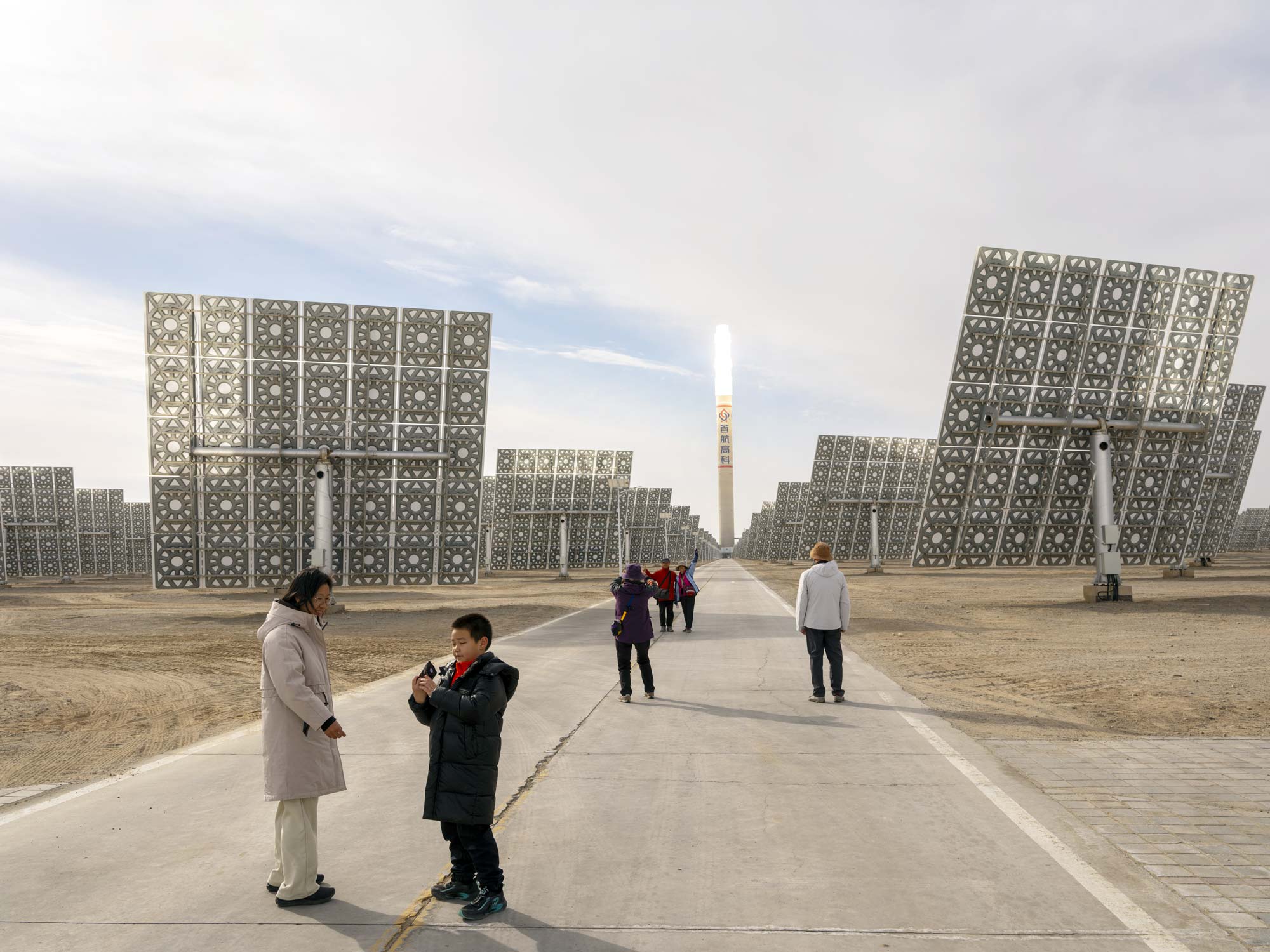
At the focus of the Shouhang Dunhuang plant’s mirrors, a tower set aglow by the concentrated sunshine holds molten salt at 565°C. The salt generates steam that powers a turbine – and because the molten material holds heat through the night, the plant can run nonstop.
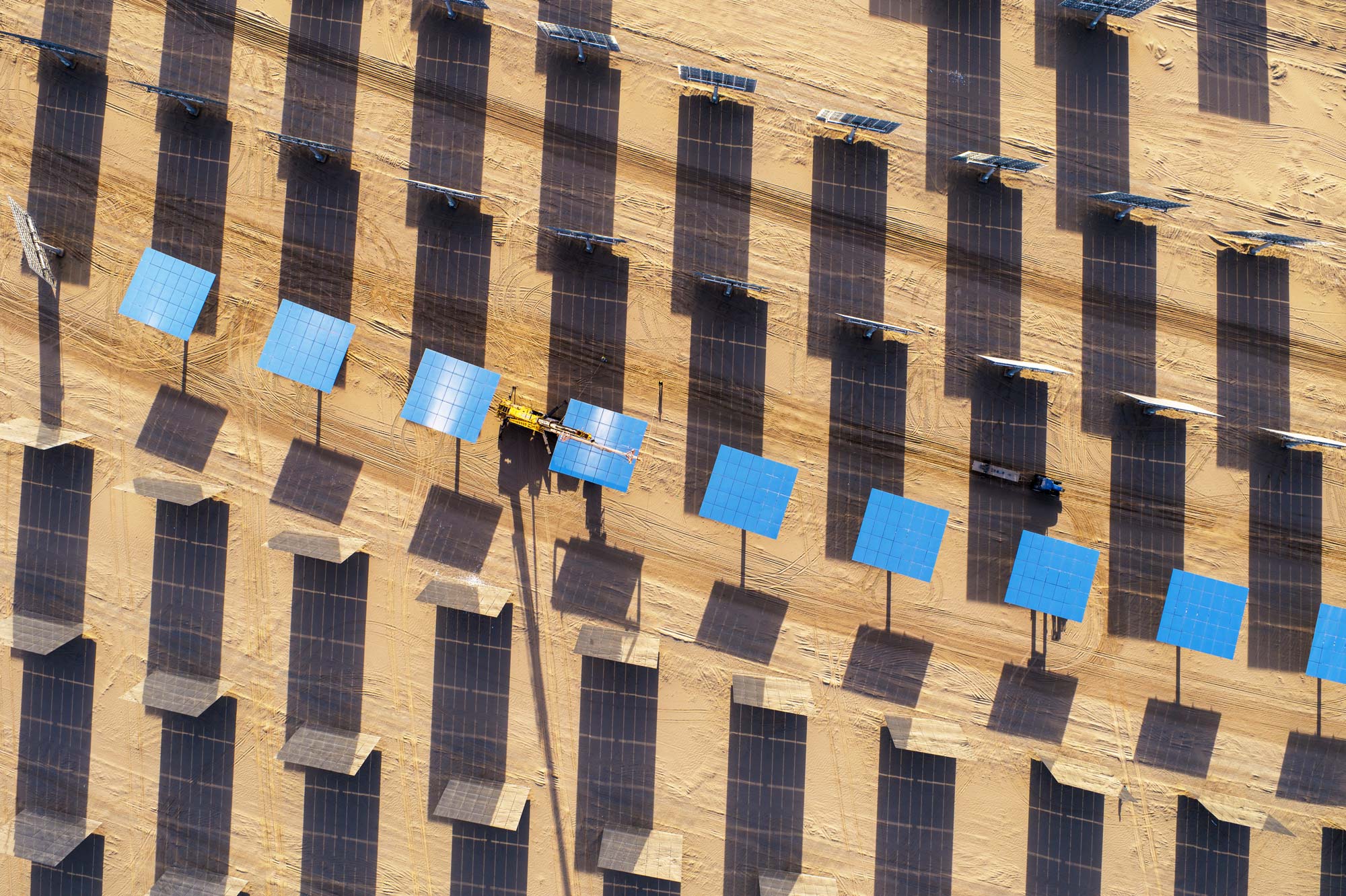
Tipped away from the Sun, a row of mirrors at China’s Shouhang Dunhuang concentrated solar power plant awaits servicing. Unlike solar panels, which generate power on their own, the plant’s 12,000 mirrors reflect sunlight to a central generating station.
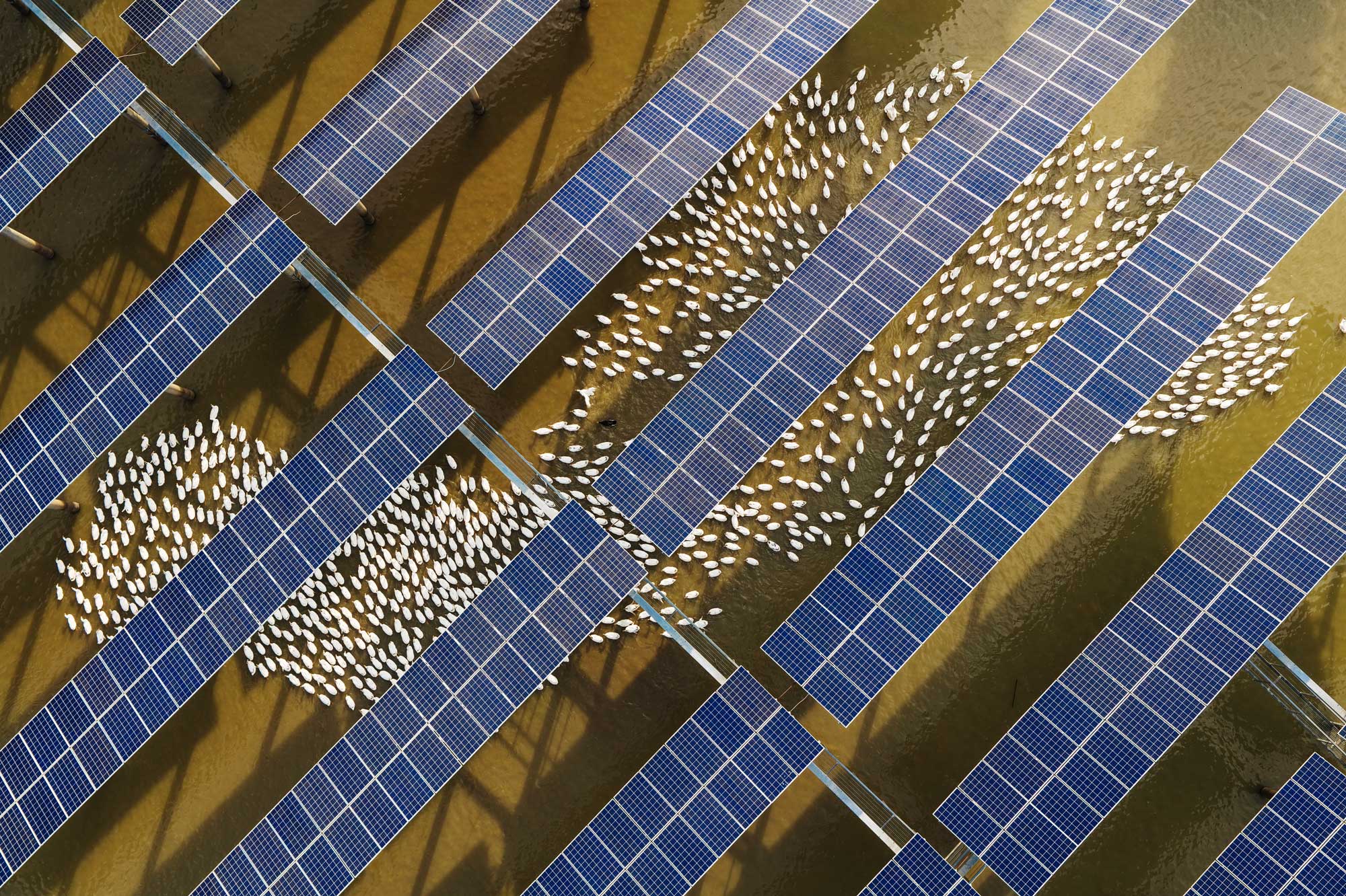
Solar panels erected in a river’s shallows provide shade for geese as well as power for China’s grid. The country’s bounty of solar power has cut electricity costs and driven investments in batteries and other technologies for storing it at night and on cloudy days.
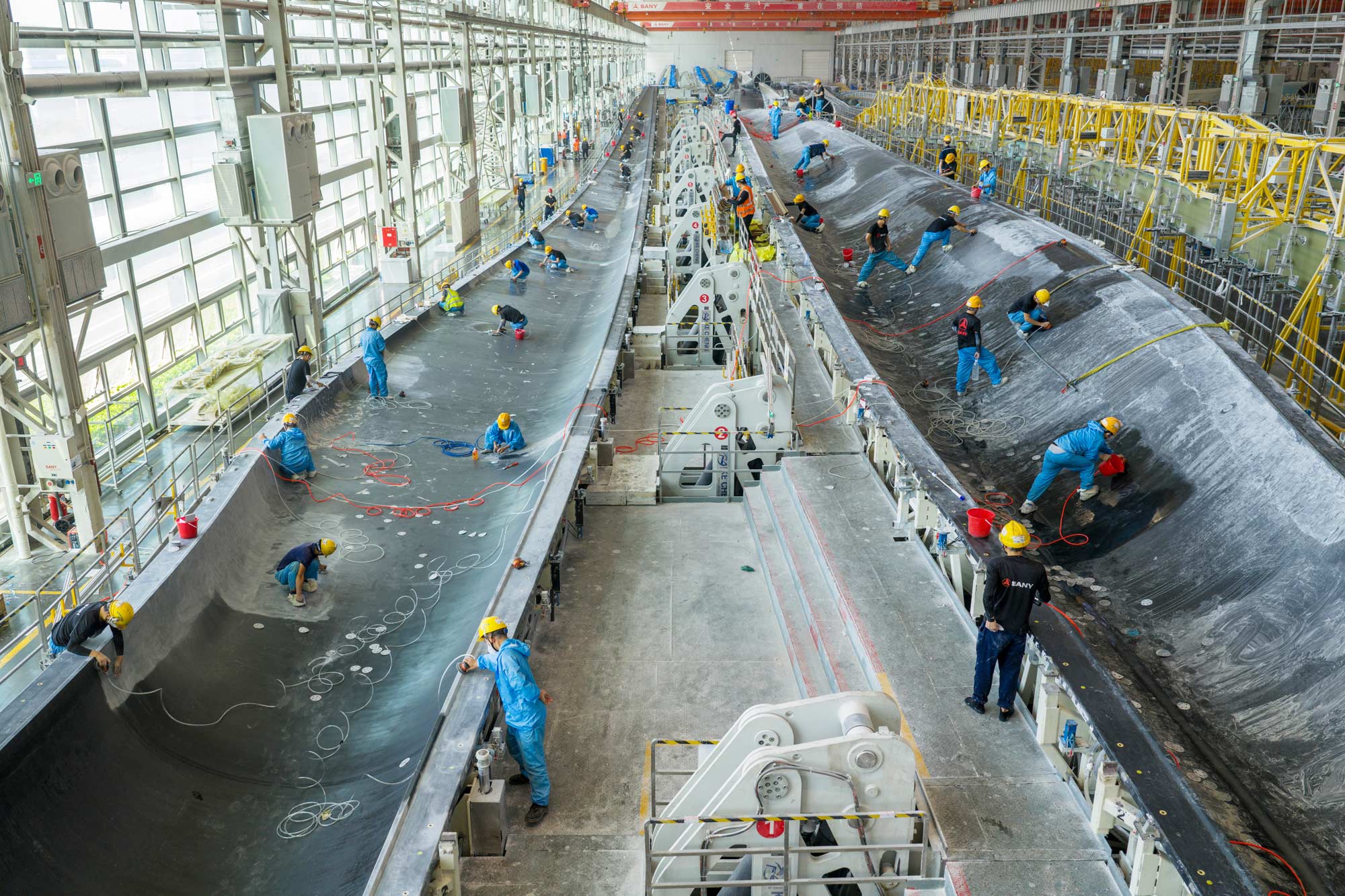
The fiberglass halves of a single wind turbine blade take shape in a SANY factory in Shaoshan, China. Among the longest in the world, the finished blades extend 107 meters – the length of a soccer field. Demand is so high the factory runs 24/7.
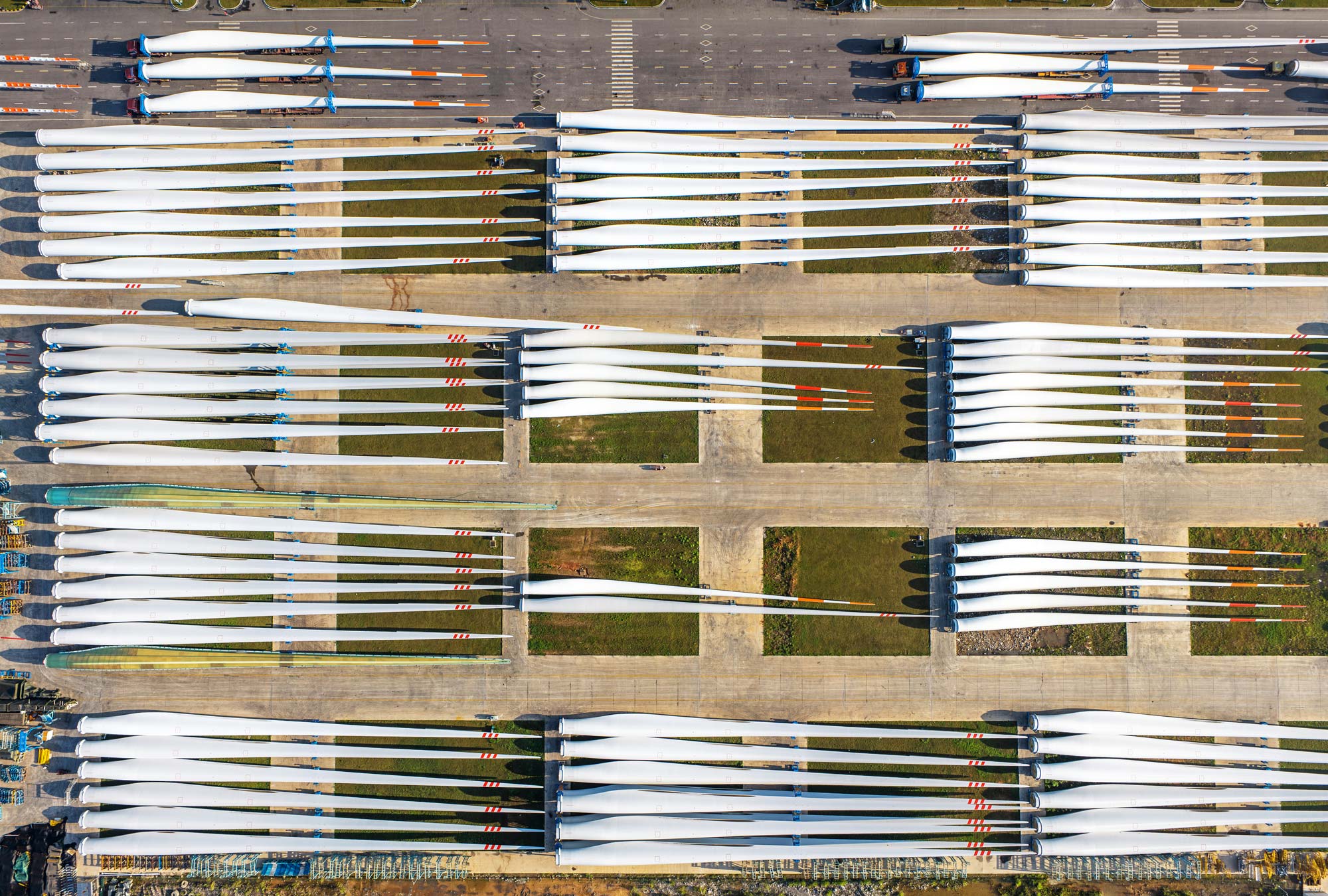
Ready to carve the wind, turbine blades await shipment outside a SANY factory. China produces two-thirds of the world’s wind turbines; most are installed domestically, but international orders are picking up
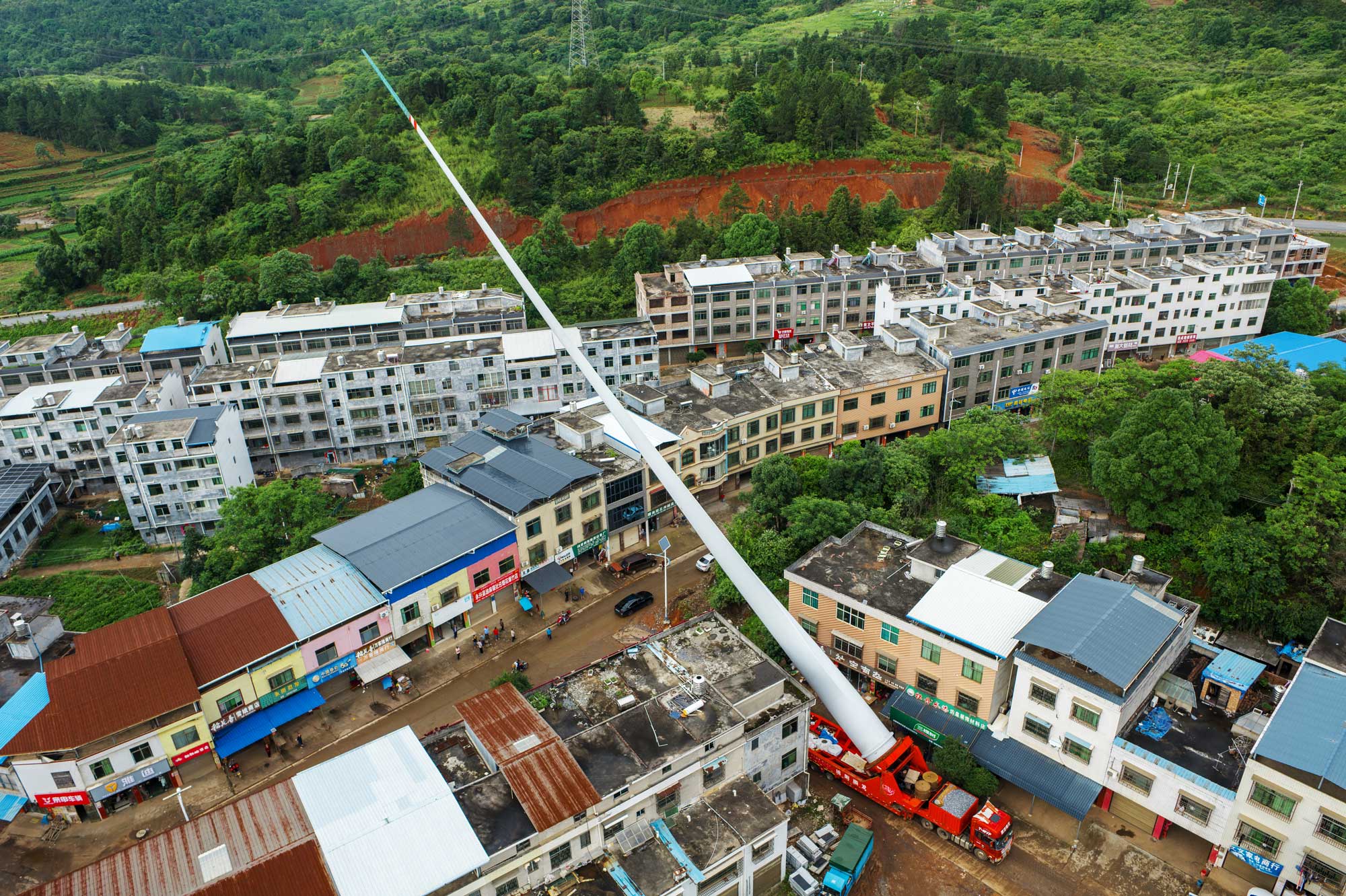
A 90-meter needle threading through town, a turbine blade makes its way to a hilltop in Hunan province. China has installed nearly half of the world’s wind power capacity, and although wind is growing more slowly than solar, it generates more reliable power.
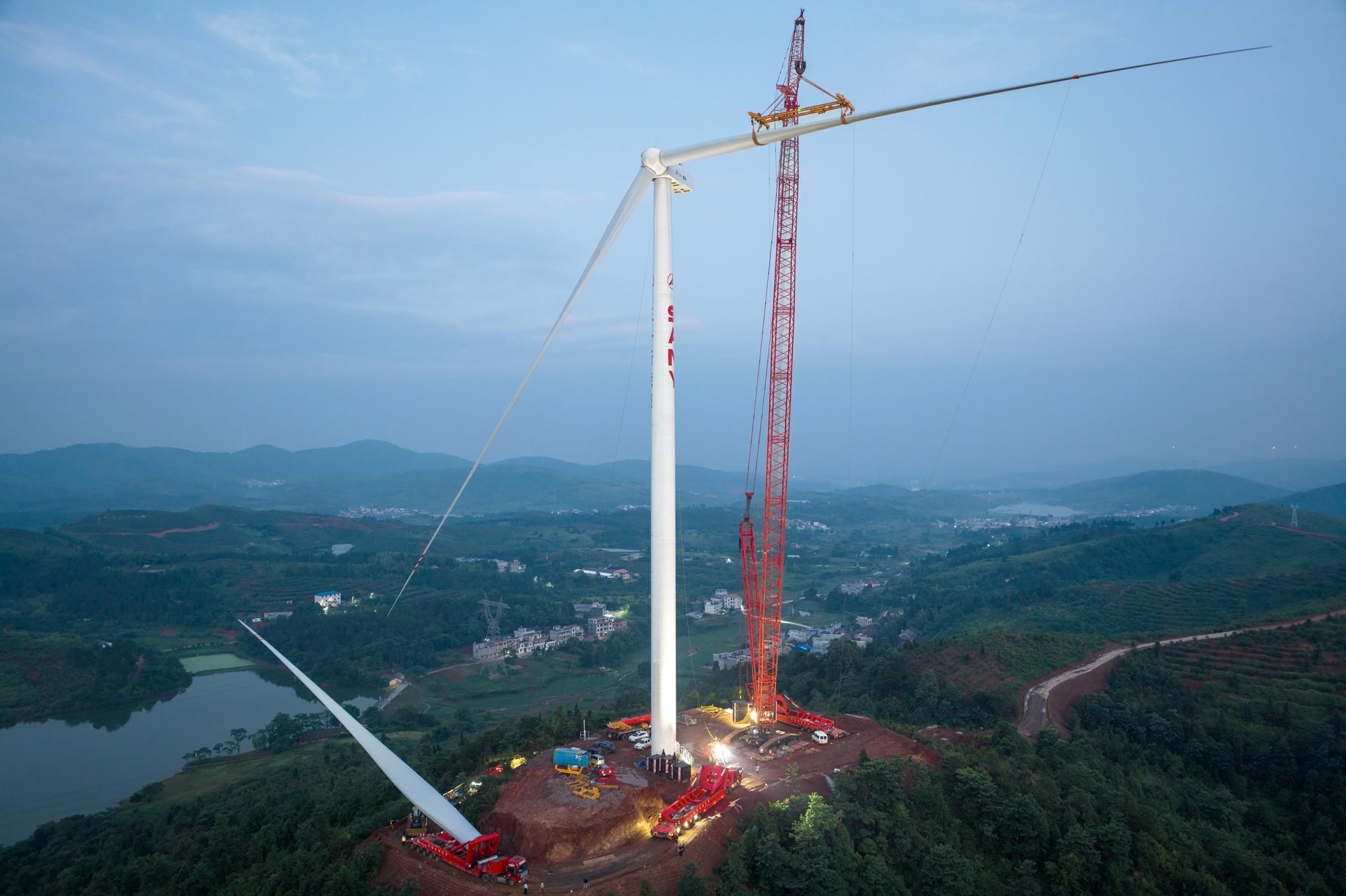
A wind turbine is erected in the hills of Hunan province, part of an 18-tower, 88-megawatt wind farm. China installed roughly 50 gigawatts of new wind power in the first half of this year – amounting to some 10,000 turbines this size.

Idling before sunrise in a Nanjing maintenance yard, electric bullet trains wait to be dispatched along the high-speed tracks that span China. At speeds of up to 350 kilometers per hour, the 1300-kilometer journey from Beijing to Shanghai can take just over 4 hours.
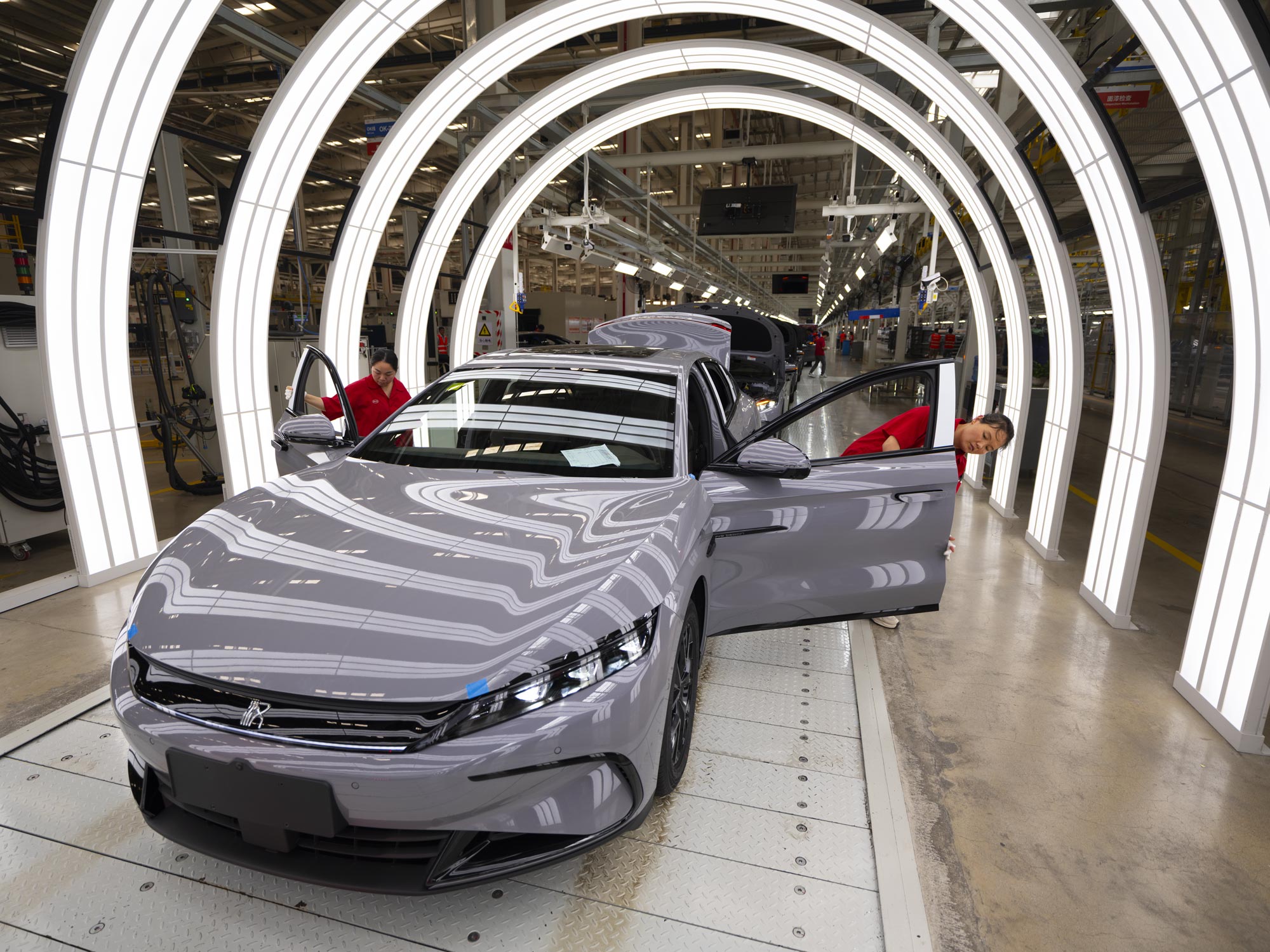
Han electric cars get a final inspection at a BYD factory near Shenzhen, China, which can turn out 300,000 cars a year. Han models can travel as far as 700 kilometers on a charge and cost as little as $25,000 in China. Trade barriers have prevented Chinese electric cars from entering the United States.
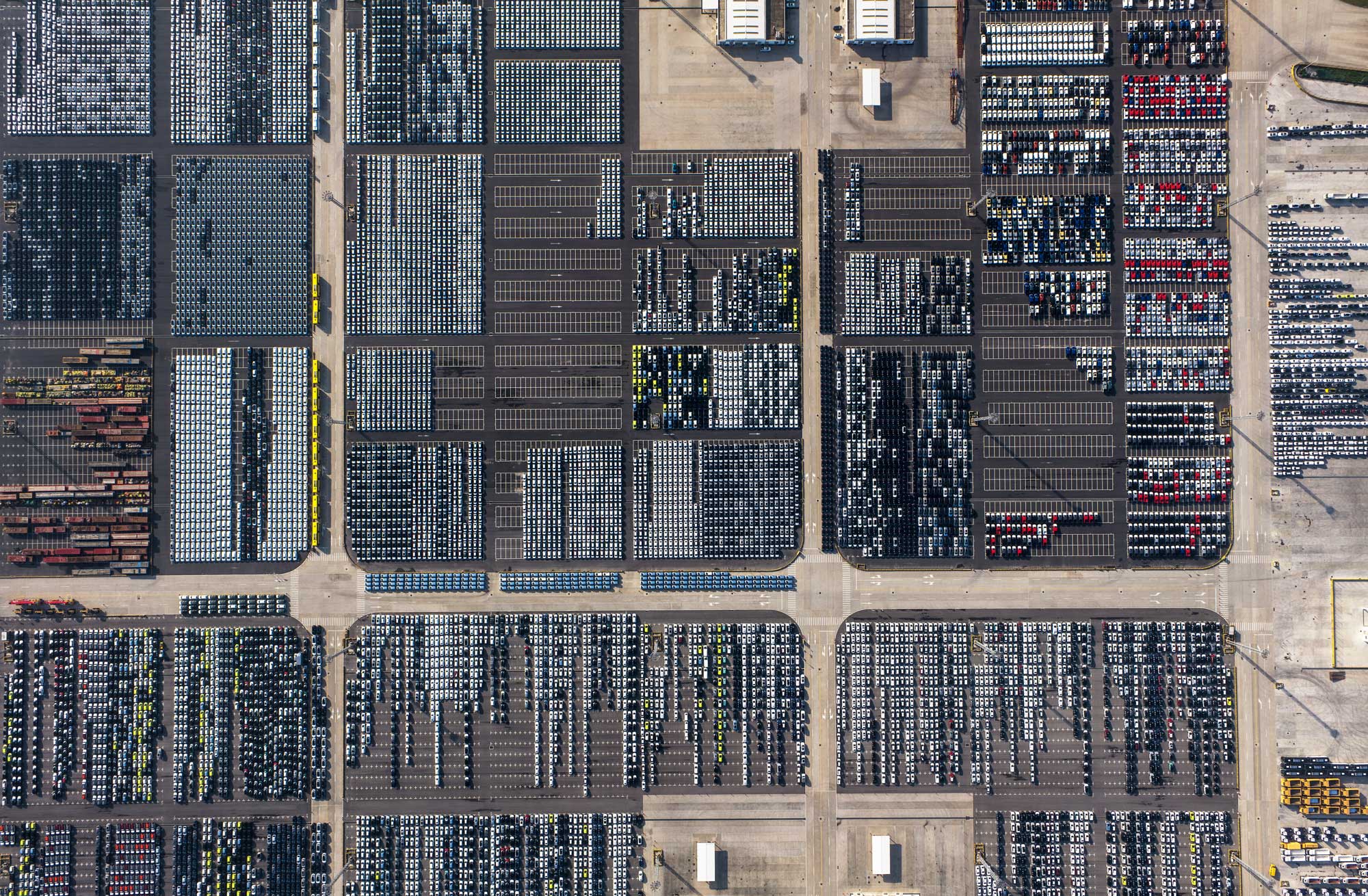
Cars, most of them electric, await export at the port of Taicang, just upriver from Shanghai. China made more than 12 million electric cars in 2024 – 70% of global production – and exported 1.25 million of them.

The emerald waters of Qarhan Salt Lake on the Tibetan Plateau beckon tourists – and hold a bounty of lithium, a critical ingredient in batteries for cars and renewable energy storage. Brines in the 160-kilometer-wide lake yielded more than 50,000 tons of lithium carbonate last year, enough for hundreds of thousands of electric cars.