
Përparimi “11” i Vitit 2025 – Trump si “Faqe-zezan” i Shkencës Amerikane
…vetë “shkenca” konkludon se Trump pandalë e ka shtuar nga “një faqe të zezë” në librin e arritjeve të shkencës amerikane, tashmë as vetë historia s’ka si e “mohon” faktin që të gjitha të “zezat” e prapangeljes shkencore amerikane i takojnë Trumpidentit : )
(foto: national geographic)
…e besueshme apo jo, por si ironi “Science” e ka shpallur “përzierjen e administratës Trump” në çështjet financiare të shkencës amerikane si “Përparim i Vitit 2025”, nga 12 të ashtuquajturat “Breakthrough of the Year”, e para ka t’bëjë me arritjet e Kinës (Numër 1, globalisht, sa u përket tekno-shkencave dhe arritjeve në fushën e “green energy”), sidoqoftë 11 prej tyre vërtet kanë t’bëjnë me arritjet e tekno-shkencave gjatë 2025, mirëpo 1-ra e mban titullin “Trump Roils U.S. Science” (Breakthrough 11)…
…vërtet ironike dhe e dhimbshme, vetë rrafshnalta shkencore e 50 shteteve së bashku e akuzon Presidentin e 50 shteteve federale për “dëmtim” të shkencës më shumë se gjithçka tjetër… sipas “Science” Trump që nga java e parë e inaugurimit si President prore e përherë, pandalë e ka shtuar nga “një faqe të zezë” në librin e arritjeve të shkencës amerikane, duke i shkatërruar normat e dekadave të vjetra, të cilat norma dhe standarde ndihmuan që ShBA të bëhej diç si “superfuqi shkencore” e mbarë globit. Tashmë as vetë historia s’ka si e “mohon” faktin që të gjitha të “zezat” e prapangeljes shkencore amerikane i takojnë Trumpidentit : )
…nuk çuditemi nëse fjalet tona tingëllojnë të “pabesueshme”, por ne flasim me fakte, nuk hyjmë në “hak” të askujt, e sidomos jo në “hak të Trumpidentit”, fjala e pionierit, dmth. më e sinqerta, kurrë… për asnjë kurrnjëherë, madje s’janë as “fjalët” tona (në komentin më lart), janë interpretim shakalogjik i fakteve të “Science” – ja më poshtë të gjitha faktet e arritjeve kulmore gjatë 2025…
(s. guraziu – ars poetica, 12-25)
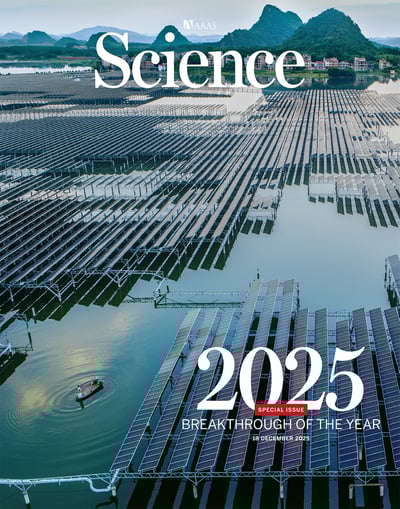 * Science is the peer-reviewed academic journal of the American Association for the Advancement of Science and one of the world’s top academic journals. It was first published in 1880, is currently circulated weekly and has a subscriber base of around 130,000. Because institutional subscriptions and online access serve a larger audience, its estimated readership is over 400,000 people.
Trump Roils U.S. Science President Donald Trump began to rewrite the playbook on how the U.S. government interacts with the research community within minutes of taking office on 20 January. Seemingly every week since then he has added a page, shattering decades-old norms that helped make the United States a scientific superpower. The now-defunct Department of Government Efficiency (DOGE), led by billionaire Elon Musk, played a prominent role in the first few months. It forced the National Institutes of Health (NIH) and the National Science Foundation (NSF) to cancel thousands of existing projects, in particular those deemed to involve diversity, equity, and inclusion; climate change; or gender identity and sexual orientation. Trump also used DOGE to spearhead another prong of the attack: shrinking the size of the federal workforce. Thousands of employees at science agencies were laid off, accepted buyout offers, quit, or retired sooner than planned, resulting in a significant loss of scientific experience. Many of those who remained are managing narrower portfolios after their agency pulled the plug on scores of programs the White House decided – suddenly, and without explanation – were “no longer aligned with the administration’s priorities.” NSF and the Department of Energy’s Office of Science have gone even further, revamping units to correspond more closely to those priorities. Several of Trump’s choices to lead federal science agencies have triggered fierce opposition. Foremost among them is Secretary of Health and Human Services Robert F. Kennedy Jr., a lawyer and longtime antivaccine activist. Kennedy has decimated senior management at NIH, the Food and Drug Administration, and the Centers for Disease Control and Prevention, along with a vast network of advisory committees. The new heads of those agencies share some of Kennedy’s contrarian views on public health and have altered many existing policies. NIH, for example, added criteria that could politicize its choices about what grant applications to fund. Claiming to find evidence of antisemitism, the Trump administration froze all federal grants to a handful of top-tier colleges and universities and threatened similar action at scores more. Some agreed to pay sizable settlements and allow greater federal oversight in return for lifting those freezes, while negotiations continue with other schools, notably Harvard University and the University of California, Los Angeles. An aggressive campaign to detain and deport people alleged to lack valid immigration status has made graduate students on valid visas fearful that they may be detained after traveling abroad, and led to fewer new international students at most U.S. colleges and universities. In response, many institutions have reduced the size of their doctoral programs in science and engineering. Research advocates have fought many Trump directives in court, with mixed success. Arguably the community’s biggest win to date was blocking attempts by four science agencies to slash payments to universities for so-called indirect costs – money spent on infrastructure and overhead that supports federally funded research. Another silver lining in this gloomy year was that both NSF and NIH managed to spend all the money Congress had given them this year despite the many disruptions to their grantmaking. And Congress appears likely to resist Trump’s request for sharp cuts in the 2026 budgets of most science agencies. Equally important, most of this year’s onslaught has been carried out not through permanent legislation, but through temporary executive orders that Trump’s successor could rescind. By Jeffrey Mervis
Science - Breakthrough 2025 - 11
Science’s 2025 – Breakthrough of the Year
Protesters holding signs with the messages “Knowlege > Ignorance”, “Science Saves Lives”, and “Restore Research Funding”.
[ https://www.science.org/do/10.1126/science.z57oqnf/full/boty2025-breakdown-trump.jpg ]
Protesters gathered at a Stand Up for Science rally in San Francisco in March.Gabrielle Lurie/San Francisco Chronicle via Getty Images
| to read more |➔| | ||
| Science - Breakthrough 2025 - 1 The "Green" Giant (China) Science's 2025 - Breakthrough of the Year Images of China's clean energy infrastructure reveal a transformation of unmatched scale and speed China's turn to green energy dwarfs any other country's, as a parade of astonishing numbers attests. In 2024 alone it installed new solar and wind generation equivalent to roughly 100 nuclear power plants, and the pace quickened early this year. Dozens of new, ultrahigh-voltage power lines are marching thousands of |
Science - Breakthrough 2025 - 2 Neurons Make a Deadly Donation to Cancer Cells Science's 2025 - Breakthrough of the Year Tumors beguile an assortment of body cells into helping them grow and spread, including neurons. This year, researchers discovered how nerve cells provide this assistance: by passing on mitochondria, the organelles that supply most of cells' chemical fuel. The result is supercharged cancer cells that more readily spread to other parts of the body, suggesting that blocking the transfers might |
Science - Breakthrough 2025 - 3 Custom Gene Editing Shows Promise for Ultrarare Diseases Science's 2025 - Breakthrough of the Year This year, a baby boy with a life-threatening metabolic condition became the world's first patient to receive a personalized gene-editing treatment. The feat could pave the way for gene editors tailored to people with unique or ultrarare mutations. KJ Muldoon was born last year in Philadelphia with defects in a gene called CSP1 that encodes an enzyme the |
| Science - Breakthrough 2025 - 4 New Weapons Against a Sexual Scourge Science's 2025 - Breakthrough of the Year Two new drugs for gonorrhea showed their mettle in large clinical trials this year, and both were approved this month by the U.S. Food and Drug Administration. The first new weapons against the sexually transmitted disease in decades, they come at a time when existing treatments are failing. Gonorrhea, which affects more than 80 million people annually, not only causes |
Science - Breakthrough 2025 - 5 An All-seeing Eye on the Sky Science's 2025 - Breakthrough of the Year A new type of telescope designed to accelerate a new sort of astronomy was completed this year on a mountaintop in Chile. Instead of zooming in on objects of interest, as most other telescopes do, the Vera C. Rubin Observatory will relentlessly sweep across the heavens. Starting early next year, it will record the whole sky in unprecedented detail every 3 days, for |
Science - Breakthrough 2025 - 6 Face to Face with a Denisovan Science's 2025 - Breakthrough of the Year This year researchers finally put a face to one of our long-lost relatives - confirming with DNA evidence that a 146,000-year-old skull known as the "Dragon Man" belonged to a Denisovan, an extinct lineage of humans that, like the Neanderthals, once shared the planet with modern humans. In 2010, geneticists announced they had discovered a new hominin, closely related to |
| Science - Breakthrough 2025 - 7 Large Language Models do Science Science's 2025 - Breakthrough of the Year When Google DeepMind unveiled its protein-structure predictor AlphaFold2 in 2020, it upended expectations for what artificial intelligence (AI) could accomplish in science. Fittingly, it was named Science's 2021 Breakthrough of the Year - and won a share of the 2024 Nobel Prize in Chemistry for its creators. Few imagined that general-purpose large language models (LLMs), trained on trillions of words and optimized simply to |
Science - Breakthrough 2025 - 8 Triumph of Calculation Helps Resolve Particle Mystery Science's 2025 - Breakthrough of the Year For decades, particle physicists have longed for something - anything - their prevailing theory, the standard model, cannot explain. In June, perhaps the most tantalizing sign of a new mystery vanished when a long-running experiment reported that, contrary to its earlier claims, a particle called the muon was not more magnetic than the standard model predicts. Behind the disappointment lurks a triumph: |
Science - Breakthrough 2025 - 9 Xenotransplants Set New Records Science's 2025 - Breakthrough of the Year For the past century, hype and sometimes dubious science have marred attempts to heal humans with transplanted animal organs. But "xenotransplantation", a potential solution to the dire shortage of donated human organs, took impressive steps forward this year thanks to pigs genetically engineered to make their tissues safer for transplants and less likely to suffer rejection from human immune systems. Most notably, |
| Science - Breakthrough 2025 - 10 Rice that Beats the Heat Science's 2025 - Breakthrough of the Year Crops can tolerate the scorching sunshine of a heat wave if they have enough water, but sweltering nights can spell particularly serious trouble, ramping up respiration, a metabolic process that normally holds steady in the dark. This year, researchers in China discovered a gene that helps protect rice from two impacts of heat: lower yield and poor-quality grain. If bred or engineered into commercial |
Science - Breakthrough 2025 - 11 Trump Roils U.S. Science Science's 2025 - Breakthrough of the Year President Donald Trump began to rewrite the playbook on how the U.S. government interacts with the research community within minutes of taking office on 20 January. Seemingly every week since then he has added a page, shattering decades-old norms that helped make the United States a scientific superpower. The now-defunct Department of Government Efficiency (DOGE), led by billionaire Elon Musk, played a |
Science - Breakthrough 2025 - 12 Global Health in Crisis Science's 2025 - Breakthrough of the Year A woman sitting on a hospital bed covers her face with the end of her headscarf. Next to her on the bed, a small child lies with one hand at its face and one arm outstretched on the bed. A hand is reaching in from the side of the frame to touch the woman's shoulder as though in comfort. For decades, aid |
 Sky Division, Science 2025