
( Sky Division & Logios, 2026 – Infographics, Timelines )
The history of space exploration from 1957 to the present, with projections toward 2035, marks humanity’s transition from a single-planet species to an interplanetary civilization. The era began with the Soviet launch of Sputnik in 1957, igniting the Cold War space race. This competition culminated in the U.S. Apollo program, achieving the first human Moon landing in 1969. The subsequent decades saw a shift toward cooperation and sustained presence in low-Earth orbit, epitomized by the development of the Space Shuttle and the International Space Station (ISS), a continuous human habitat in space since 2000.
The 21st century introduced a new paradigm characterized by the rise of commercial spaceflight. Companies like SpaceX and Blue Origin revolutionized access to space with reusable rocket technology, reducing costs and increasing launch frequency. This commercial boom supports a renewed global focus on lunar exploration, such as NASA’s Artemis program aiming to return humans to the Moon by 2026, and ambitious plans for crewed missions to Mars in the 2030s. Looking toward 2035, the trajectory points toward establishing a sustainable lunar gateway, advancing deep-space technologies, and laying the foundational infrastructure for eventual human exploration of the Red Planet, solidifying a permanent, expanding human footprint in the solar system.
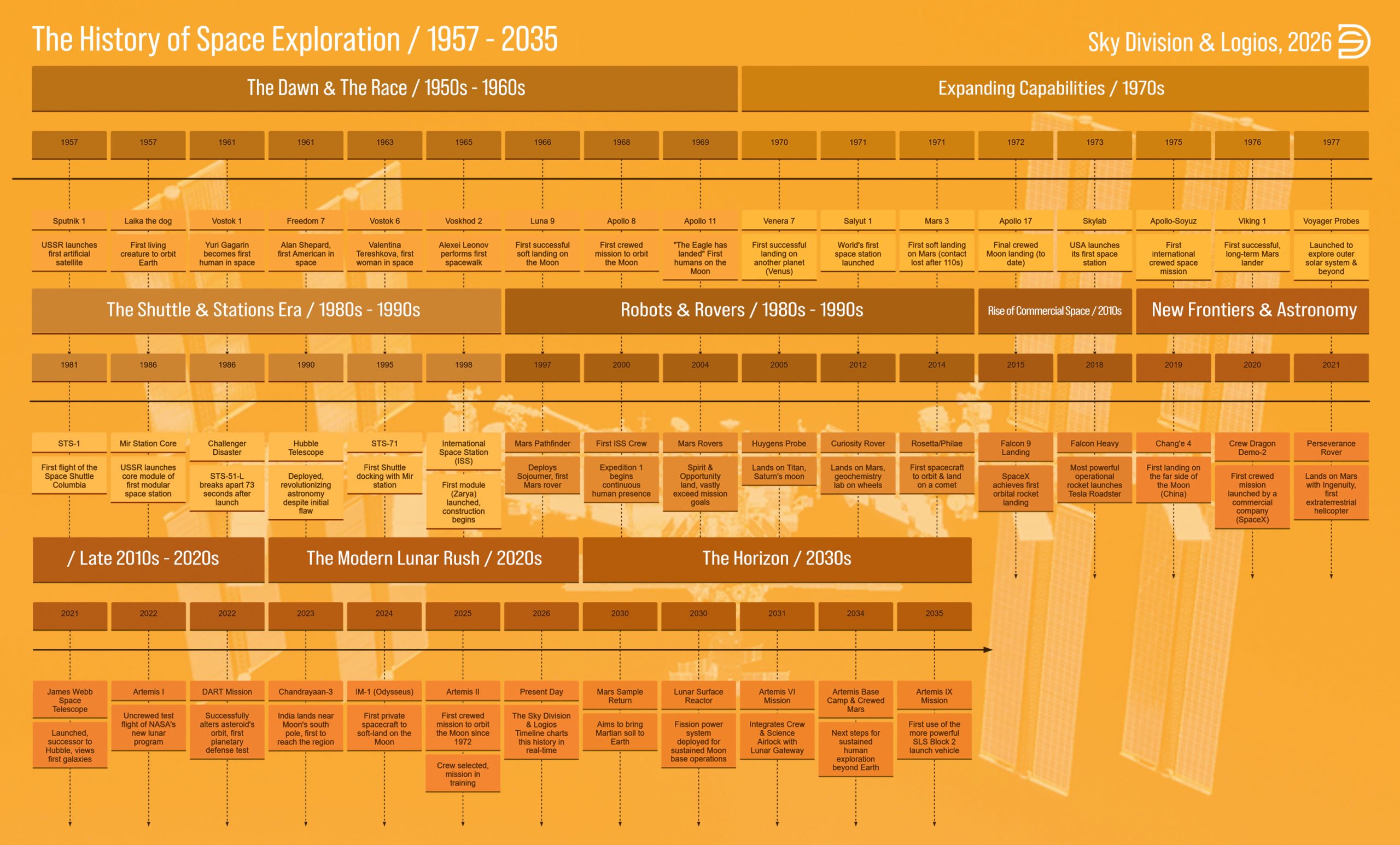
[ click expand in the lightbox, or download the graphic to view it properly ]
The Dawn & The Race, 1950s-1960s
The dawn of the Space Age was fundamentally defined by geopolitical competition. Beginning with the launch of Sputnik in 1957, the Cold War rivalry between the United States and the Soviet Union catalyzed a rapid series of technological firsts, including the first human in space (Yuri Gagarin, 1961). This “Space Race” culminated in the U.S. Apollo program, which achieved the monumental feat of landing astronauts on the Moon with Apollo 11 in 1969. This period was characterized by state-funded, national-prestige missions driven by political urgency. The technological and ideological contest established foundational capabilities in rocketry, satellite communications, and human spaceflight, while permanently altering humanity’s perspective on its place in the cosmos.
Expanding Capabilities, 1970s
The 1970s marked a transition from short-duration, politically driven missions to the development of sustained capabilities in Earth orbit and beyond. Following the Apollo lunar landings, the U.S. launched its first space station, Skylab, while the Soviet Union continued its long-duration Salyut station program. This decade also saw the dawn of interplanetary exploration with robotic pioneers; NASA’s Viking landers conducted the first successful searches for life on Mars, and the Voyager probes began their grand tours of the outer planets. The era emphasized scientific return and operational longevity, moving from proving the possibility of spaceflight to demonstrating its practical utility for astronomy, Earth observation, and extended human habitation.
The Shuttle & Stations Era, 1980s-1990s
This period was dominated by the operational phase of NASA’s Space Shuttle program, conceived as a reusable and cost-effective launch system for routine access to orbit. The Shuttle fleet deployed satellites, conducted scientific research in its Spacelab module, and serviced the Hubble Space Telescope – a mission critical to correcting its flawed mirror and revolutionizing astronomy. Concurrently, space station efforts evolved with the Soviet – Russian Mir station, which set records for continuous human occupation. International cooperation became a defining theme, culminating in the 1993 partnership between the U.S. and Russia to develop the International Space Station (ISS), laying the groundwork for a permanent human presence in low-Earth orbit.
Robots & Rovers, 1980s-1990s
While human spaceflight focused on orbital operations, robotic exploration of the solar system advanced significantly. Following the Voyager flybys, missions like Magellan mapped Venus, while Galileo entered orbit around Jupiter, studying its complex moons. The decade’s most profound shift occurred on Mars with the 1997 Pathfinder mission and its Sojourner rover. This small, mobile robot demonstrated a new paradigm for planetary surface exploration, proving the value of mobility for conducting diverse geological analyses. These robotic missions, often more cost-effective and less risky than human expeditions, vastly expanded our detailed knowledge of planetary surfaces, atmospheres, and histories, setting the stage for more sophisticated rovers in the following century.
Rise of Commercial Space, 2010s
The 2010s witnessed a transformative shift with the rise of private companies as primary drivers of launch innovation and service providers. Enabled by NASA’s Commercial Crew and Cargo programs, firms like SpaceX and Orbital Sciences (now Northrop Grumman) began resupplying the ISS. SpaceX’s development of the partially reusable Falcon 9 rocket dramatically reduced launch costs and increased flight cadence. This “commercial space” era moved key logistical operations from government-led to publicly traded companies, fostering a new ecosystem of satellite constellations, commercial resupply, and eventually, commercial crew capabilities. This model allowed space agencies to become anchor customers, focusing their resources on deep-space exploration while leveraging commercial innovation for routine orbital access.
New Frontiers & Astronomy, Late 2010s-2020s
This era has been defined by groundbreaking astronomical observatories and ambitious robotic explorers reaching new frontiers. The James Webb Space Telescope, launched in 2021, began observing the universe’s first galaxies in infrared light. Robotic missions achieved unprecedented feats: NASA’s Perseverance rover is caching samples on Mars for future return, and the OSIRIS-REx mission successfully retrieved material from an asteroid. Meanwhile, probes like New Horizons provided the first close-up views of Pluto, and Juno continues to study Jupiter’s interior. These missions, characterized by their high scientific ambition and technological complexity, are addressing fundamental questions about planetary formation, the potential for life elsewhere, and the origins of the cosmos itself.
The Modern Lunar Rush, 2020s
The Moon has re-emerged as a primary destination, sparking a global and commercial rush. NASA’s Artemis program aims to return humans to the lunar surface, targeting a sustainable presence at the lunar south pole, likely utilizing water ice resources. This effort is highly international, with contributions from the European Space Agency, Canada, Japan, and others via the Artemis Accords. Critically, it relies on commercial partners for landers and logistics. Simultaneously, numerous national space agencies (e.g., China, India, Japan) and private companies have launched robotic orbiters, landers, and rovers. This new lunar activity is not merely about flags and footprints but is focused on establishing a strategic, economic, and technological foothold for future exploration, particularly as a proving ground for missions to Mars.
The Horizon, 2030s
Looking toward the 2030s, the horizon is defined by the goal of sustained interplanetary exploration. The central focus is the first human mission to Mars, for which the Moon serves as a crucial testing ground. Key enabling technologies under development include advanced propulsion (e.g., nuclear thermal), habitats for deep-space transit, and systems for in-situ resource utilization (ISRU) to produce fuel and air from Martian or lunar materials. Orbital infrastructure, such as the Lunar Gateway, will support these endeavors. Furthermore, the next generation of giant ground- and space-based telescopes will continue the search for habitable exoplanets and biosignatures. This decade is poised to transition from planning to execution, potentially establishing humanity as a multi-planet species.