
( Sky Division & Logios, 2026 – Infographics, Timelines )
The period from 1940 to 1977 represents a pivotal and transformative era in Modern Art, characterized by a decisive shift away from European dominance toward the United States and a radical expansion in the definition of art itself.
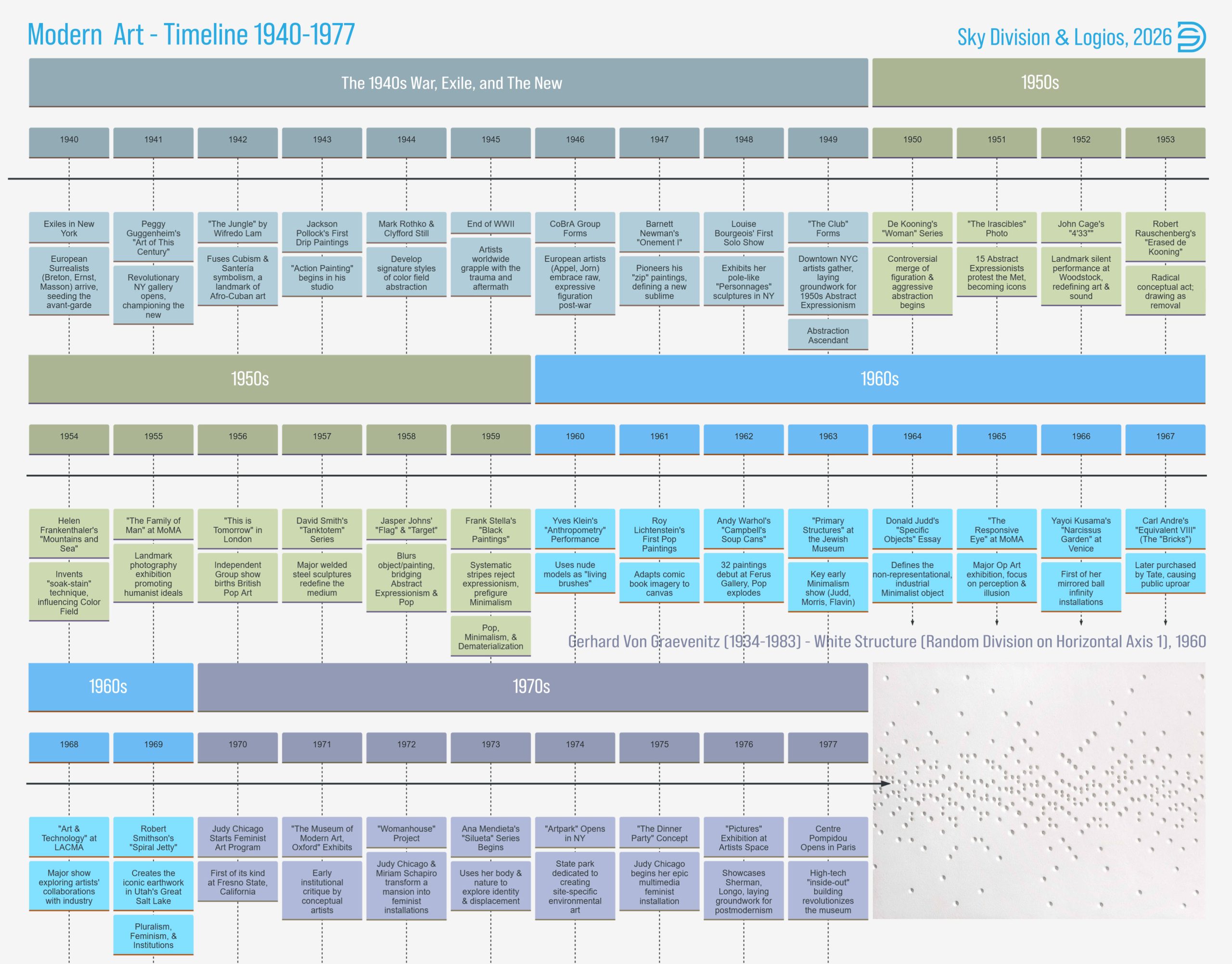
[ click expand in the lightbox, or download the graphic to view it properly ]
The early 1940s saw the culmination of European modernism, but the devastation of World War II and the emigration of many artists to New York City catalyzed a new movement: Abstract Expressionism. Emerging in the late 1940s and peaking in the 1950s, artists like Jackson Pollock, Willem de Kooning, and Mark Rothko rejected figurative representation to explore subconscious creation, existential themes, and the pure physical act of painting. Their large-scale, gestural, or color-field works emphasized individual expression and the flatness of the canvas, establishing New York as the new epicenter of the avant-garde.
By the late 1950s and 1960s, a strong reaction against the emotional intensity and subjectivity of Abstract Expressionism emerged. This led to a proliferation of diverse, often coolly impersonal movements. Pop Art, pioneered by figures such as Andy Warhol and Roy Lichtenstein, embraced imagery from mass media, advertising, and consumer culture, blurring the lines between high art and popular commerce. Minimalism, exemplified by artists like Donald Judd and Agnes Martin, reduced art to its essential geometric forms, industrial materials, and literal presence, rejecting illusion and metaphor. Concurrently, Conceptual Art, as practiced by Sol LeWitt and others, posited that the idea or concept behind the work was paramount, often dematerializing the art object entirely in favor of plans, photographs, or text.
The period concluded in the late 1960s and 1970s with movements that further challenged institutional and formal boundaries. Performance Art and Body Art used the artist’s own body as the medium. Land Art (or Earthworks), as seen in projects by Robert Smithson, moved creation into the landscape on a monumental scale. These developments, alongside the rise of feminist art and institutional critique, underscored a central legacy of the era: art was no longer defined by a specific style or object, but could be an action, an idea, a process, or a political statement, setting the stage for the pluralistic condition of contemporary art.