
( Sky Division & Logios, 2026 – Infographics, Timelines )
The 15th century in Europe, spanning the years 1400 to 1500, marks a pivotal period of profound artistic transformation, often termed the Early Renaissance. Centered initially in the wealthy merchant cities of Italy, particularly Florence, this era witnessed a decisive break from the stylized conventions of the International Gothic style and a conscious revival of classical Greco-Roman principles. The period was driven by the intellectual movement of Humanism, which shifted focus from the purely spiritual to include the dignity, rationality, and experience of the individual in the natural world.
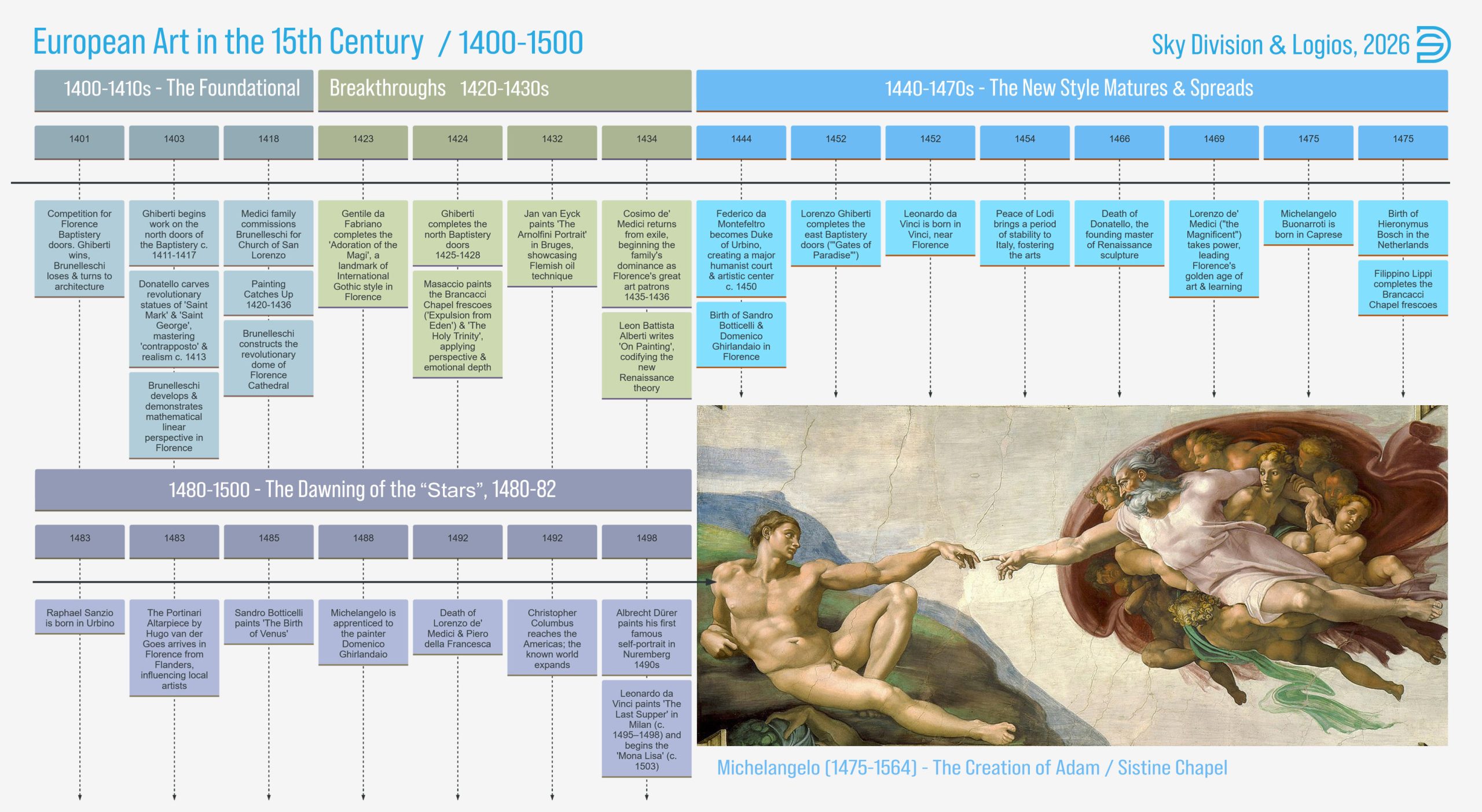
[ click expand in the lightbox, or download the graphic to view it properly ]
Artists pioneered revolutionary techniques to achieve new ideals of realism, harmony, and emotional depth. In painting, the development of linear and atmospheric perspective by figures like Filippo Brunelleschi and its application by Masaccio created the illusion of three-dimensional space on a flat surface, anchoring figures in believable settings. The use of chiaroscuro (modeling with light and shadow) enhanced volume and solidity. In sculpture, artists like Donatello revived the freestanding nude and contrapposto stance, infusing figures with classical grace and psychological presence. Architecture, led by Brunelleschi and Leon Battista Alberti, rejected the verticality of Gothic for classical proportions, symmetry, and mathematical order based on human scale.
While Italy was the epicenter, parallel innovations occurred in Northern Europe, particularly in Flanders. Artists such as Jan van Eyck, Rogier van der Weyden, and Hugo van der Goes perfected oil painting, allowing for unprecedented detail, luminous color, and meticulous realism in depicting textures, landscapes, and domestic interiors. Their work often retained a more symbolic and devotional intensity compared to the idealized classicism of the South.
Major patrons included the Catholic Church, rising merchant dynasties (like the Medici in Florence), and secular rulers, all using art to demonstrate piety, power, and cultural prestige. By the century’s end, masters like Sandro Botticelli, Andrea Mantegna, and Leonardo da Vinci (whose early work began in the 1490s) had fully embraced the Renaissance synthesis of naturalism, classical inspiration, and humanist thought, setting the stage for the High Renaissance. Thus, the 15th century fundamentally redefined artistic purpose and technique, establishing a new visual language that celebrated both the divine and the human experience.
1400-1410s – The Foundational Breakthroughs
1420-1430s
1440-1470s – The New Style Matures & Spreads
1480-1500 – The Dawning of the “Stars”, 1480-82