
The period from 1977 onward marks a decisive shift from the formalist, medium-specific concerns of late Modernism to the expansive, pluralistic, and conceptually driven field of Contemporary Art. This era is characterized by the dissolution of a single dominant narrative, giving way to a multitude of concurrent movements, critical theories, and global perspectives.
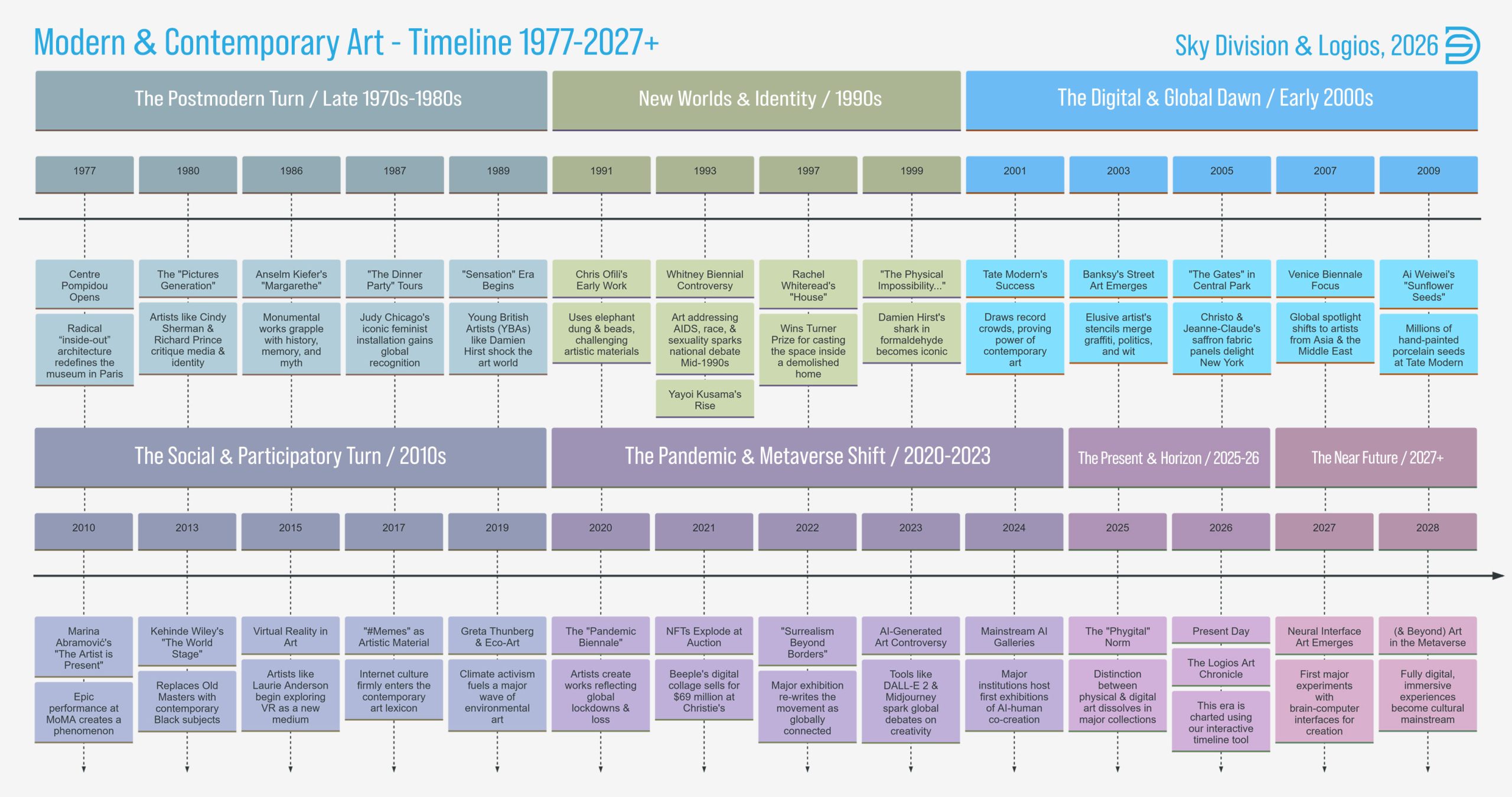
[ click expand in the lightbox, or download the graphic to view it properly ]
The late 1970s and 1980s saw the rise of ‘Postmodernism’, which critically deconstructed Modernist ideals of originality and progress. Key developments included the appropriation of imagery in ‘Pictures Generation’ art, which questioned authorship and media saturation, and the return to expressive figuration in ‘Neo-Expressionism’. Crucially, this period was defined by a powerful influx of critical theory – feminist, psychoanalytic, post-colonial, and institutional critique – that examined art’s relationship to power, identity, and representation. Artists like Cindy Sherman, Barbara Kruger, and Jean-Michel Basquiat became emblematic of these interrogations.
The 1990s accelerated globalization and the rise of new media. The ‘Young British Artists (YBAs)’ embraced sensationalism and conceptual shock, while artists worldwide began exploring installation, video, and digital technologies as primary mediums. A defining feature was the “global turn”, as biennials proliferated and art histories expanded beyond Western centers, bringing artists from Asia, Africa, Latin America, and the Middle East to international prominence.
The 21st century, particularly post-2000, is marked by several interconnected themes: the pervasive influence of the internet and digital culture, urgent engagements with “climate change” and the Anthropocene, and a deepening focus on “identity politics”, social justice, and decolonization. Artistic practices have become increasingly research-based, interdisciplinary, and socially engaged. The period from approximately 2020 onward has been further shaped by the COVID-19 pandemic, which accelerated digital presentation and questioned art’s physical spaces, and by heightened calls for institutional equity.
Looking toward 2027 and beyond, Contemporary Art continues to evolve as a porous field defined by its responsiveness to technological innovation, geopolitical shifts, and pressing ethical and ecological crises, all while critically examining its own systems and histories.
The Postmodern Turn / Late 1970s-1980s
New Worlds & Identity / 1990s
The Digital & Global Dawn / Early 2000s
The Social & Participatory Turn / 2010s
The Pandemic & Metaverse Shift / 2020-2023
The Present & Horizon / 2025-26
The Near Future / 2027+