
The measure, called the Securing Innovation and Research from Adversaries (SIRA) Act, would prohibit U.S. scientists from using federal funding “to enter into, support, or carry out any research collaboration” with any Chinese scientist “associated with” Chinese entities on one of several U.S. government blacklists. The bill’s sweeping definition of collaboration includes co-authorship, sharing data, material transfers, and any joint supervision of students. The blacklists are equally broad. They include any university, laboratory, or hospital considered part of the country’s “military-civilian fusion strategy” to boost the country’s standing as a science and technology superpower.
The SIRA Act is the latest effort by conservatives to halt all research interactions with China on the grounds that they pose an imminent threat to U.S. national security.
Critics say cutting off all joint research with China would deprive U.S. scientists of an important source of talent and slow progress.
“The CCP [Chinese Communist Party] actively exploits the openness of academia, research partnerships, and scientific collaboration to acquire sensitive technologies and advance its military capabilities.” – Representative John Moolenaar (R-MI), who is also chair of the House of Representatives’s Select Committee on the CCP.
“The CCP [Chinese Communist Party] should not get a single dime, directly or indirectly, of American research funding.” – Senator Jim Banks (R-IN), who introduced an identical bill in the Senate.
“The United States achieved its technological prowess by cultivating and attracting the best and brightest minds from at home and around the world, overly broad legislation risks chilling legitimate, nonsensitive research and actually harms our ability to outinnovate China.” – Representative Ro Khanna (CA), the top Democrat on the House select committee, in a statement to Science.
***
“I feel sad about losing the chance to work with my friends and mentors, and I also feel bad about what it could mean for ordinary people. The cessation of collaborative cancer research [between the U.S. and China] could eliminate their last hope for new therapies against such a deadly disease.” – Jiang Yang, he joined Sun Yat-sen University Cancer Center in 2019 after spending 15 years at leading U.S. universities.
“Even though many people still believe U.S. universities are the best in the world, many Chinese students are no longer willing to pursue a postdoc in the U.S., the vibe is shifting toward other countries for collaboration.” – Jiang Yang had trained at the University of Wisconsin, Stanford University, and the Memorial Sloan Kettering Cancer Center before returning to his native China in 2019
[ doi: 10.1126/science.zp3mvey ]
[ https://www.science.org/content/article/lawmakers-propose-banning-all-u-s-chinese-research-collaborations ]
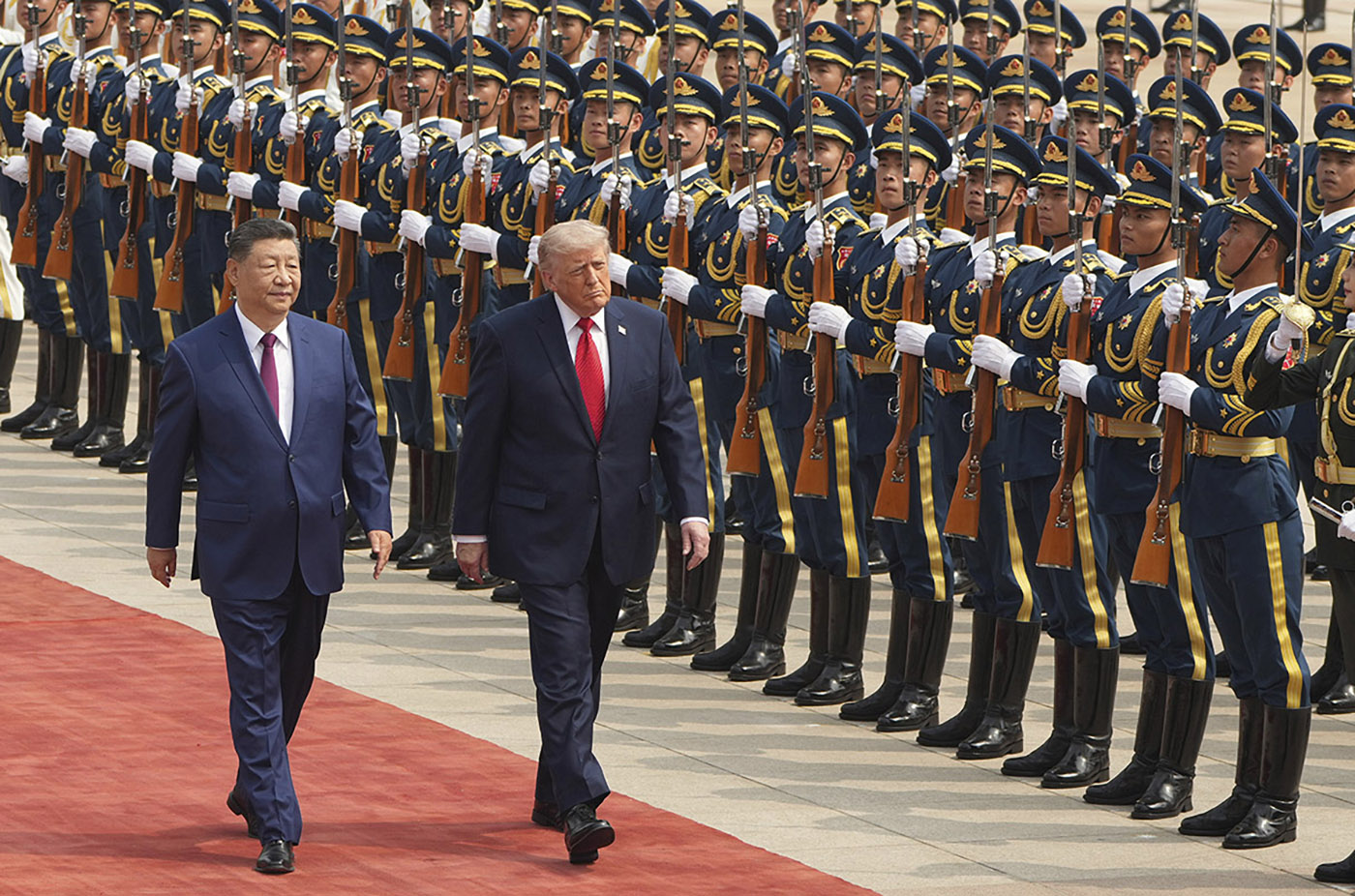
[ Photo ] Chinese President Xi Jinping (left) hosted US President Donald Trump earlier this month in Beijing – 14 May, 2026 by Mark Schiefelbein / AP