
( Sky Division & Logios, 2026 – Infographics, Timelines )
The period from 1750 to 1800 in Europe was characterized by a complex intellectual and artistic transition, marked by the dominance of Enlightenment rationalism and the emergence of early challenges that would culminate in Romanticism. This era is often defined by the tension between established academic norms and new, emotionally charged sensibilities.
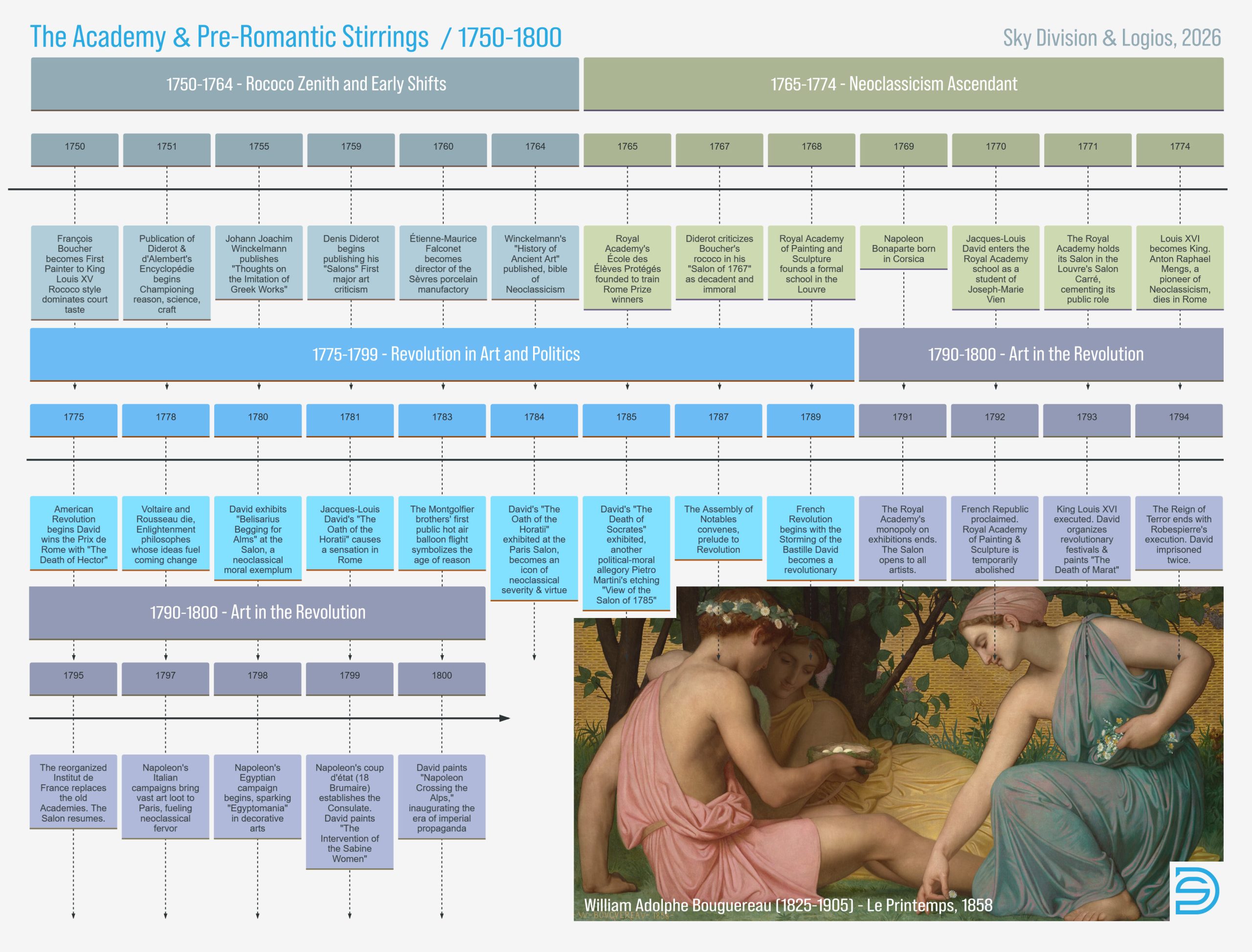
[ click expand in the lightbox, or download the graphic to view it properly ]
The mid-18th century was the height of the Enlightenment, or the “Age of Reason”. Cultural authority resided in official Academies, such as the French Academy of Fine Arts, which promoted neoclassical ideals. These institutions championed order, balance, and universal truths derived from the classical art and philosophy of ancient Greece and Rome. In literature, this translated into a preference for formal precision, satirical wit, and didactic purpose, as seen in the works of Alexander Pope and Voltaire. The aesthetic philosophy of the period was largely governed by principles of decorum and imitation of established models.
Concurrently, however, a series of cultural movements began to challenge this rationalist consensus. Often grouped under the term “Pre-Romanticism”, these stirrings emphasized emotion, imagination, and individual experience over strict reason. Key developments included:
“The Cult of Sensibility” – A focus on heightened emotional responsiveness and sympathy, evident in the sentimental novels of Samuel Richardson and the “man of feeling” archetype.
“The Sublime” – A fascination with awe-inspiring, terrifying natural landscapes that evoked overwhelming emotion, theorized by Edmund Burke in his ‘Philosophical Enquiry into the Origin of Our Ideas of the Sublime and Beautiful’ (1757).
“Gothic Literature” – The emergence of the Gothic novel, with its medieval settings, supernatural elements, and exploration of terror and the irrational, as in Horace Walpole’s ‘The Castle of Otranto’ (1764).
“Interest in the Folk and the Primitive” – A growing appreciation for folk ballads, medieval romances, and perceived “natural” poetry, exemplified by James Macpherson’s Ossian poems and Thomas Percy’s ‘Reliques of Ancient English Poetry’ (1765).
“Nature as Refuge” – An increasing view of nature not as a mechanistic system but as a source of spiritual renewal and solitary reflection, a theme developed by Jean-Jacques Rousseau and foreshadowed in the poetry of James Thomson.
Thus, the late 18th century was not a monolithic age but a dynamic field where the disciplined, public-oriented values of the Academy coexisted and increasingly clashed with new, introspective, and emotionally intense modes of expression. This fertile conflict laid the essential groundwork for the full flourishing of the Romantic movement in the decades following 1800.