
( Sky Division & Logios, 2026 – Infographics, Timelines )
The sixteenth century in Europe was a period of profound artistic transformation, driven by the intellectual currents of Humanism, the religious upheaval of the Reformation, and expanding global horizons. The High Renaissance, centered in Italy and epitomized by Leonardo da Vinci, Michelangelo, and Raphael, reached its zenith in the early decades. Their work pursued ideal beauty, harmonious composition, and a mastery of human anatomy and perspective, creating some of the most iconic images of Western art, from the ‘Mona Lisa’ to the Sistine Chapel ceiling.
[ click expand in the lightbox, or download the graphic to view it properly ]
Following this peak, Mannerism emerged as a dominant style from the 1520s onward. Reacting against classical balance, Mannerist artists like Pontormo, Parmigianino, and El Greco employed exaggerated proportions, artificial elegance, complex poses, and unnatural lighting or colors to convey heightened emotion, intellectual sophistication, and spiritual intensity.
In Northern Europe, particularly the Netherlands and Germany, artists blended meticulous realism with powerful religious and secular themes. Albrecht Dürer mastered printmaking, disseminating Renaissance ideas north of the Alps, while Pieter Bruegel the Elder focused on vibrant depictions of peasant life and landscapes. The Reformation’s rejection of religious imagery in Protestant regions spurred an extraordinary growth in portraiture, landscape, and still-life painting – genres that celebrated the material world and individual identity.
Concurrently, the Catholic Church’s Counter-Reformation, formalized by the Council of Trent (1545-1563), sought to reinvigorate faith through direct and emotionally resonant art. This led to the Baroque style’s early development, characterized by dynamic movement, dramatic lighting (chiaroscuro), and intense realism, aimed at engaging the viewer’s senses and devotion. Thus, the century laid the essential groundwork for the Baroque era, marking a decisive shift from the idealized harmony of the Renaissance toward greater dynamism, emotional force, and engagement with the viewer.
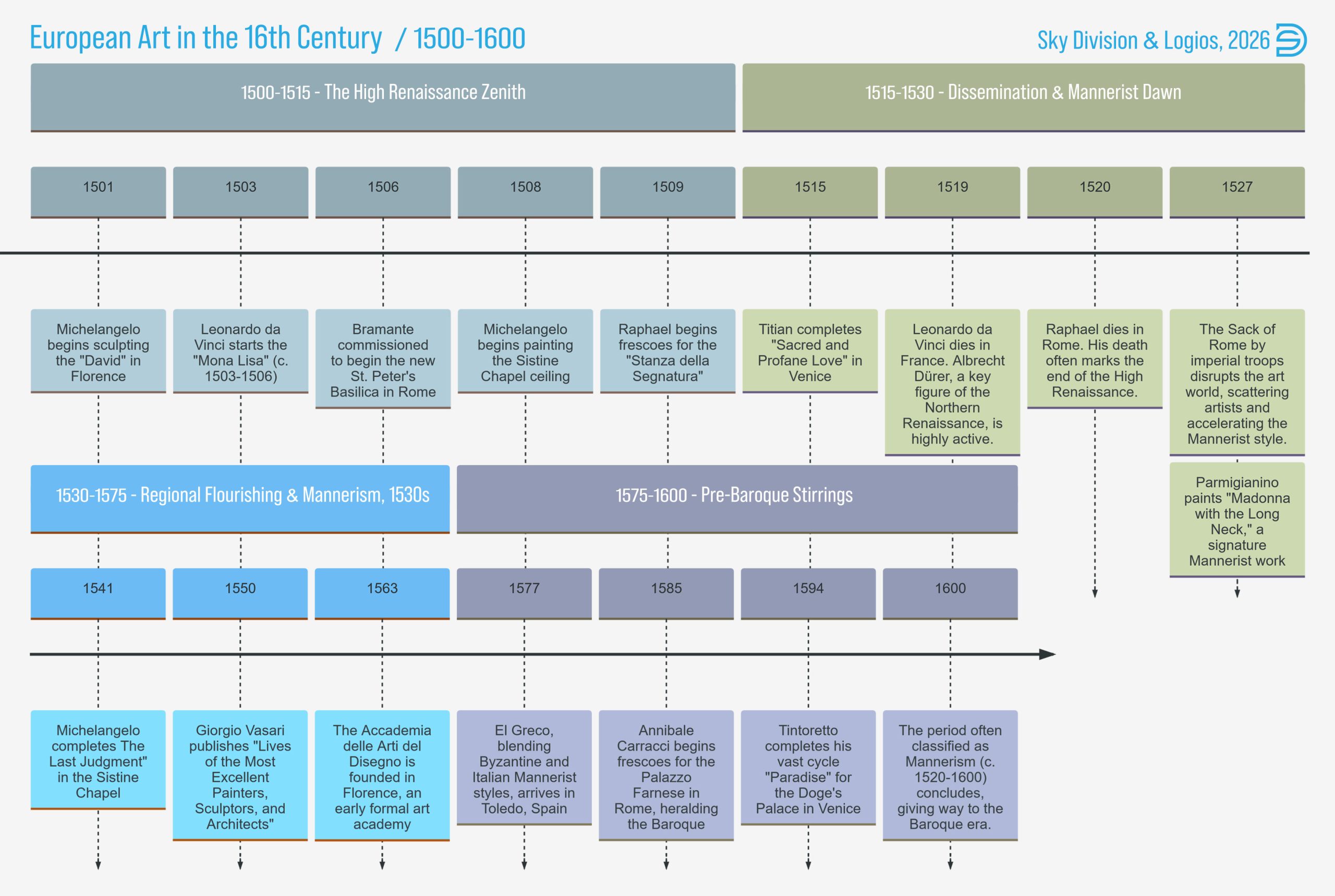
1500-1515 – The High Renaissance Zenith
1515-1530 – Dissemination & Mannerist Dawn
1530-1575 – Regional Flourishing & Mannerism, 1530s
1575-1600 – Pre-Baroque Stirrings