
[ by Simeon Netchev – 14 April 2022 / WorldHistory ]
The global spread of tea and its many names, tracing how two primary root words – “cha” and “te” – originated in China and dispersed across cultures through trade. The linguistic patterns reveal how tea’s journey followed both land routes like the Silk Road and maritime networks, particularly during the age of European exploration.
The term “cha” spread via overland trade, especially across Central Asia and the Islamic world, while “te” traveled with Dutch maritime merchants who introduced tea to Europe in the 17th century. Interestingly, in regions where tea is indigenous, such as parts of South Asia and East Africa, local names for tea developed independently of Chinese influence. This map captures not just the commodity’s movement, but also how language traces its global path.
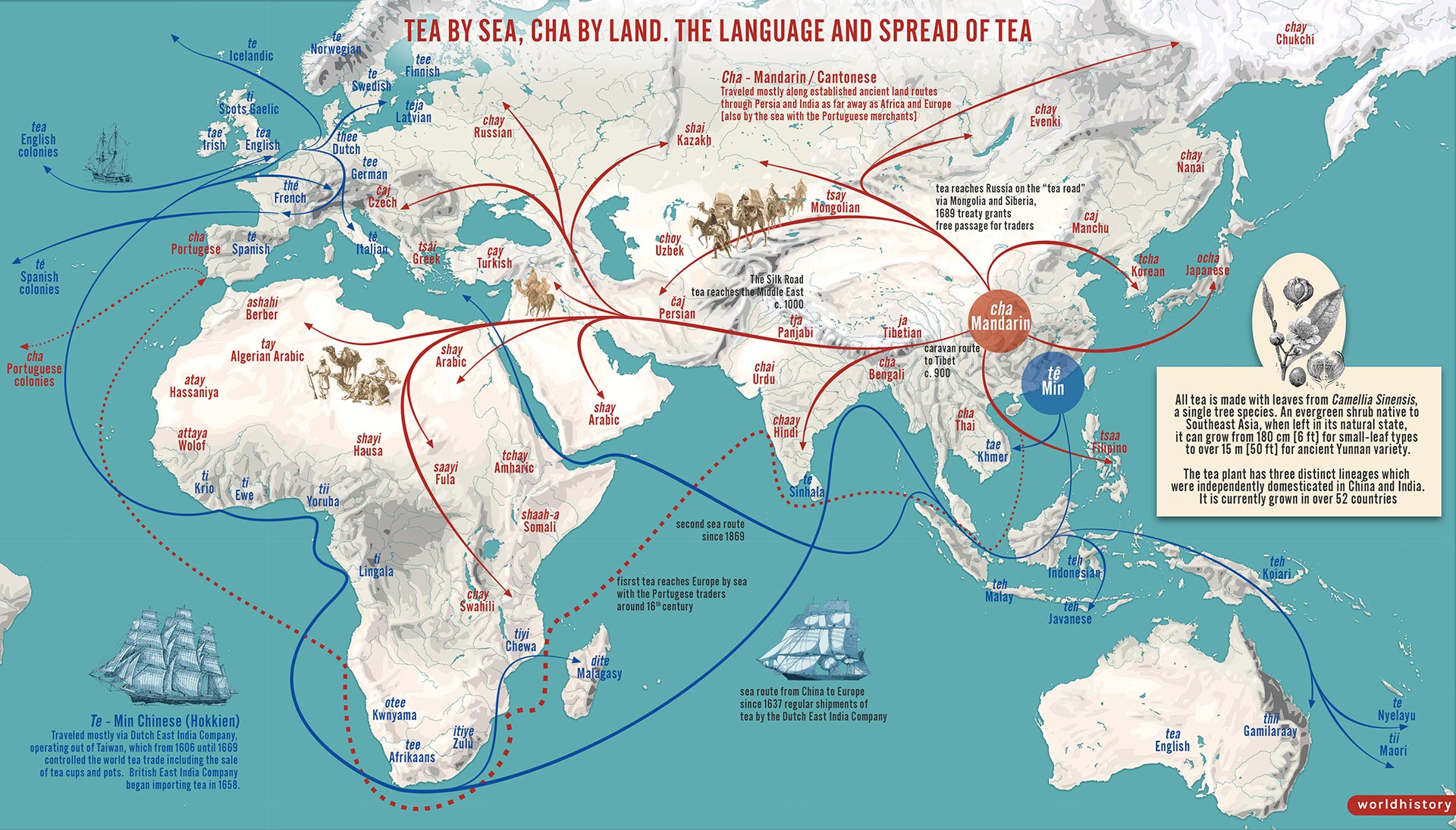
Tea by sea, cha by land – The language and spread of tea
All tea is made with leaves from Camellia Sinensis, a single tree species. An evergreen shrub native to Southeast Asia, when left in its natural state, it can grow from 180 cm for small-leaftypes to ever 15 m for ancient Yunnan variety. The tea plant has three distinct lineages which were independently domesticated in China and India. It is currently grown In over 52 countries.
Cha (Mandarin / Cantonese
Traveled mostly along established ancient land routes through Persia and India as far away as Africa and Europe (also by the sea with Portugese merchants)
Te – Min Chinese (Hokkien)
Traveled mostly via Dutch East India Company, operating out of Taiwan, which from 1606 until 1669 controlled the world tea trade including the sale of tea cups and pots. British East India Company began importing tea in 1658.
-First tea reaches Europe by sea with the Portugese traders around 16th century
– Sea route from China to Europe since 1637 regular shipments of tea by the Dutch East India Company
– Second sea route since 1869
– Tea reaches Russia on the “tea road” via Mongolia and Sieria, 1689 treaty grants free passage for traders.
– Caravan route to Tibet c. 900.
– The Silk Road tea reaches the Middle East c. 1000.
[ ➔ See also: Tea – A Drink that Quenches the Soul ]